
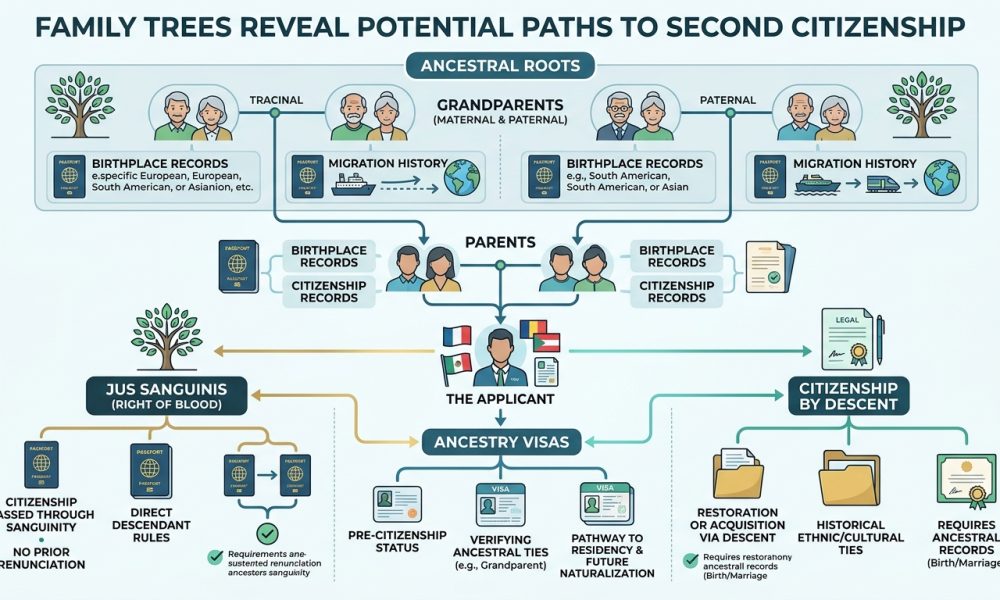
Birthplaces, immigration histories, ancestral citizenship records, and family relationships can offer valuable starting points for Americans exploring potential second citizenship. However, eligibility depends on nationality laws, historical naturalization events, documentary evidence, and the legal rules governing citizenship transmission across generations.
WASHINGTON, DC, November 1, 2026 — Americans investigating the possibility of obtaining second citizenship are increasingly examining family trees, historical immigration documents, and ancestral nationality records, discovering that relatives who crossed international borders generations earlier may have created legal connections relevant to present-day citizenship applications.
For individuals whose parents, grandparents, or more distant ancestors were born outside the United States, citizenship by descent can offer an alternative to investment migration programs or residence-based naturalization. However, family heritage alone does not automatically establish entitlement to another nationality.
The growing interest in ancestry-based citizenship reflects broader demand for international residence rights, employment opportunities, educational access, and long-term family security, particularly among Americans seeking additional options without necessarily committing to immediate relocation or substantial overseas investments.
However, determining whether ancestral citizenship remains legally transferable requires considerably more than identifying a foreign birthplace, because nationality laws can change over time and historical events involving marriage, naturalization, adoption, or migration may affect eligibility.
Family History Can Provide the First Clue to Another Nationality
The initial investigation often begins with basic family information, including the birthplaces of parents and grandparents, the countries where earlier generations lived, and the circumstances surrounding their migration to the United States.
These details can reveal potential citizenship connections that were never formally documented in the family, particularly when earlier generations retained their original nationality or automatically transmitted citizenship under the legislation in effect at the time.
A grandparent’s foreign birth certificate may provide an important starting point. Still, applicants must determine whether that individual actually possessed the relevant nationality and whether it legally passed through subsequent generations.
The distinction becomes significant when family members were born in countries where citizenship depended on parental nationality rather than birthplace alone, or where historical legal restrictions affected the transmission of citizenship through particular family relationships.
Citizenship by Descent Is Different From Naturalization
Citizenship by descent generally concerns nationality acquired or recognized through a qualifying family relationship. At the same time, naturalization ordinarily involves an application process based on residence, marriage, or other conditions established by a country’s legislation.
In some cases, individuals may already have another nationality from birth without knowing it. Hence, the administrative process involves obtaining official recognition or documentary proof rather than asking a government to confer entirely new citizenship.
Other countries offer special application procedures for descendants of former citizens without necessarily treating those applicants as citizens from birth, creating important distinctions in eligibility, legal status, and when nationality takes effect.
Understanding the precise legal pathway matters because an application to recognize existing citizenship can require different evidence and carry different consequences than an application for discretionary naturalization based on ancestral connections.
Italy’s Citizenship Changes Illustrate the Importance of Current Laws
Italy has long attracted substantial interest from Americans, Canadians, Argentinians, Brazilians, and other descendants of Italian emigrants, largely because its citizenship-by-descent framework previously allowed certain claims involving ancestors from several generations earlier.
A Reuters report on Italy’s restrictions on citizenship by descent, published on March 28, 2025, described the government’s decision to narrow eligibility after a substantial rise in applications from descendants living abroad.
The reporting highlighted concerns from Italian officials about increasingly distant ancestral claims and the commercialization of historical citizenship applications, while documenting criticism that the restrictions could disadvantage individuals with longstanding family connections.
The legislative changes, incorporated into Law No. 74 of May 23, 2025, established important limitations affecting foreign-born applicants with another citizenship, subject to specific statutory exceptions and transitional protections.
Consequently, an American with an Italian great-grandparent should not assume that previous eligibility standards remain available, because current law requires a more detailed assessment of qualifying parent or grandparent connections and other legally recognized circumstances.
Canada’s Revised Citizenship Rules Have Opened Additional Questions
Canada provides another example of how changes in nationality legislation can alter opportunities for descendants born abroad, particularly following the December 15, 2025, implementation of amendments addressing the former first-generation limit.
Under the revised framework, certain individuals born abroad before the legislation took effect may qualify for Canadian citizenship despite previously being excluded by generational restrictions, provided their circumstances meet the relevant statutory requirements.
For qualifying children born abroad on or after December 15, 2025, citizenship transmission beyond the first generation generally requires a Canadian parent who was also born or adopted abroad to demonstrate at least 1,095 days of physical presence in Canada before the child’s birth or adoption.
These distinctions demonstrate why applicants need to examine birth dates, ancestral citizenship status, and the timing of family residence rather than assuming that all descendants of Canadian grandparents receive identical treatment.
The Canadian developments also illustrate how a historical family tree can become newly relevant after legislative amendments, potentially creating opportunities for individuals who previously believed that ancestral citizenship was unavailable.
Ireland Remains an Important Ancestral Citizenship Destination
Ireland’s citizenship framework can provide opportunities for individuals with qualifying Irish parents or grandparents, although the required procedures depend on where earlier generations were born and how nationality was transmitted.
For certain descendants born outside Ireland, registering in the Foreign Births Register is an essential step toward becoming an Irish citizen, particularly when the connection comes through an Irish-born grandparent rather than a qualifying parent.
Timing becomes especially important when citizenship is intended to pass to another generation, because a parent’s registration status before a child’s birth can determine whether that child has an available citizenship pathway.
An applicant whose Irish ancestry extends beyond grandparents may therefore need to examine earlier registrations and the dates of subsequent births, rather than assuming that every documented Irish ancestor establishes an unlimited entitlement.
These rules illustrate the importance of examining legal continuity between generations, because family heritage can remain historically clear even when the relevant nationality was not transmitted under applicable legislation.
Historical Naturalization Records Can Determine Eligibility
One of the most consequential discoveries in an ancestral citizenship investigation can involve determining whether an immigrant ancestor became an American citizen and, if so, precisely when that naturalization occurred.
Historical nationality laws sometimes provided for the loss of original citizenship when an individual voluntarily naturalized elsewhere, potentially affecting whether nationality could pass to children born before or after the change.
A family history showing that an ancestor arrived in the United States during the early twentieth century may therefore require further research into naturalization petitions, declarations of intention, certificates, and other relevant government records.
The date of a child’s birth relative to the ancestor’s naturalization can be legally significant in certain citizenship systems, making approximate family recollections insufficient when formal eligibility depends on a particular chronological sequence.
Applicants should also recognize that declarations of intention and completed naturalization records are not interchangeable, because historical documents may establish different stages of the immigration process rather than conclusively proving citizenship acquisition.
Birth Certificates Establish Important Family Connections
Civil birth records often provide the documentary foundation for citizenship-by-descent applications because they identify individuals, record birthplaces and dates, and may establish the parental relationships needed to show nationality transmission.
However, birth certificates must often be examined alongside marriage records, death certificates, naturalization documents, and other official materials when names, family relationships, or citizenship status changed between generations.
A document establishing that an applicant’s grandfather was born in a particular country does not, by itself, prove that nationality passed through the applicant’s parent, particularly where historical legal conditions affected citizenship transmission.
The evidentiary task therefore involves constructing a continuous documentary connection from the qualifying ancestor to the present applicant, with each generation supported by records acceptable to the relevant government authority.
Applicants may also need long-form certificates that include information missing from abbreviated extracts, particularly where the issuing country’s consular procedures require detailed parental particulars or evidence of the original registration.
Marriage Records Can Explain Changes in Family Names
Marriage certificates often play an important role in ancestral citizenship research because names appearing on birth records may differ from those used in subsequent immigration, employment, or family documentation.
These differences can be especially noticeable in historical records involving changing surnames, local naming conventions, transliteration from other alphabets, or administrative changes made during international migration.
An applicant whose grandmother appears under one surname in a European birth record and another surname in an American marriage certificate may need supporting evidence establishing that both documents concern the same individual.
Such inconsistencies do not automatically invalidate a citizenship claim, but they may require official corrections, additional civil records, or legally sufficient explanations before the receiving authority accepts the documentary chain.
Applicants should avoid altering documents informally or inventing historical details to resolve discrepancies, because authentic records and properly documented corrections provide a more reliable basis for government recognition.
Historical Archives Can Reveal Previously Unknown Citizenship Connections
Genealogical investigations frequently involve locating records maintained by municipal governments, national archives, religious institutions, immigration authorities, and historical registries that document births, marriages, residence, and nationality-related events.
Passenger arrival records may identify an ancestor’s country of origin or last residence, while census documents and historical applications can provide additional clues about family relationships and possible naturalization events.
However, historical records created for immigration or population administration do not necessarily establish nationality conclusively, especially where reported citizenship information was incomplete, outdated, or supplied without formal verification.
Applicants should therefore use these materials to identify relevant government records rather than assuming that every historical reference to a birthplace or nationality constitutes sufficient legal evidence for citizenship recognition.
Professional genealogical research can help locate difficult records, but the legal significance of each discovery must ultimately be assessed under the nationality legislation governing the intended application.
Maternal and Paternal Citizenship Lines Can Raise Different Questions
Historical citizenship legislation in numerous countries treated nationality transmission differently depending on whether the relevant parent was the mother or father, creating potential complications for applicants tracing ancestry through earlier generations.
Some legal systems imposed restrictions based on marriage, legitimacy, or parental nationality, while later reforms and judicial decisions altered or corrected those historical rules.
For example, particular Italian citizenship claims involving maternal transmission before January 1, 1948, have historically required separate legal consideration because the relevant legislation treated citizenship transmission differently before constitutional changes.
Applicants researching maternal ancestry should therefore avoid assuming that current principles of equal nationality transmission automatically resolve every historical question arising from births that occurred under earlier legal frameworks.
A qualified assessment may need to consider the legal rules in force when each ancestor was born, alongside subsequent legislative amendments and judicial decisions that may affect the claim.
Adoption and Family Relationships Require Specialized Examination
Adoption can create additional questions in citizenship-by-descent applications because nationality laws differ in their treatment of adopted children, the relevant timing of adoption, and the legal recognition of parent-child relationships.
Some countries provide specific citizenship procedures for children adopted by citizens, while others distinguish adoption-based nationality acquisition from citizenship transmitted automatically through biological descent.
Documentary requirements may include adoption judgments, original civil records, amended birth certificates, and evidence that the adoption was legally recognized under the applicable national framework.
Applicants should also consider whether historical adoption records are confidential or subject to restricted access, because those protections may affect how they can obtain and submit supporting evidence.
These circumstances show why ancestral citizenship research must examine legally recognized family relationships rather than relying exclusively on biological ancestry or information in informal family trees.
DNA Testing Cannot Replace Official Nationality Evidence
Commercial genetic ancestry services have made it easier for individuals to explore potential family origins, sometimes revealing unexpected connections to countries or populations previously unknown in their immediate households.
However, genetic ancestry estimates generally do not establish the legal relationships, historical citizenship status, or nationality transmission required under formal citizenship-by-descent procedures.
A DNA result suggesting substantial ancestry from Ireland, Italy, Poland, or another country cannot, on its own, demonstrate that a particular ancestor held citizenship or that the applicant qualifies under existing law.
Genetic information may help researchers identify possible family connections, but official civil documentation and the relevant legal standards remain central to establishing eligibility for government recognition.
Individuals should therefore distinguish genealogical discovery from legal nationality evidence, especially when commercial advertising suggests that ethnic heritage percentages automatically translate into citizenship rights.
American Dual Citizenship Rules Permit Additional Nationality
Americans investigating ancestral citizenship should understand that United States nationality law generally permits individuals to hold another citizenship. However, rights and responsibilities may differ under each country’s laws. The Department of State’s official guidance on dual nationality explains that Americans may hold citizenship through birth, descent, or naturalization under another country’s laws without necessarily relinquishing U.S. citizenship.
American dual nationals remain subject to relevant United States legal requirements, including the general obligation to use valid American passports when entering or departing the United States.
The department also identifies possible complications involving military service, consular assistance, and obligations imposed by other countries on individuals they recognize as their nationals.
Consequently, Americans exploring ancestry-based citizenship should weigh the benefits of nationality diversification against any additional responsibilities that may arise from formal recognition of another citizenship.
Second Citizenship Can Provide Rights Beyond Travel
The practical value of citizenship through ancestry can extend beyond visa-free travel because nationality may provide permanent residence rights, employment opportunities, educational access, and other benefits established by the issuing country’s laws.
European Union citizenship can be particularly significant when it provides qualifying rights to move and reside in other member states under applicable European legislation, subject to the conditions governing particular circumstances.
For families considering overseas education or future employment, these rights may become more important than the number of countries accessible through short-term tourist arrangements.
However, citizenship does not necessarily grant unrestricted access to every public benefit, because healthcare, education funding, and other services may require additional residence, registration, or contribution requirements.
Applicants should therefore review the specific rights attached to their prospective nationality and assess whether those rights align with their personal and family objectives.
Passports and Citizenship Recognition Are Separate Administrative Stages
Individuals who qualify for citizenship by descent may need to complete a formal recognition, registration, or proof-of-citizenship procedure before obtaining an official passport from the relevant government.
In some countries, an applicant may already have nationality as a matter of law, while the administrative process provides sufficient evidence for authorities to recognize and document that status.
Other jurisdictions require formal registration or an application before the individual acquires citizenship, making the sequence of approval and passport issuance dependent on the specific legislation.
An official passport generally reflects nationality recognized by the issuing state, but applicants should not assume that presenting genealogical records to a private intermediary equals government confirmation.
This distinction matters because a completed family tree can support an application without independently establishing that the receiving government has accepted the claim.
Electronic Passport Security Supports Document Verification
Modern biometric passports contain electronic chips designed to store identifying information and support authentication procedures, creating technical safeguards that can help determine whether electronically stored data appears consistent with the issuing authority’s security protections.
Amicus International Consulting explains these features in its guidance on scanning a passport’s NFC chip and interpreting the results, helping individuals distinguish electronic document authentication from broader legal questions about nationality.
A successful electronic authentication result can provide evidence about the integrity and apparent origin of stored passport information. Still, it does not independently establish how the holder acquired citizenship or whether ancestral eligibility requirements were satisfied.
Applicants should therefore confirm legal issuance and citizenship recognition through appropriate government channels, rather than relying solely on electronic passport scanning or a commercial provider’s representations.
The strongest documentary foundation combines official nationality recognition with authentic civil records and properly issued travel credentials, allowing each element to serve its distinct administrative purpose.
Ancestral Citizenship Applications Can Involve Multiple Governments
An applicant born in the United States whose parents and grandparents were born in different countries may need documents from several jurisdictions before authorities can evaluate the full family history.
American naturalization records might establish when an ancestor acquired United States citizenship, while foreign civil registries may provide evidence of birth, marriage, residence, and original nationality.
These records can be subject to different access requirements, certification procedures, translation standards, and document authentication rules depending on the jurisdiction and intended administrative use.
Some authorities may require apostilles or other recognized authentication procedures for foreign public documents, and additional requirements may apply when records are incomplete or contain discrepancies.
Coordinating records across several countries can therefore become one of the most time-consuming aspects of a citizenship-by-descent application, even where the underlying eligibility appears relatively straightforward.
Processing Timelines Depend on Documentary Complexity
Citizenship-by-descent applications can involve substantial waiting periods when government offices face administrative backlogs, historical archives require extensive searches, or applicants must resolve inconsistencies appearing across several generations of records.
A straightforward claim supported by readily available civil documents may require far less preparation than an application involving disputed nationality transmission, missing registrations, or events governed by historical legislation.
Applicants should distinguish the time needed to assemble supporting records from the processing period the citizenship authority requires after receiving a formally complete submission.
Government procedures and appointment availability can change, making commercial promises of guaranteed completion dates unreliable when they depend on decisions or administrative capacity outside the adviser’s control.
Families planning overseas employment, education, or relocation should therefore consider whether their intended timeline matches realistic documentary preparation and the applicable government process.
Citizenship Eligibility Does Not Eliminate Financial Responsibilities
Americans acquiring another nationality through ancestry generally remain subject to applicable United States tax and financial reporting rules, including obligations that may arise independently of where the individual chooses to reside.
A second passport does not automatically create a different tax residence, end American citizenship, or eliminate requirements for foreign financial accounts and reportable international assets.
Likewise, the right to reside in another country does not necessarily determine how relevant jurisdictions tax employment income, investments, pensions, or family trusts.
Individuals intending to use ancestral citizenship for relocation or financial planning should obtain qualified advice concerning those matters rather than treating nationality recognition as a universal solution to cross-border obligations.
The legal value of another citizenship can remain substantial even as the individual continues fulfilling existing responsibilities, showing why immigration rights and financial consequences require separate evaluation.
Professional Genealogy and Legal Analysis Serve Different Functions
Genealogists can help locate historical records, reconstruct family relationships, and identify documentary discrepancies, while nationality lawyers or other qualified professionals assess whether those findings meet the relevant legal requirements.
A family history consultant may discover previously unknown ancestors or immigration events without necessarily possessing authority to interpret foreign citizenship law or represent applicants before the relevant government.
Similarly, a legal adviser may determine that an ancestral connection potentially supports eligibility but still require authentic historical evidence before submitting a formal recognition application.
Clients should understand which professional is responsible for research, document procurement, legal analysis, government submissions, and any necessary appeals or administrative corrections.
Clear professional boundaries can improve the quality of citizenship applications while reducing misunderstandings concerning what historical research establishes and which decisions remain within government authority.
Family Trees Can Reveal Opportunities Across Generations
Discovering an ancestral nationality connection may have consequences beyond the original applicant, especially when citizenship recognition creates additional opportunities for children or later descendants.
However, the ability to transmit nationality to future generations depends on the relevant country’s legislation, including any registration deadlines, residence requirements, or restrictions affecting children born abroad.
Families should therefore examine whether an applicant’s recognition of citizenship changes the eligibility of existing children or creates opportunities that will require separate applications under future circumstances.
In some cases, the timing of a parent’s registration or recognition can become legally significant, making early investigation useful even when no immediate relocation is contemplated.
The potential intergenerational value of citizenship should nevertheless be assessed carefully rather than assumed, because nationality rights do not always pass indefinitely through every branch of a family tree.
Historical Research Must Lead to Official Legal Recognition
The increasing accessibility of genealogical databases has made ancestral discovery easier, but meaningful citizenship planning still requires distinguishing family tradition, historical probability, and documentary evidence sufficient to satisfy government requirements.
Applicants may discover several foreign-born ancestors without identifying a legally continuous nationality connection, while another family may qualify through a more recent ancestor supported by complete and consistent records.
Changes in legislation can also affect the relevance of the same historical facts, as developments in Italian and Canadian citizenship law demonstrate through their different approaches to ancestry, generational eligibility, and nationality transmission.
Families should therefore begin with accurate genealogical research, examine the law applicable to each potential pathway, and obtain the official documentation necessary for a properly supported application.
Ultimately, family trees reveal potential paths to second citizenship because earlier generation migration decisions create lasting legal connections. Still, those opportunities become meaningful only when authentic records and current legislation establish a valid claim.




