
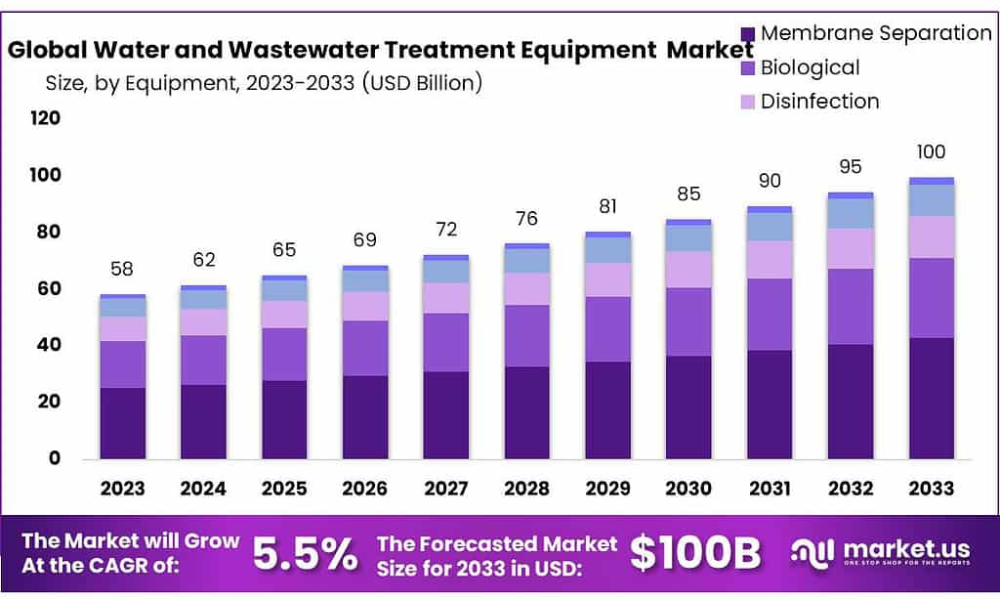
According to market.us, The global Water and Wastewater Treatment Equipment Market is projected to reach approximately USD 100 billion by 2033, rising from USD 58 billion in 2023, with a steady compound annual growth rate (CAGR) of 5.5% over the forecast period from 2023 to 2033. This market comprises a wide array of technologies and tools used to treat wastewater, ensuring that it is safe for discharge into the environment or suitable for reuse. The equipment involved plays a critical role in removing pollutants, hazardous chemicals, and contaminants from water generated by households, industries, and commercial establishments. Treatment typically involves multiple stages—physical, chemical, and biological—to deliver comprehensive purification.
A major driver of market growth is the implementation of strict government regulations across different regions. In the United States, the Environmental Protection Agency (EPA) actively supports wastewater infrastructure through initiatives such as the Clean Water State Revolving Fund (CWSRF), which provided USD 1.1 billion in 2022 for wastewater treatment projects. In Europe, the EU Water Framework Directive (WFD) obligates member states to achieve “good” water quality by 2027, prompting considerable investments in upgrading water treatment systems across the region.
In India, the market is being shaped by large-scale government programs aimed at improving water quality and access. The National Mission for Clean Ganga (NMCG), launched in 2014, has received USD 1.5 billion in funding between 2020 and 2025 for nationwide wastewater management and river cleaning initiatives. Additionally, the Jal Jeevan Mission, which aims to deliver safe drinking water to every rural household by 2024, is expected to significantly boost demand for water treatment infrastructure and technologies in both urban and rural settings.
Trade dynamics also contribute to the industry’s momentum. According to UN Comtrade, global exports of water and wastewater treatment equipment were valued at USD 12.5 billion in 2021. The United States and Germany are recognized as top exporters, supplying advanced technologies such as membrane filtration systems and high-efficiency wastewater treatment equipment. Meanwhile, regions such as Asia-Pacific and Africa are emerging as key import markets, driven by rising industrialization, population growth, and a growing need for sustainable water management solutions.
Key Takeaways
- Water and Wastewater Treatment Equipment Market set to reach USD 100 billion by 2033, with a 5.5% CAGR from 2023.
- Membrane Separation technology captured 43.2% market share in 2023, vital for water purification.
- Filtration and Adsorption Importance Captured 34.3% market share removes impurities, while adsorption tackles organic compounds and heavy metals.
- Primary Treatment Dominance Captured 49.3% market share in 2023, essential for removing solids and organic matter from wastewater.
- Municipal Application Dominance Captured 69.3% market share in 2023, crucial for ensuring public health and environmental protection.
- Asia Pacific Market Leadership Held a commanding 38.4% market share, driven by industrial activities and urbanization.
Access a Complimentary Sample of This Premium Report: https://market.us/report/water-and-wastewater-treatment-equipment-market/free-sample/
Factors Affecting the Growth of the Water and Wastewater Treatment Equipment Market
- Stringent Environmental Regulations: One of the primary factors fueling market growth is the increasing enforcement of environmental standards by governments worldwide. Regulatory frameworks such as the U.S. Clean Water Act, the EU Water Framework Directive (WFD), and national initiatives like India’s National Green Tribunal (NGT) mandate industries and municipalities to meet specific wastewater discharge limits. Compliance with these standards requires investment in advanced treatment equipment, boosting demand across sectors.
- Rising Industrial and Urban Wastewater Generation: With rapid industrialization and urban expansion, the volume of wastewater being generated has surged. Industries such as chemicals, pharmaceuticals, textiles, and food processing produce significant volumes of wastewater that must be treated before disposal. Urban centers are also producing more domestic sewage, intensifying the need for efficient municipal treatment systems, including mechanical screens, clarifiers, sludge handling units, and membrane-based technologies.
- Government Funding and Infrastructure Programs: Substantial public investment in water infrastructure is another key growth factor. For instance, the U.S. Clean Water State Revolving Fund allocated USD 1.1 billion in 2022 for wastewater projects. In India, programs like the National Mission for Clean Ganga received USD 1.5 billion between 2020 and 2025, while the Jal Jeevan Mission is actively funding clean water access in rural areas. Such initiatives are significantly expanding the market for treatment equipment.
- Technological Advancements: Innovations in wastewater treatment technology are making systems more efficient, compact, and cost-effective. Advanced processes such as membrane bioreactors (MBR), moving bed biofilm reactors (MBBR), UV disinfection, and zero-liquid discharge (ZLD) are gaining traction due to their ability to meet stringent discharge standards and enable water reuse. These technologies are particularly attractive in water-scarce regions and industries aiming to minimize environmental impact.
- Growing Awareness of Water Reuse and Sustainability: As freshwater scarcity becomes more pronounced, especially in parts of Asia, the Middle East, and Africa, the push for wastewater recycling and reuse is intensifying. Treated wastewater is increasingly being reused for agriculture, industrial cooling, and even potable purposes, prompting investments in high-efficiency treatment equipment. Sustainability goals and ESG mandates are also encouraging industries to upgrade outdated systems with modern, eco-friendly alternatives.
Report Segmentation:
Equipment Analysis: In 2023, Membrane Separation led the global wastewater treatment equipment market, capturing over 43.2% of the total share. This technology plays a key role in removing fine particles and contaminants from water, making it ideal for both industrial wastewater treatment and potable water purification. Its growing adoption is largely driven by its high efficiency, precision, and ability to meet strict environmental regulations. The rising need for high-quality water across sectors continues to support strong demand for membrane-based systems.
By Type Analysis: In 2023, Filtration Systems dominated the Water and Wastewater Treatment Equipment Market by type, holding a share of more than 34.3%. These systems are central to removing suspended solids and impurities from water, using methods such as sand filtration, activated carbon, and membrane filtration. Their adaptability to different treatment stages and applications makes them indispensable in both municipal and industrial settings.
By Process Analysis: Primary Treatment dominated the market in 2023, with a market share of more than 49.3%. This stage focuses on removing large solids and organic matter using sedimentation and flotation. As the first step in most treatment systems, primary treatment significantly reduces the load on secondary and tertiary stages, enhancing overall system efficiency. Its cost-effectiveness and fundamental role in water processing underpin its continued market leadership.
By Application Analysis: In 2023, Municipal Applications commanded a dominant share of over 69.3% in the wastewater treatment equipment market. This segment includes the vast infrastructure needed to provide clean water and treat wastewater for growing urban populations. Municipal demand is driven by regulatory pressures, the need to modernize aging systems, and increased investment in public health and environmental protection. As cities expand, so does the need for reliable, large-scale water treatment technologies.
To Purchase this Premium Report@ https://market.us/purchase-report/?report_id=100178
Key Market Segments
Based on Equipment
- Membrane Separation
- Biological
- Disinfection
- Sludge Treatment
- Other Equipment
By Type
- Filtration
- Disinfection
- Adsorption
- Desalination
- Testing
- Others
Based on Process
- Primary
- Secondary
- Tertiary
Based on Application
- Municipal
- Industrial
- Other Applications
Regional Analysis
The Asia Pacific region holds a leading position in the global water and wastewater treatment equipment market, accounting for a substantial 38.4% share. This strong market presence is driven by the rising demand for advanced water treatment solutions across both municipal and industrial sectors. Rapid industrialization and urbanization across key economies such as China, India, Japan, South Korea, Australia, and New Zealand are major contributors to this growth. As these countries face increasing pressure to manage water resources efficiently and meet stricter environmental regulations, the adoption of modern treatment technologies continues to accelerate, reinforcing the region’s dominance in the global market.
Market Key Players
- Ecolab Inc.
- Aquatech International LLC
- Calgon Carbon Corporation
- DuPont
- Ecologix Environmental Systems, LLC
- Evonik Industries AG
- Evoqua Water Technologies LLC
- General Electric
- Koch Membrane Systems, Inc
- Lenntech B.V.
- Ovivo
- Parkson Corporation
- Pentair plc
- Samco Technologies, Inc.
- Toshiba Water Solutions Private Limited (TOSHIBA CORPORATION)
- Veolia Group
- Xylem, Inc.
Refer More Related Reports:
- Dairy Products Market
- Biostimulant Market
- Methyl Methacrylate Market
- Plant-Based Energy Drink Market
- Azelaic Acid Market
Get in Touch with Us:
Market.us (Powered By Prudour Pvt. Ltd.)
Address: 420 Lexington Avenue, Suite 300, New York City, NY 10170, United States.
Contact No: +1 718 874 1545 (International), +91 78878 22626 (Asia).
Email: [email protected]



