
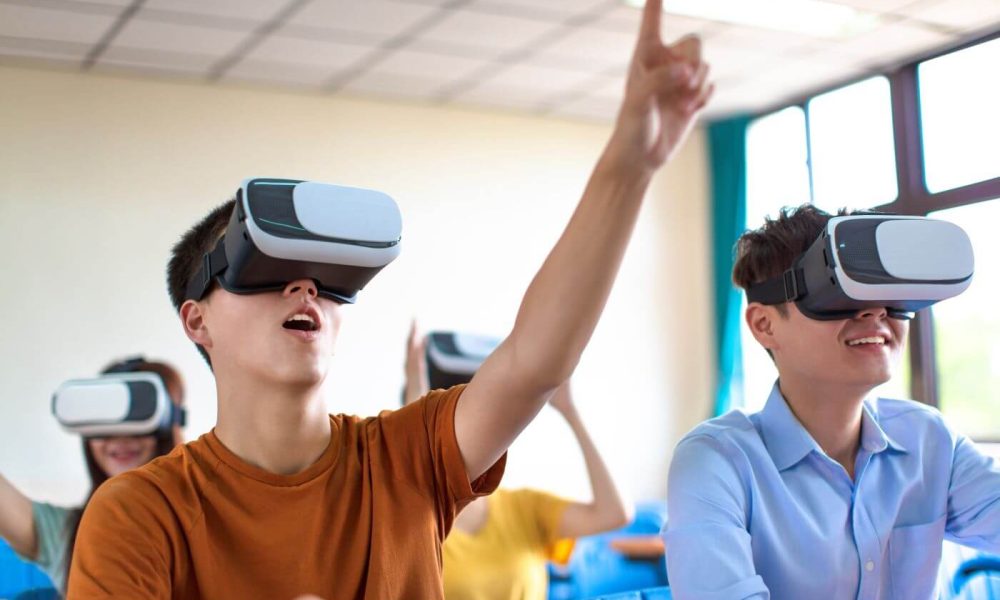
The virtual reality (VR) in education market is experiencing rapid growth, revolutionizing traditional learning methodologies by offering immersive and interactive educational experiences. This overview provides insights into key points, trends, and recent developments in the VR in education market. The Virtual Reality in Education market size is estimated to grow from USD 0.931 Billion in 2019 to USD 15.39 Billion by 2027, growing at a CAGR of 42.3% during the forecast year from 2021 to 2027.
The virtual reality (VR) in education market is witnessing substantial growth driven by several key trends. One significant trend is the increasing adoption of VR technology by educational institutions to enhance teaching and learning experiences. VR offers immersive and interactive environments that enable students to explore concepts, engage with content, and participate in simulations that would otherwise be challenging or impossible in traditional classroom settings.
Download a sample copy of Report:
https://www.marketdigits.com/request/sample/547
Moreover, the COVID-19 pandemic has accelerated the adoption of VR in education as schools and universities have shifted to remote and hybrid learning models. VR technology provides a solution for delivering engaging and interactive learning experiences, regardless of physical location, helping to overcome the limitations of traditional online learning platforms.
Additionally, the availability of affordable VR hardware, such as standalone headsets and smartphone-based VR systems, is making VR more accessible to educational institutions and students. This accessibility is driving widespread adoption of VR across various educational levels, from K-12 to higher education and professional training programs.
Key Points:
- Market Size and Growth: The global VR in education market is witnessing significant growth, with a projected compound annual growth rate (CAGR) exceeding 30% in the forecast period. This growth is driven by the increasing adoption of VR technology in educational institutions, driven by its ability to enhance engagement, retention, and learning outcomes.
- Technology Landscape: VR technology creates immersive, three-dimensional environments that users can explore and interact with using VR headsets and controllers. Educational VR applications range from virtual field trips and simulations to interactive lessons and training modules, offering students hands-on learning experiences across various subjects and disciplines.
- Application Areas: VR in education finds applications across all levels of education, including K-12 schools, higher education institutions, vocational training programs, and corporate training environments. Common use cases include science and biology simulations, historical reconstructions, architectural walkthroughs, medical training, and soft skills development such as public speaking and teamwork.
- Benefits of VR in Education: VR technology offers several benefits for education, including increased engagement, improved knowledge retention, enhanced spatial awareness, and the ability to simulate real-world scenarios in a safe and controlled environment. By immersing students in virtual environments, VR fosters active learning, critical thinking, and problem-solving skills, making complex concepts more accessible and memorable.
- Market Dynamics by Region: The adoption of VR in education varies by region, with North America leading the market due to its advanced technology infrastructure, strong presence of VR content developers, and supportive regulatory environment. However, regions such as Europe, Asia-Pacific, and Latin America are also witnessing significant growth, driven by government initiatives, digitalization trends, and investments in educational technology.
Enquiry before buying:
https://www.marketdigits.com/request/enquiry-before-buying/547
Major Classifications are as follows:
By Product
- VR hardware
- VR content
By End-User
- Higher Education
- K-12
- Vocational Training
By Region
- North America
- US
- Canada
- Europe
- UK
- Germany
- Franc
- Rest of Europe
- Asia-Pacific (APAC)
- China
- Japan
- India
- Rest of APAC
- Rest of the World (RoW)
- Middle East
- Africa
- South America
Reason to purchase this report:
- Determine prospective investment areas based on a detailed trend analysis of the global Virtual Reality in Education market over the next years.
- Gain an in-depth understanding of the underlying factors driving demand for different and Virtual Reality in Education market segments in the top spending countries across the world and identify the opportunities offered by each of them.
- Strengthen your understanding of the market in terms of demand drivers, industry trends, and the latest technological developments, among others.
- Identify the major channels that are driving the global market, providing a clear picture of future opportunities that can be tapped, resulting in revenue expansion.
- Channelize resources by focusing on the ongoing programs that are being undertaken by the different countries within the global market.
- Make correct business decisions based on a thorough analysis of the total competitive landscape of the sector with detailed profiles of the top market providers around the world which include information about their products, alliances, recent contract wins and financial analysis wherever available.
Key Trends:
- Integration with Curriculum: Educational institutions are integrating VR technology into their curriculum to supplement traditional teaching methods and engage students in immersive learning experiences. VR content developers and educational publishers are partnering with schools and universities to develop curriculum-aligned VR modules that cover a wide range of subjects and learning objectives.
- Accessibility and Affordability: Advances in VR hardware and software technologies are making VR more accessible and affordable for educational institutions. Lower-cost VR headsets, such as standalone and mobile VR devices, are becoming increasingly popular in classrooms, enabling schools with limited resources to adopt VR technology and provide students with enriching learning experiences.
- Personalized Learning: VR in education enables personalized learning experiences tailored to individual student needs and learning styles. Adaptive learning algorithms and data analytics tools track student progress, identify areas for improvement, and deliver customized content and feedback, ensuring that each student receives a personalized learning journey that maximizes their learning potential.
Recent Developments:
- Expansion of VR Content Libraries: VR content developers and educational publishers are expanding their libraries of educational VR content, offering a diverse range of experiences across different subjects and grade levels. These content libraries include virtual field trips to historical landmarks and natural wonders, interactive science experiments, language learning simulations, and career exploration modules.
- Partnerships with Educational Institutions: VR technology companies are forming strategic partnerships with educational institutions to pilot VR programs, conduct research studies, and gather feedback from educators and students. These partnerships facilitate the development of innovative VR solutions tailored to specific educational needs and provide valuable insights into the efficacy of VR in enhancing teaching and learning outcomes.
- Emergence of Social VR Platforms: Social VR platforms are gaining popularity in education, enabling students and educators to collaborate, communicate, and engage with each other in virtual environments. These platforms support group activities, team projects, and interactive discussions, fostering a sense of community and collaboration among students in remote and virtual classrooms.
Get this report at a discount:
https://www.marketdigits.com/request/discount/547
In conclusion, the VR in education market holds immense potential to transform learning experiences and empower students with immersive and interactive educational content. With the integration of VR technology into curriculum, advancements in accessibility and affordability, and emphasis on personalized learning, VR is poised to revolutionize education and prepare students for success in the digital age.
Contact Us:
1248 CarMia Way Richmond,
VA 23235, United States.
Phone: +1 510-730-3200
Email: [email protected]
Website: https://www.marketdigits.com