
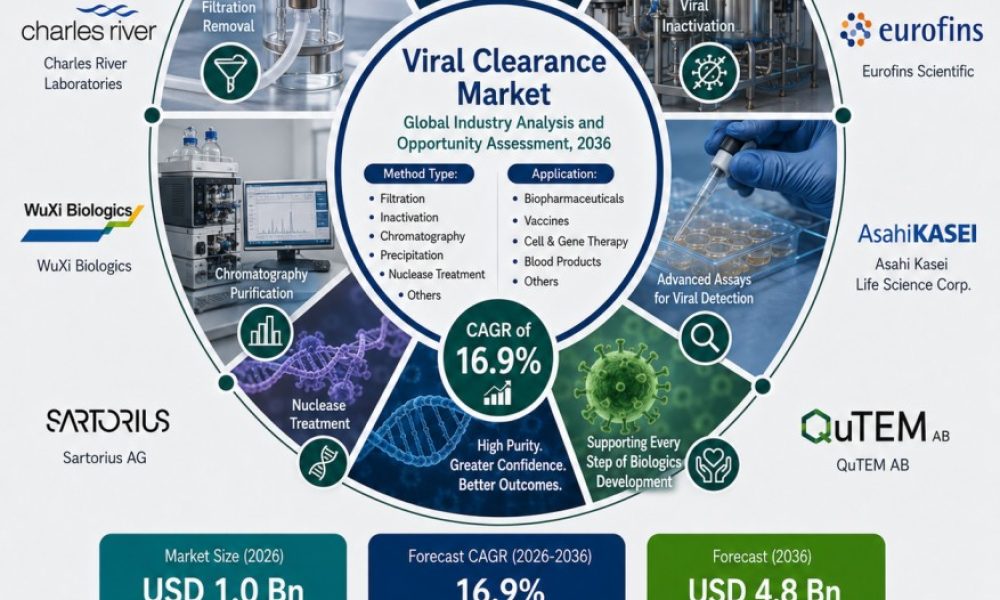
NEWARK, Del — The global Viral Clearance Market is expanding as pharmaceutical and biotechnology companies strengthen viral safety controls across biologics development and manufacturing. According to Future Market Insights (FMI), the market is projected to grow from USD 1.0 billion in 2026 to USD 4.8 billion by 2036, registering a 16.9% CAGR during the forecast period.
Growth is being supported by the expanding biologics pipeline, increasing regulatory scrutiny of viral safety, greater use of recombinant proteins, and the need for validated viral reduction strategies across manufacturing processes. Viral clearance studies provide evidence that manufacturing steps can consistently reduce or remove potential viral contaminants while maintaining product quality.
The market is expected to create an absolute dollar opportunity of approximately USD 3.8 billion between 2026 and 2036. Adoption will increasingly depend on representative scale-down models, sensitive analytical assays, recovery controls, appropriate viral models, and validation strategies capable of demonstrating clearance across orthogonal process steps.
👉 Get Detailed Market Forecasts, Competitive Benchmarking, and Pricing Trends: https://www.futuremarketinsights.com/reports/sample/rep-gb-34522
Key Viral Clearance Market Highlights at a Glance
- Market Size (2026): USD 1.0 Billion
- Forecast Market Size (2036): USD 4.8 Billion
- Forecast Period: 2026–2036
- CAGR (2026–2036): 16.9%
- Absolute Dollar Opportunity: Approximately USD 3.8 Billion
- Leading Method: Viral Removal, 51.0% Market Share in 2026
- Leading Application: Recombinant Proteins, 34.0% Market Share in 2026
- Leading End User: Pharmaceutical and Biotechnology Companies, 51.0% Market Share in 2026
- Key Growth Areas: North America, Europe, and Asia Pacific
- Key Companies: Merck KGaA, Charles River Laboratories, WuXi Biologics, Sartorius AG, Texcell SA, Eurofins Scientific, Asahi Kasei Life Science Corp., and QuTEM AB
Analyst Viewpoint
“Commercial value in viral clearance increasingly depends on whether validation models accurately reproduce manufacturing conditions while preserving analytical sensitivity. Sponsors need to establish loading limits, recovery expectations, neutralization controls, and assay suitability before pivotal validation studies begin. As biologics pipelines expand, providers that combine robust viral characterization, sensitive assays, and process-relevant scale-down models are positioned to strengthen their role in regulated manufacturing programs.”
Why Is the Viral Clearance Market Growing?
The increasing production of biologics and the need to demonstrate viral safety throughout regulated manufacturing processes are creating sustained demand for viral clearance technologies and services.
Viral safety strategies combine raw-material controls, validated manufacturing processes, viral reduction steps, and appropriate product-stage testing. These controls are particularly important for biologics derived from cell lines and other biological production systems where viral contamination risks must be systematically assessed.
Regulatory submissions and major manufacturing changes can also generate recurring demand for viral clearance studies. FDA recorded 17 biologics license applications and 26 biologics license application supplements during 2024, according to its January 2025 CBER report, highlighting the continuing submission activity surrounding regulated biologics programs.
Key Growth Drivers
- Expansion of biologics and recombinant protein pipelines.
- Increasing pharmaceutical and biotechnology R&D investment.
- Rising regulatory focus on viral safety.
- Growing demand for validated viral clearance studies.
- Increasing use of cell-line-derived manufacturing systems.
- Greater adoption of orthogonal viral reduction processes.
- Expansion of contract testing and characterization services.
- Increasing manufacturing changes and regulatory submissions.
Viral clearance programs enable manufacturers to demonstrate that specific process steps provide measurable viral reduction while maintaining acceptable product recovery and quality.
Which Method Leads the Viral Clearance Market?
Viral removal is estimated to account for 51.0% of method demand in 2026, making it the leading method segment.
Viral removal can involve filtration and chromatography-based manufacturing steps designed to reduce viral contaminants while maintaining the desired product characteristics.
The effectiveness of these approaches depends on process conditions, viral characteristics, product concentration, filter performance, chromatography parameters, and the ability to reproduce manufacturing conditions during validation.
Why Do Recombinant Proteins Lead Application Demand?
Recombinant proteins are projected to account for 34.0% of application demand in 2026.
The expansion of therapeutic proteins and antibody-based development programs is increasing the need for documented viral safety controls. Recombinant protein manufacturing often involves multiple purification and processing stages where viral reduction must be assessed and demonstrated.
Recurring development programs, process changes, scale-up activities, and regulatory submissions can further support demand for viral clearance characterization and validation services.
Why Do Pharmaceutical and Biotechnology Companies Dominate End-user Demand?
Pharmaceutical and biotechnology companies are forecast to represent 51.0% of end-user demand in 2026.
These organizations maintain responsibility for manufacturing processes, product quality, regulatory submissions, and viral safety strategies. As biologics portfolios expand, sponsors increasingly require validated viral clearance data throughout development and commercial manufacturing.
Contract research and testing providers also play an important role by supplying specialized viral assays, characterization capabilities, scale-down models, and validation expertise.
How Is Technology Improving Viral Clearance Validation?
Technology development is increasingly focused on improving analytical sensitivity, model representativeness, process reproducibility, and confidence in viral reduction measurements.
Major trends include:
- Development of sensitive viral detection assays.
- Improved scale-down manufacturing models.
- Greater use of orthogonal clearance steps.
- Advances in viral filtration and chromatography.
- Improved assay interference controls.
- Increasing automation of analytical workflows.
- Greater emphasis on product recovery.
- Expanded viral characterization capabilities.
- Increasing use of specialized contract testing services.
The industry is also placing greater emphasis on ensuring that assay detection limits remain reliable in complex product matrices. Insufficient process material, matrix interference, or inadequate neutralization can compromise results and delay regulated studies.
What Are the Key Market Challenges and Restraints?
Limited process material, assay interference, complex biological matrices, specialized testing requirements, high validation costs, and the technical difficulty of reproducing commercial manufacturing conditions can restrict market adoption.
A major challenge is creating scale-down models that accurately represent full-scale manufacturing. Differences in loading, residence time, filtration conditions, chromatography behavior, or neutralization can influence measured viral clearance.
Sensitive assays must also maintain suitable detection limits throughout the study. Poor recovery or interference can weaken confidence in viral reduction results and potentially require additional studies.
What Is the Regional Outlook?
North America remains a major market due to its strong pharmaceutical and biotechnology ecosystem, advanced biologics manufacturing infrastructure, and established regulatory environment.
Europe supports market growth through its sophisticated biologics industry, regulatory focus on product safety, and expanding use of specialized testing and characterization services.
Asia Pacific is emerging as an important growth region as biologics manufacturing, contract development and manufacturing organizations, biotechnology investment, and pharmaceutical production capabilities expand across major markets.
Regional adoption will depend on biologics production volumes, regulatory requirements, availability of specialized laboratories, manufacturing investments, and access to advanced analytical technologies.
What Is the Competitive Landscape?
Competition is centered on viral testing capabilities, assay sensitivity, characterization expertise, process validation, scale-down modeling, filtration and chromatography technologies, and regulatory support.
Leading companies are expanding their capabilities through technology development, testing services, strategic partnerships, manufacturing support, and specialized viral characterization platforms.
Key Companies
- Merck KGaA
- Charles River Laboratories
- WuXi Biologics
- Sartorius AG
- Texcell SA
- Eurofins Scientific
- Asahi Kasei Life Science Corp.
- QuTEM AB
These companies compete through viral clearance testing, viral characterization, process technologies, filtration systems, analytical services, contract research capabilities, and support for regulated biologics manufacturing.
👉 Read Full Report: https://www.futuremarketinsights.com/reports/viral-clearance-market
Frequently Asked Questions
- What is the projected size of the Viral Clearance Market by 2036? The global Viral Clearance Market is projected to reach USD 4.8 billion by 2036, increasing from USD 1.0 billion in 2026.
- What is the expected CAGR of the Viral Clearance Market? The market is forecast to expand at a 16.9% CAGR between 2026 and 2036.
- Which viral clearance method dominates the market? Viral removal is estimated to lead the method segment with 51.0% of demand in 2026.
- Which application holds the largest market share? Recombinant proteins are projected to account for 34.0% of application demand in 2026.
- Which end-user segment dominates the market? Pharmaceutical and biotechnology companies are forecast to account for 51.0% of end-user demand in 2026.
- What factors are driving the Viral Clearance Market? Expanding biologics pipelines, regulatory viral safety requirements, increasing recombinant protein production, manufacturing changes, and demand for validated viral reduction strategies are driving market growth.
- What are the major challenges in viral clearance validation? Limited process material, assay interference, complex product matrices, scale-down model limitations, and the need to preserve sensitive detection limits remain important challenges.
About Future Market Insights (FMI)
Future Market Insights (FMI) is a global market intelligence and consulting firm providing comprehensive market research, competitive intelligence, and strategic business insights across industries. The firm delivers detailed forecasts, technology analysis, and data-driven recommendations that support informed decision-making for manufacturers, investors, distributors, and policymakers worldwide.
For Press & Corporate Inquiries
Rahul Singh
AVP – Marketing and Growth Strategy
Future Market Insights, Inc.
+91 8600020075



