
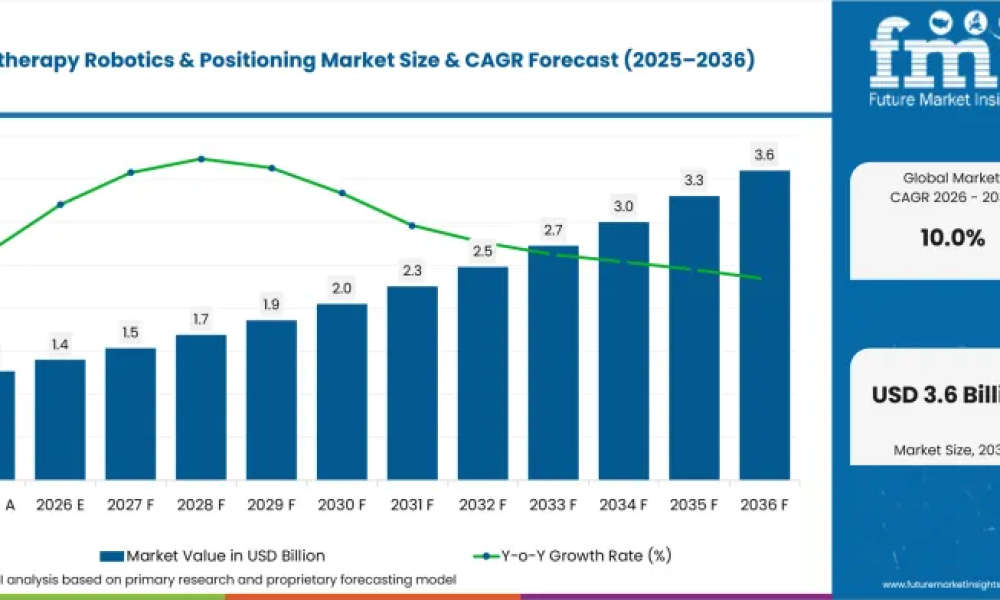
NEWARK, Del – The global Radiotherapy Robotics & Positioning Market is expanding as cancer treatment centers increasingly adopt robotic delivery, automated positioning, motion-management, and image-guided technologies to improve treatment accuracy and consistency. According to Future Market Insights (FMI), the market is projected to grow from USD 1.4 billion in 2026 to USD 3.6 billion by 2036, registering a 10.0% CAGR during the forecast period.
Growth is being supported by rising cancer incidence, increasing demand for stereotactic treatments, advances in image-guided radiotherapy, and the need to accurately position patients and manage motion during radiation delivery. Robotic systems are increasingly being evaluated as integrated components of treatment workflows rather than standalone mechanical equipment.
The market is expected to create an absolute dollar opportunity of approximately USD 2.2 billion between 2026 and 2036. Adoption will increasingly depend on positioning accuracy, motion tracking, treatment throughput, interoperability, installation requirements, medical physics expertise, and the ability to integrate robotics with imaging, planning, and radiation-delivery platforms.
👉 Get Detailed Market Forecasts, Competitive Benchmarking, and Pricing Trends: https://www.futuremarketinsights.com/reports/sample/rep-gb-34070
Key Radiotherapy Robotics & Positioning Market Highlights at a Glance
- Market Size (2026): USD 1.4 Billion
- Forecast Market Size (2036): USD 3.6 Billion
- Forecast Period: 2026–2036
- CAGR (2026–2036): 10.0%
- Absolute Dollar Opportunity: Approximately USD 2.2 Billion
- Leading Product: Robotic Radiosurgery Systems (38.0% Share in 2026)
- Leading Application: Intracranial Radiosurgery (34.0% Share in 2026)
- Leading Component: Systems (62.0% Share in 2026)
- Fast-Growing Markets: United States and European Union
- Key Growth Areas: North America, Europe, and Asia Pacific
- Key Companies: Accuray, Varian, Brainlab, C-RAD, Vision RT, Leo Cancer Care, and RaySearch Laboratories
Analyst Viewpoint
“Radiotherapy robotics is increasingly being evaluated according to its contribution to treatment consistency, clinical throughput, and workflow integration. Cancer centers need robotic positioning and delivery systems that can operate reliably alongside imaging, treatment planning, and linear accelerator platforms without creating excessive commissioning or validation requirements. Adoption will depend on implementation efficiency, motion-management capabilities, medical physics expertise, and the ability to support high-volume treatment programs.”
Why Is the Radiotherapy Robotics & Positioning Market Growing?
The increasing global cancer burden is creating pressure on radiotherapy departments to deliver precise treatments while managing growing patient volumes.
The National Cancer Institute reported that almost 20 million new cancer cases occurred worldwide in 2022, highlighting the need for technologies that can improve treatment efficiency and accuracy.
Radiotherapy robotics can support repeatable patient positioning and automated treatment delivery, particularly for stereotactic procedures that require narrow treatment margins.
Motion management is another important growth factor. Patient movement and organ motion can affect radiation targeting, making accurate positioning and monitoring increasingly important for high-precision treatment.
Key Growth Drivers
- Rising global cancer incidence.
- Increasing adoption of stereotactic radiotherapy.
- Growing demand for precise radiation delivery.
- Expansion of image-guided radiotherapy.
- Increasing need for repeatable patient positioning.
- Advances in robotic motion management.
- Growth of intracranial radiosurgery.
- Increasing investment in high-precision cancer centers.
- Integration of robotics with treatment planning and imaging.
- Rising demand for automated treatment workflows.
Robotic systems can help treatment centers standardize positioning and coordinate multiple treatment steps, potentially supporting consistent clinical workflows.
Which Product Leads the Radiotherapy Robotics & Positioning Market?
Robotic radiosurgery systems are estimated to account for 38.0% of product demand in 2026, making them the leading product category.
These systems are used across intracranial and body stereotactic treatment applications where precise targeting and controlled radiation delivery are particularly important.
Their adoption is supported by the increasing use of high-precision radiotherapy and the need to manage treatment geometry accurately.
The growing integration of imaging, positioning, and beam-delivery technologies is further increasing the value of robotic radiosurgery platforms within modern treatment centers.
Why Does Intracranial Radiosurgery Dominate Application Demand?
Intracranial radiosurgery is projected to hold 34.0% of application demand in 2026.
Intracranial treatments require accurate patient positioning, frequent imaging, and precise radiation delivery because treatment targets are located close to sensitive neurological structures.
Robotic positioning systems can support repeatable setup and precise treatment geometry, making them valuable within stereotactic radiosurgery workflows.
The expansion of image-guided and noncoplanar treatment techniques is expected to further support demand for advanced positioning technologies
Why Do Systems Lead Component Demand?
Systems are forecast to account for 62.0% of component demand in 2026.
The systems category captures the core hardware and integrated technologies required for robotic treatment delivery, imaging, positioning, and motion management.
Hospitals increasingly evaluate these technologies as integrated treatment platforms rather than isolated components. This encourages demand for systems capable of communicating with treatment-planning software, imaging equipment, and linear accelerators.
How Are Robotics Improving Radiotherapy?
Radiotherapy robotics is increasingly shifting from mechanical automation toward integrated treatment coordination.
Modern systems can support automated positioning, motion tracking, surface monitoring, beam-hold controls, and image-guided treatment workflows.
These capabilities can help treatment teams maintain patient alignment and respond to movement during radiation delivery.
However, robotic systems do not eliminate the need for clinical oversight. Medical physicists and radiation oncology teams remain responsible for commissioning, validation, treatment planning, quality assurance, and patient safety.
What Are the Latest Technology and Innovation Trends?
Innovation continues reshaping the radiotherapy robotics and positioning industry.
Major trends include:
- Expansion of robotic radiosurgery systems.
- Increasing use of surface-guided radiation therapy.
- Growth of automated patient positioning.
- Advances in motion tracking.
- Increasing integration with imaging systems.
- Greater use of beam-hold controls.
- Integration with third-party linear accelerators.
- Increasing compatibility with treatment-planning software.
- Expansion of stereotactic treatment applications.
- Development of upright positioning approaches.
Upright positioning is also gaining attention in selected treatment configurations, particularly where alternative room designs can potentially reduce infrastructure requirements.
What Are the Key Market Challenges and Restraints?
High equipment costs remain a major constraint for healthcare providers. Capital-intensive robotic platforms require substantial investment in equipment, installation, facility modifications, commissioning, maintenance, and staff training.
Implementation can also require specialized medical physics expertise. Hospitals must validate robotic positioning, imaging, treatment delivery, and software integration before systems enter routine clinical operation.
Interoperability with existing linear accelerators and treatment-planning systems can further influence purchasing decisions.
What Is the Regional Outlook?
North America remains a major market because of its established oncology infrastructure, high healthcare expenditure, advanced radiotherapy capacity, and adoption of precision treatment technologies.
The United States is expected to record approximately 10.0% CAGR through 2036, supported by replacement cycles for an established radiotherapy equipment base and continued investment in high-precision treatment.
Europe is also an important market, with the European Union expected to expand at approximately 9.5% CAGR through 2036. National hospital budgets and common medical-device requirements support continued investment in advanced radiotherapy infrastructure.
Asia Pacific is emerging as a significant growth region as countries expand cancer treatment capacity and invest in image-guided and high-precision radiotherapy.
What Is the Competitive Landscape?
Competition is increasingly focused on robotic precision, motion tracking, surface-guided monitoring, interoperability, treatment throughput, and integration with existing radiotherapy infrastructure.
Leading companies are strengthening their positions through advanced robotics, radiosurgery platforms, motion-management technologies, imaging integration, and treatment-planning software.
Key Companies
- Accuray
- Varian
- Brainlab
- C-RAD
- Vision RT
- Leo Cancer Care
- RaySearch Laboratories
These companies compete through robotic radiosurgery, positioning platforms, surface-guided radiation therapy, motion tracking, treatment-planning solutions, and integrated radiotherapy technologies.
👉 Read Full Report: https://www.futuremarketinsights.com/reports/radiotherapy-robotics-and-positioning-market
Frequently Asked Questions
- What is the projected size of the Radiotherapy Robotics & Positioning Market by 2036? The global market is projected to reach USD 3.6 billion by 2036, increasing from USD 1.4 billion in 2026.
- What is the expected CAGR of the Radiotherapy Robotics & Positioning Market? The market is forecast to expand at a 10.0% CAGR between 2026 and 2036.
- Which product segment dominates the market? Robotic radiosurgery systems are estimated to lead the product segment with a 38.0% share in 2026.
- Which application holds the largest market share? Intracranial radiosurgery is projected to account for 34.0% of application demand in 2026.
- Which component segment leads the market? Systems are forecast to account for 62.0% of component demand in 2026.
- What is driving demand for radiotherapy robotics? Rising cancer incidence, growing adoption of stereotactic treatments, demand for precise radiation delivery, motion management, and increasing investment in high-precision cancer treatment are supporting market growth.
- What is the major restraint affecting the market? High equipment costs, along with installation, commissioning, maintenance, and specialized expertise requirements, remain significant adoption barriers.
About Future Market Insights (FMI)
Future Market Insights (FMI) is a global market intelligence and consulting firm providing comprehensive market research, competitive intelligence, and strategic business insights across industries. The firm delivers detailed forecasts, technology analysis, and data-driven recommendations that support informed decision-making for manufacturers, investors, distributors, and policymakers worldwide.
For Press & Corporate Inquiries
Rahul Singh
AVP – Marketing and Growth Strategy
Future Market Insights, Inc.
+91 8600020075



