
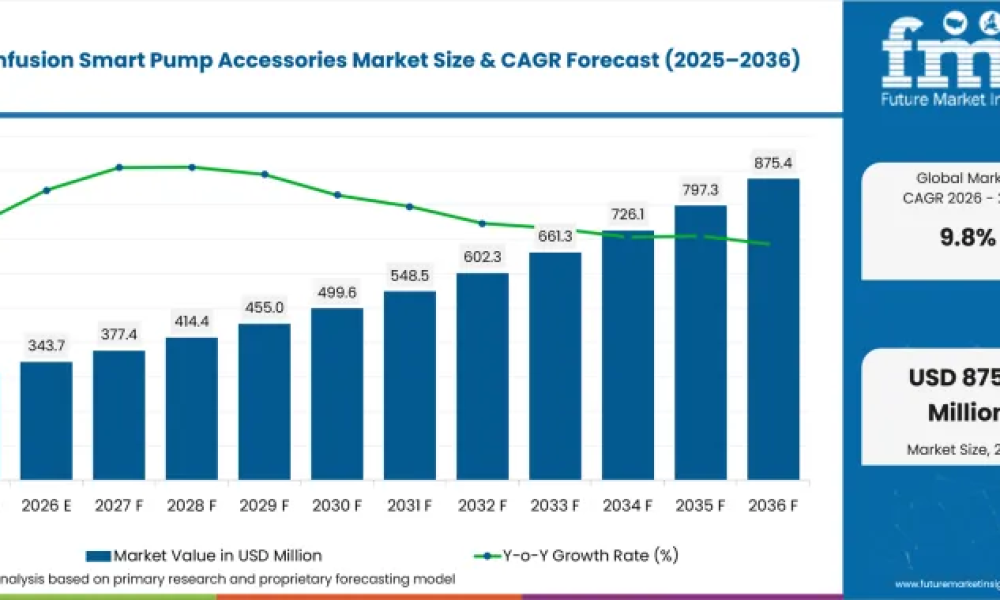
NEWARK, Del. — The global Home Infusion Smart Pump Accessories Market is expanding as healthcare providers increasingly shift selected infusion therapies from acute-care facilities to supervised home settings. According to Future Market Insights (FMI), the market is projected to grow from USD 343.7 million in 2026 to USD 875.4 million by 2036, registering a 9.8% CAGR during the forecast period.
Growth is being supported by the expansion of home infusion programs, increasing use of smart connected pumps, recurring replacement requirements for administration sets and other consumables, and growing demand for remote monitoring of patients receiving therapy outside hospitals.
The market is expected to create an absolute dollar opportunity of approximately USD 531.7 million between 2026 and 2036. Adoption will increasingly depend on accessory compatibility, product reliability, supply continuity, monitoring capabilities, regulatory compliance, reimbursement structures, and the ability of suppliers to support distributed home-care programs.
👉 Get Detailed Market Forecasts, Competitive Benchmarking, and Pricing Trends: https://www.futuremarketinsights.com/reports/sample/rep-gb-34121
Key Home Infusion Smart Pump Accessories Market Highlights at a Glance
- Market Size (2026): USD 343.7 Million
- Forecast Market Size (2036): USD 875.4 Million
- Forecast Period: 2026–2036
- CAGR (2026–2036): 9.8%
- Absolute Dollar Opportunity: Approximately USD 531.7 Million
- Leading Product Type: Consumables (42.0% Share in 2026)
- Leading Application: Monitoring (28.0% Share in 2026)
- Key Growth Areas: North America, Europe, and Asia Pacific
- Key Market Drivers: Home-Based Infusion, Recurring Accessory Replacement, Remote Monitoring, and Connected Pump Adoption
- Key Companies: B. Braun, Baxter, ICU Medical, Fresenius Kabi, Eitan Medical, Moog Medical, Micrel Medical, and BD
Analyst Viewpoint
“Reliable home infusion delivery depends on the consistent performance of every accessory used throughout the treatment cycle. Healthcare providers increasingly evaluate administration-set compatibility, alarm response, product availability, and documented quality performance before approving accessories for recurring home-care programs. As infusion therapy becomes more distributed, suppliers that combine reliable consumables with monitoring support, technical service, and consistent availability are likely to strengthen their position across home-based care networks.”
Why Is the Home Infusion Smart Pump Accessories Market Growing?
The expansion of home-based infusion therapy is creating sustained demand for accessories that enable patients to receive treatment safely outside acute-care facilities.
Home infusion programs rely on smart pumps, administration sets, tubing, monitoring components, batteries, locks, carrying accessories, and other supporting products. Many of these components require recurring replacement throughout extended treatment cycles.
The Centers for Medicare & Medicaid Services recorded 27,834 home infusion therapy service visits during 2024, highlighting the volume of care delivered through home infusion programs.
The transition toward supervised home treatment can reduce dependence on hospital-based care for appropriate patients while providing greater flexibility. As the number of patients receiving infusion therapy at home increases, demand for compatible accessories is expected to rise alongside the installed base of infusion pumps.
Key Growth Drivers
- Expansion of home infusion therapy programs.
- Increasing preference for supervised home-based treatment.
- Recurring replacement of disposable administration sets.
- Growing adoption of smart infusion pumps.
- Increasing use of remote patient monitoring.
- Rising demand for treatment continuity outside hospitals.
- Expansion of connected home-care technologies.
- Growing need for reliable pump-compatible accessories.
Consumables represent a particularly recurring revenue opportunity because administration sets and related disposable components must be replaced throughout repeated infusion cycles.
Why Do Consumables Lead the Market?
Consumables are estimated to account for 42.0% of product-type demand in 2026, making them the leading category.
Administration sets and other disposable components are repeatedly replaced during ongoing infusion therapy, generating recurring demand across home-care programs.
Compatibility with specific smart pumps remains important because accessories must support accurate delivery and reliable operation. Healthcare organizations therefore evaluate suppliers based on documented performance, product availability, quality controls, and technical support.
The recurring nature of consumable replacement provides a stable foundation for market expansion as home infusion volumes increase.
Why Does Monitoring Lead Application Demand?
Monitoring is projected to account for 28.0% of application demand in 2026.
Remote monitoring can allow healthcare teams to review pump status and identify potential interruptions between scheduled nursing visits.
Monitoring capabilities are becoming increasingly important as care moves away from hospitals and into patients’ homes. Connected systems can help support treatment oversight while reducing the need for continuous in-person supervision.
The growth of remote monitoring is also encouraging accessory suppliers to consider connectivity, alarm management, and interoperability alongside basic mechanical compatibility.
How Are Smart Accessories Supporting Home Infusion?
Home infusion accessories are increasingly becoming part of connected treatment ecosystems rather than isolated components.
Smart pumps can be supported by monitoring technologies, backup batteries, security locks, carrying pouches, administration sets, and software-enabled systems.
These components help patients maintain treatment continuity while allowing healthcare professionals to oversee therapy remotely.
However, reliable operation remains essential. An equipment failure or incompatible accessory can interrupt prescribed therapy and create additional work for patients, caregivers, and clinical teams.
What Are the Latest Technology and Innovation Trends?
Innovation continues reshaping the home infusion smart pump accessories industry.
Major trends include:
- Expansion of smart pump-compatible consumables.
- Growth of remote pump monitoring.
- Increasing use of connected infusion systems.
- Development of improved administration sets.
- Greater emphasis on alarm management.
- Expansion of portable pump accessories.
- Increasing use of backup power solutions.
- Development of specialized carrying systems.
- Greater interoperability between pumps and monitoring platforms.
- Increasing focus on product reliability and quality assurance.
The industry is moving toward more integrated home-infusion ecosystems in which accessories contribute to treatment continuity, monitoring, portability, and patient safety.
What Are the Key Market Challenges and Restraints?
Device-quality issues and fragmented reimbursement policies remain important barriers to broader adoption.
Home infusion programs operate across distributed care environments, making product reliability and technical support particularly important. Device failures can result in treatment interruptions and require additional intervention from nursing teams.
Reimbursement also varies across healthcare systems and payers. Differences in coverage policies can complicate purchasing decisions and influence the economic attractiveness of home infusion programs.
Regulatory compliance adds another layer of complexity. In June 2026, the Centers for Medicare & Medicaid Services listed six approved home infusion therapy accrediting organizations, highlighting the importance of quality documentation and accreditation within the United States.
What Is the Regional Outlook?
North America remains a major market because of established home infusion networks, advanced healthcare infrastructure, smart-pump adoption, and growing interest in reducing hospital-based care.
Europe supports market development through expanding home-care services, healthcare digitization, and demand for reliable infusion technologies. Countries such as Germany place strong emphasis on product reliability and technical support.
Asia Pacific represents an important growth opportunity as healthcare systems expand home nursing capabilities and seek more affordable approaches to long-term infusion therapy. China and India are increasingly evaluating cost-effective disposable supplies compatible with home-care workflows.
What Is the Competitive Landscape?
Competition is focused on pump compatibility, consumable quality, product availability, monitoring capabilities, technical service, and regulatory compliance.
Leading companies are strengthening their positions through smart pump technologies, compatible administration sets, remote monitoring solutions, service networks, and expanded home-infusion portfolios.
Key Companies
- B. Braun
- Baxter
- ICU Medical
- Fresenius Kabi
- Eitan Medical
- Moog Medical
- Micrel Medical
- BD
These companies compete through infusion pump technologies, disposable accessories, monitoring solutions, administration sets, connected platforms, and technical support services.
👉 Read Full Report: https://www.futuremarketinsights.com/reports/home-infusion-smart-pump-accessories-market
Frequently Asked Questions
- What is the projected size of the Home Infusion Smart Pump Accessories Market by 2036? The global market is projected to reach USD 875.4 million by 2036, increasing from USD 343.7 million in 2026.
- What is the expected CAGR of the Home Infusion Smart Pump Accessories Market? The market is forecast to expand at a 9.8% CAGR between 2026 and 2036.
- Which product type dominates the market? Consumables are estimated to lead the product segment with a 42.0% share in 2026.
- Which application holds the largest market share? Monitoring is projected to account for 28.0% of application demand in 2026.
- What is driving demand for home infusion smart pump accessories? Expansion of home infusion therapy, recurring replacement of consumables, smart pump adoption, remote monitoring, and the shift toward supervised home-based care are driving market growth.
- What are the major challenges facing the market? Device-quality concerns, fragmented reimbursement policies, regulatory requirements, product compatibility, and the need for reliable technical support remain key challenges.
- Which companies are prominent in the market? Key companies include B. Braun, Baxter, ICU Medical, Fresenius Kabi, Eitan Medical, Moog Medical, Micrel Medical, and BD.
About Future Market Insights (FMI)
Future Market Insights (FMI) is a global market intelligence and consulting firm providing comprehensive market research, competitive intelligence, and strategic business insights across industries. The firm delivers detailed forecasts, technology analysis, and data-driven recommendations that support informed decision-making for manufacturers, investors, distributors, and policymakers worldwide.
For Press & Corporate Inquiries
Rahul Singh
AVP – Marketing and Growth Strategy
Future Market Insights, Inc.
+91 8600020075



