
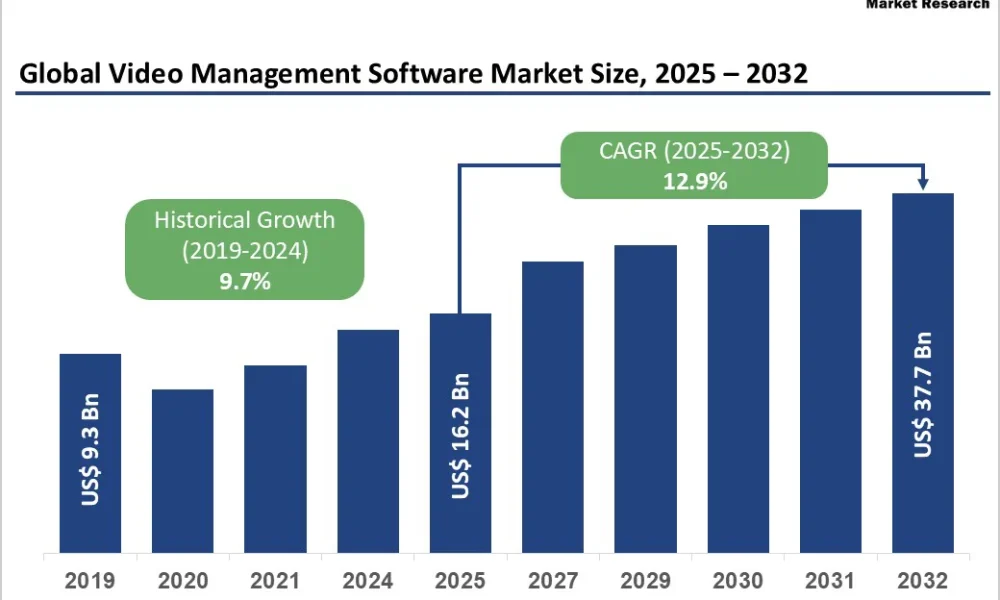
The global Video Management Software (VMS) market is undergoing a major transformation as video shifts from being a passive security asset to an active source of operational intelligence. In 2025, the market is estimated to be valued at US$16.2 billion and is expected to reach US$37.7 billion by 2032, expanding at a robust CAGR of approximately 12.9% during the forecast period.
This growth is powered by rapid cloud migration, accelerating adoption of AI-driven video analytics, rising public and private security investments, and the widespread deployment of IP cameras across smart cities, retail environments, transportation hubs, and industrial facilities. As enterprises demand smarter, scalable, and more integrated surveillance ecosystems, VMS platforms are evolving into intelligent data hubs that deliver real-time insights, automation, and predictive capabilities.
Understanding Video Management Software
Video Management Software refers to platforms that enable the capture, storage, management, analysis, and retrieval of video streams from network cameras and other visual sensors. Traditionally used for surveillance and incident review, modern VMS solutions now integrate artificial intelligence, machine learning, and cloud computing to deliver advanced analytics such as facial recognition, object tracking, behavior analysis, and anomaly detection.
Today’s VMS platforms are no longer standalone security tools. They are increasingly embedded into broader enterprise systems, including access control, building management, logistics software, and smart infrastructure platforms. This shift has significantly expanded the addressable market for VMS vendors.
Market Growth Drivers
Rapid Migration to Cloud and Hybrid VMS Platforms
One of the strongest growth drivers in the VMS market is the accelerating transition from on-premise systems to cloud-based and hybrid deployments. Enterprises are adopting cloud VMS solutions to benefit from improved scalability, centralized management, reduced hardware dependency, and predictable subscription-based costs.
Hybrid models, which combine on-premise storage with cloud analytics and remote access, are especially popular in compliance-heavy industries such as banking, government, and critical infrastructure. These architectures allow organizations to modernize their surveillance capabilities while preserving existing investments.
AI-Based Video Analytics Turning Video into Intelligence
Artificial intelligence has fundamentally changed the value proposition of video management software. Instead of manually reviewing footage, organizations now leverage AI-powered analytics to extract actionable insights in real time.
Advanced capabilities such as people counting, license plate recognition, heat mapping, intrusion detection, and behavioral analysis are being widely adopted across sectors. Retailers use VMS analytics to optimize store layouts and reduce shrinkage, while transportation authorities apply them for traffic optimization and passenger safety.
As AI models become more accurate and cost-efficient, demand for analytics-enabled VMS platforms continues to rise sharply.
Rising Security Investments Across Public and Private Sectors
Heightened concerns around public safety, terrorism, theft, and cyber-physical threats are driving sustained investments in surveillance infrastructure. Governments are allocating significant budgets toward smart policing, urban surveillance, and border security initiatives.
In the private sector, enterprises are expanding video surveillance beyond traditional security use cases to include workforce monitoring, operational efficiency, and regulatory compliance. These expanding applications are directly contributing to increased adoption of advanced VMS solutions.
Proliferation of IP Cameras and Smart City Projects
The widespread deployment of IP cameras across urban environments has created massive volumes of video data, increasing the need for scalable and intelligent VMS platforms. Smart city initiatives rely heavily on video feeds for traffic management, crowd monitoring, emergency response, and environmental surveillance.
Transportation hubs, logistics centers, airports, and ports are also adopting large-scale video management systems to improve situational awareness and operational coordination. This proliferation of video endpoints is a key factor fueling long-term market growth.
Market Challenges and Restraints
Cybersecurity and Data Privacy Concerns
As VMS platforms become more connected and cloud-based, concerns around cybersecurity and data privacy have intensified. Video data is highly sensitive, and breaches can lead to regulatory penalties, reputational damage, and operational disruption.
Organizations must comply with strict data protection regulations, including GDPR and regional privacy laws. As a result, VMS vendors are under pressure to deliver robust encryption, access controls, and compliance-ready architectures, which can increase development and deployment costs.
Legacy System Compatibility and Integration Complexity
Many enterprises continue to operate legacy surveillance systems that were not designed for modern analytics or cloud integration. Migrating these systems to next-generation VMS platforms can be complex, time-consuming, and costly.
Compatibility challenges related to hardware, codecs, and proprietary protocols remain a significant barrier, particularly for large organizations with geographically distributed surveillance infrastructures.
Deployment Mode Analysis
On-Premise VMS Remains Dominant
Despite growing cloud adoption, on-premise deployments accounted for approximately 54.8% of total installations in 2025. This dominance is driven by organizations that prioritize data sovereignty, low-latency performance, and direct control over security infrastructure.
Sectors such as defense, government, financial services, and critical infrastructure continue to favor on-premise VMS solutions due to regulatory and compliance requirements.
Rapid Growth of Cloud and Hybrid Models
Cloud-based and hybrid VMS deployments are experiencing faster growth rates compared to traditional models. These solutions are particularly attractive to mid-sized enterprises and multi-location organizations seeking centralized management and rapid scalability.
Subscription-based pricing, automatic updates, and seamless AI integration are key factors accelerating cloud adoption during the forecast period.
Elevate your business strategy with comprehensive market data. Request a sample report now: https://www.persistencemarketresearch.com/samples/35884
Component Analysis
Core VMS Software Leads the Market
The core VMS software segment contributed over 47.9% of total market revenue in 2025, reflecting its foundational role in multi-level surveillance architectures. Core platforms provide essential functionalities such as video recording, device management, playback, and user access control.
As organizations expand analytics capabilities, core VMS software increasingly serves as the central orchestration layer, integrating cameras, AI engines, and third-party applications.
Growing Demand for Analytics and Add-On Modules
While core software remains dominant, analytics modules and value-added services are growing rapidly. Features such as facial recognition, advanced search, and predictive analytics are becoming key differentiators among vendors.
This trend is enabling vendors to increase average revenue per user through modular pricing and premium feature offerings.
Regional Market Insights
North America: Market Leader
North America accounted for over 34.5% of global VMS revenues in 2025, retaining its position as the leading regional market. The region benefits from mature surveillance ecosystems, high enterprise adoption, and strong presence of established VMS vendors.
Widespread use of AI-driven analytics across retail, transportation, and corporate campuses continues to support market leadership.
Asia Pacific: Fastest-Growing Region
The Asia Pacific region recorded the fastest growth during the forecast period, driven by large-scale smart city initiatives, urbanization, and expanding investments in logistics and retail security.
Countries such as China, India, Japan, and South Korea are deploying extensive video surveillance networks, creating strong demand for scalable and AI-enabled VMS platforms.
Europe and Other Regions
Europe’s VMS market growth is shaped by strict data privacy regulations and increasing investments in public safety infrastructure. Meanwhile, Latin America and the Middle East & Africa are emerging markets, supported by infrastructure modernization and growing urban security needs.
Competitive Landscape and Investment Trends
Leading VMS vendors are prioritizing cloud-first strategies and AI innovation, with many reporting double-digit annual growth in cloud subscriptions. Edge AI capabilities are also gaining traction, enabling real-time analytics directly at the camera level to reduce latency and bandwidth usage.
Strategic partnerships with cloud service providers, camera manufacturers, and AI startups are becoming increasingly common as vendors seek to expand ecosystem capabilities and global reach.
Future Outlook: From Surveillance to Intelligence Platforms
Looking ahead, the Video Management Software market is set to evolve from a security-focused industry into a broader video intelligence ecosystem. VMS platforms will increasingly integrate with IoT devices, digital twins, and enterprise analytics systems.
Advancements in edge computing, 5G connectivity, and generative AI are expected to further enhance real-time decision-making and automation. As video becomes a strategic data asset, organizations will continue to invest in intelligent VMS solutions that deliver measurable business value beyond security.
Conclusion
The global Video Management Software market is on a strong growth trajectory, expanding from US$16.2 billion in 2025 to US$37.7 billion by 2032 at a 12.9% CAGR. Driven by cloud migration, AI-powered analytics, rising security investments, and smart infrastructure deployment, VMS platforms are redefining how organizations capture and use video data.
While challenges around cybersecurity and legacy integration persist, ongoing innovation and investment are positioning VMS as a critical component of modern digital ecosystems. As enterprises and governments alike embrace intelligent video solutions, the market is poised for sustained, long-term growth.
Related Reports:




