
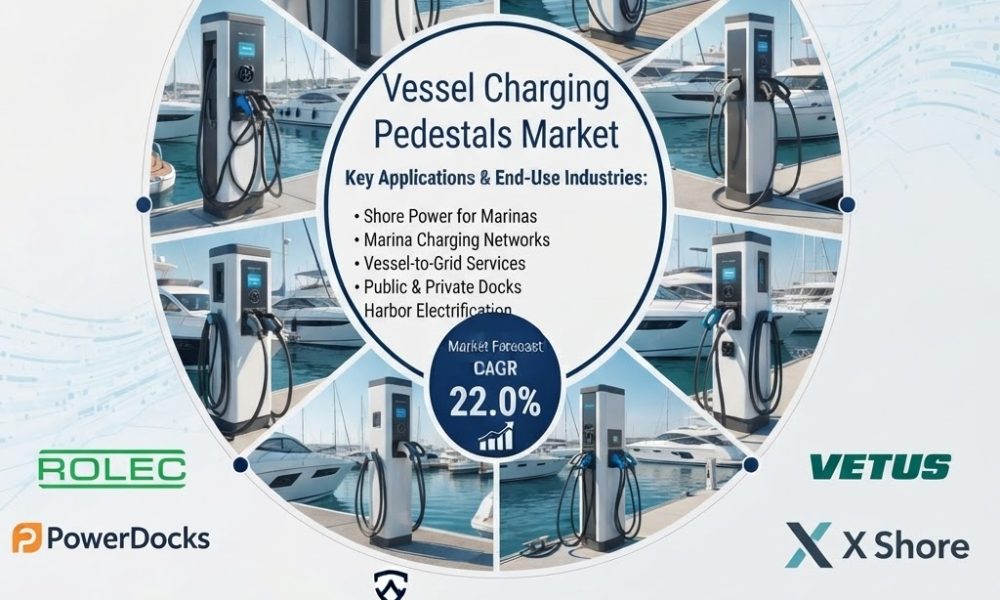
The global vessel charging pedestals market is projected to increase from USD 145 million in 2026 to USD 1,059.2 million by 2036, expanding at a 22.0% CAGR during the forecast period. The market reached USD 188.9 million in 2025, while the forecast indicates a USD 914 million absolute opportunity through 2036. Growth is being supported by rising electric vessel adoption, marina electrification, public investment in low-emission marine transport, and increasing use of smart energy management across waterfront charging infrastructure.
A specific industry development cited in the report is the Maritime and Port Authority of Singapore’s 2024 launch of the first pilot electric harbour craft charging point at Marina South Pier, using a 150 kW DC charging pedestal for electric vessels. The development illustrates the expansion of dedicated charging infrastructure for marine transport.
Get detailed market forecasts, competitive benchmarking, and pricing trends: https://www.factmr.com/connectus/sample?flag=S&rep_id=15466
Global Segment Leaders
- DC fast charging — 38.0% share in 2026: Operators are seeking shorter charging cycles between vessel departures, while faster charging can improve berth utilization during busy operating periods.
- Marinas — 36.0% share in 2026: Marinas remain a major deployment location as recreational boat owners increasingly require dedicated charging facilities and operators upgrade waterfront infrastructure.
- Leisure craft — 30.0% share in 2026: Electric propulsion is gaining adoption among private boat owners, supporting charging demand at recreational boating facilities.
- Smart metering — 35.0% share in 2026: Operators require accurate electricity measurement for billing and energy management, while metering also supports network planning.
- Marina operators — 34.0% share in 2026: Marina operators directly manage charging services for berth users and continue expanding charging facilities.
- Europe — 41.0% share in 2026: Strong policy support for electric boating projects is contributing to regional charging infrastructure development.
Country-Level Performance
| Country | CAGR | Key Growth Driver |
| United States | 23.0% | Marina electrification and electric boat adoption; public investment is improving waterfront infrastructure across coastal regions. |
| Norway | 22.7% | Electric ferries and battery-powered boats already play an important role in coastal transport, while marina operators continue expanding charging capacity. |
| Germany | 22.1% | Inland waterways and recreational boating facilities are adopting electric charging infrastructure amid waterfront modernization. |
| China | 21.5% | Coastal cities are increasing investment in electric marine transport and incorporating charging infrastructure into broader waterfront redevelopment. |
| India | 20.8% | Recreational boating infrastructure is gradually expanding across selected coastal destinations, while pilot electrification projects are increasing awareness of marine charging technology. |
Source note: The supplied report content does not provide a named external organization/statistic for each individual country driver. The driver descriptions above therefore use the report’s own country-wise analysis rather than introducing unsupported external sources.
Regional Context
The fastest-growing country markets are concentrated around regions where electric marine transport, marina modernization, and waterfront electrification are advancing. The United States leads the profiled countries at 23.0% CAGR, followed by Norway at 22.7% and Germany at 22.1%. Norway benefits from established electric marine transport, while Germany is seeing charging infrastructure adoption across inland waterways and recreational boating facilities.
China and India also represent high-growth markets, with CAGRs of 21.5% and 20.8%, respectively. China’s growth is linked to waterfront infrastructure investment and electric marine transport development, while India’s market is at an earlier stage, with marina modernization and pilot electrification projects supporting future demand.
The full report covers North America, Europe, East Asia, South Asia, Latin America, and the Middle East and Africa, with country-level coverage extending across 31+ countries.
Competitive Landscape
The competitive landscape includes Aqua superPower, Kempower, ABB, Siemens, Rolec, PowerDocks, VETUS, and X Shore. Aqua superPower focuses on marine charging networks, while Kempower brings fast-charging expertise to commercial marine applications. ABB and Siemens combine charging hardware with energy management capabilities, while Rolec develops charging equipment for waterfront and leisure applications. PowerDocks focuses on dedicated marine charging systems, VETUS participates through its electric propulsion portfolio and marina partnerships, and X Shore promotes compatible charging infrastructure alongside electric vessel adoption.
Recent developments cited in the report include the Maritime and Port Authority of Singapore’s 2024 launch of a pilot electric harbour craft charging point at Marina South Pier using a 150 kW DC charging pedestal. In 2025, IGY Marinas and Aqua superPower launched Sardinia’s first Aqua 75 marine fast-charging pedestal at IGY Portisco Marina. The report also cites Aqua superPower’s 2024 expansion of its commercial port charging services.
Top Trending Reports:
About Fact MR
Fact MR is a leading provider of market research and consulting services, offering syndicated and customized research across industries including marine transport, industrial infrastructure, and energy technology.



