
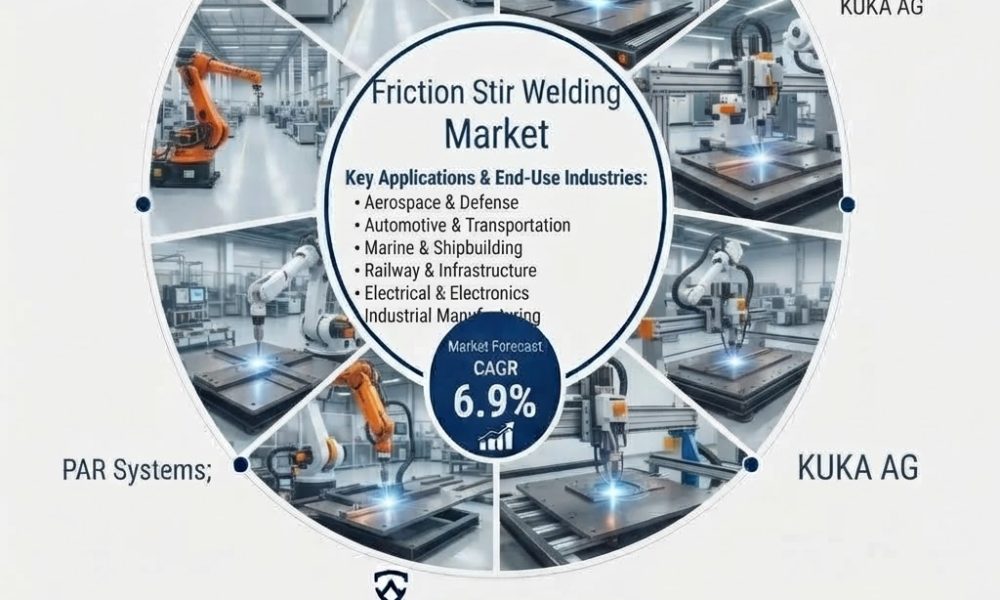
The global friction stir welding equipment market is projected to increase from USD 296.7 million in 2026 to USD 578.2 million by 2036, registering a 6.9% CAGR during the forecast period. The market crossed USD 277.5 million in 2025 and is expected to create an absolute opportunity of USD 281.5 million through 2036. Growth is being supported by demand for low-distortion solid-state joining in electric-vehicle battery structures, aerospace components, rail vehicles, and aluminum shipbuilding. The International Energy Agency reported that electric car sales exceeded 17 million in 2024, strengthening demand for repeatable welding of battery trays, cooling plates, and related structures.
Get detailed market forecasts, competitive benchmarking, and pricing trends: https://www.factmr.com/connectus/sample?flag=S&rep_id=15498
Global Segment Leaders
- Fixed FSW Equipment — 39% share in 2026: Fixed equipment leads the type segment because rigid machine structures and repeatable force control suit dedicated production programs.
- Aerospace — 30% share in 2026: Aerospace leads end use due to high-value aluminum structures and demanding qualification requirements for joining processes.
- Gantry and Portal FSW Systems — 33% share in 2026: These systems lead installation formats because their long travel ranges and reaction-force capacity support extended welding paths.
- Aluminum Alloys — 46% share in 2026: Aluminum remains the leading material focus because friction stir welding can produce long joints with controlled distortion without full melting.
Country-Level Performance
| Country | CAGR | Key Growth Driver |
| Argentina | 9.4% | Argentina’s government created a 50,000-unit annual electrified-vehicle import quota in 2025, providing a clearer mobility technology reference point for manufacturers. |
| India | 9.1% | The Press Information Bureau reported 4.4 million registered electric vehicles by March 2025, while local FSW machine capability supports equipment development. |
| China | 8.6% | Government data placed new-energy vehicle production near 13.02 million units during the first ten months of 2025, supporting demand for automated aluminum joining. |
| Brazil | 7.8% | Embraer delivered 244 aircraft during 2025, supporting aerospace-related demand for specialized joining equipment. |
| Japan | 7.4% | Yamazaki Mazak positions FSW solutions for battery cases, inverter cases, motor cases, and cooling components, supporting controlled cell integration. |
Regional Context
Argentina and India represent the fastest-growing country markets in the supplied analysis, with CAGRs of 9.4% and 9.1%, respectively. Argentina’s growth is linked to electrified-mobility investment and industrial equipment renewal, while India’s large vehicle-production base and domestic machine-building capability are supporting the movement from pilot weld development toward repeatable production cells.
China follows with an 8.6% CAGR, supported by high-volume new-energy vehicle production, battery structures, and supplier localization. Brazil is projected to grow at 7.8%, supported by aerospace manufacturing and transport-equipment investment, while Japan is forecast at 7.4% as automotive engineering depth and automation integration support tightly controlled joining cells.
The full report covers North America, Europe, Asia Pacific, Latin America, and the Middle East & Africa, with 22+ countries covered in the analysis.
Competitive Landscape
The competitive landscape includes ETA Technology, Yamazaki Mazak Corporation, FOOKE GmbH, PAR Systems, Grenzebach Maschinenbau GmbH, Stirtec GmbH, and KUKA AG. ETA Technology focuses on customized three-axis to five-axis FSW systems, while Yamazaki Mazak applies its machining-platform expertise to battery and thermal-management components. FOOKE addresses large travel ranges and high-performance machines for rail and aerospace structures, while PAR Systems provides aerospace and defense integration through its I-STIR platform.
Grenzebach supplies gantry and robot-based systems for aluminum joining, Stirtec provides vertical and horizontal machines alongside gantry formats, and KUKA focuses on robot-led cells and turnkey integration. In July 2025, KUKA received a follow-up order for twelve additional FSW cells following an earlier 23-cell program for a major automotive manufacturer. The cells are designed for electric-vehicle battery cases and cooling jackets, with training and acceptance support included.
Competition through 2036 is expected to center on force-control repeatability, qualification support, local tooling access, and service response. The report identifies high machine stiffness and fixture costs, safety-critical qualification cycles, process-force limits on flexible cells, and specialist tool-support requirements as key restraints.
Top Trending Reports:
About Fact MR
Fact MR is a leading provider of market research and consulting services, offering syndicated and customized research across industries including industrial manufacturing, automotive, and aerospace.



