
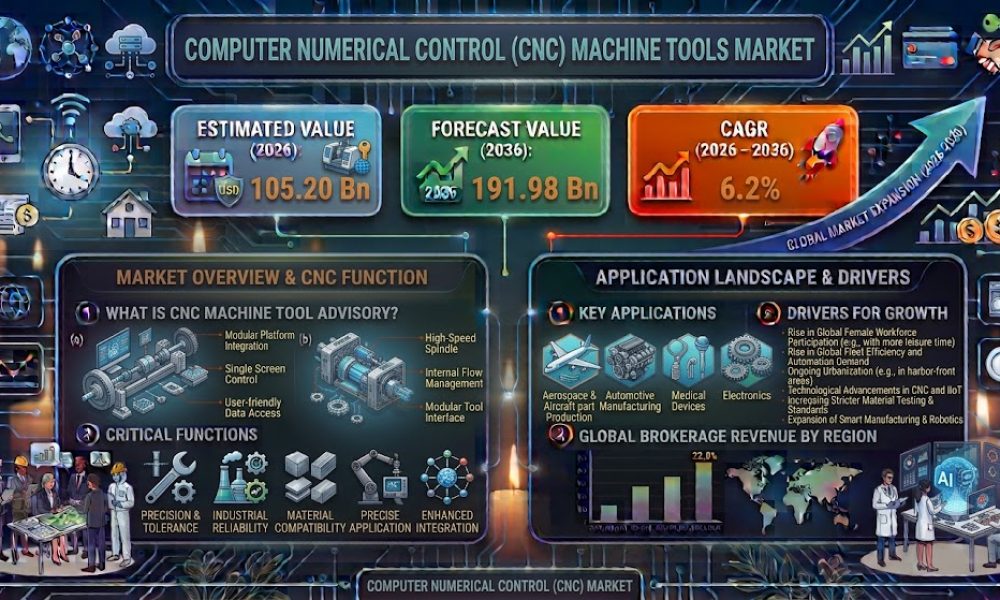
The global Computer Numerical Control (CNC) Machine Tools Market is projected to grow from USD 105.20 billion in 2026 to USD 191.98 billion by 2036, registering a 6.2% CAGR during the forecast period. The market crossed USD 99.1 billion in 2025 and is expected to create an absolute opportunity of USD 86.78 billion through 2036.
CNC machine tools are becoming central to automated manufacturing as automotive plants, aerospace manufacturers, precision job shops, and engineering companies seek repeatable machining, faster changeovers, and tighter dimensional control. Demand is also supported by multi-axis machining, connected CNC software, and growing use of automated production cells.
Get Detailed Market Forecasts, Competitive Benchmarking, and Pricing Trends: https://www.factmr.com/connectus/sample?flag=S&rep_id=15496
Global Segment Leaders
- CNC Systems lead the technology segment with 86% share in 2026, supported by programmable repeatability and easier integration with automated production cells.
- Metal Cutting CNC accounts for 75% share, driven by broad turning and milling requirements across industrial production.
- Closed-loop CNC Systems hold 57% share, reflecting demand for feedback control and tighter positioning accuracy.
- 3-Axis CNC represents 48% share, supported by its broad installed base across general machining and job shops.
- Automotive holds 40% share among end uses, driven by recurring component machining and frequent tooling changes.
Automation and Labor Pressure Support CNC Demand
Manufacturers are increasingly using CNC cells to extend productive hours while reducing the need for direct operator attention during stable machining cycles. Fact.MR identifies unattended machining and labor pressure as the strongest growth driver, with an estimated 0.9 percentage point impact on CAGR.
Automotive retooling and platform changes contribute another 0.7 percentage points, while multi-axis process consolidation adds 0.6 percentage points. Connected CNC software and diagnostics contribute an estimated 0.5 percentage point impact.
The need for flexible machining is particularly relevant to automotive production, where component programs can change with new vehicle platforms. In January 2026, China’s National Bureau of Statistics reported that automotive manufacturing value added increased 8.3% year over year in December 2025.
CNC connectivity is also expanding. NIST published a CNC digital twin study in December 2024 that mapped machine data into a virtual representation for monitoring and analysis. Such applications can help manufacturers use machine information for maintenance and process decisions.
CNC Retrofits and Five-Axis Machining Open New Opportunities
Existing-machine CNC control retrofits represent a major opportunity, with an estimated 0.5 percentage point impact on CAGR. Factories can extend the useful life of mechanically sound equipment by replacing obsolete controls rather than purchasing complete new machines.
Robot-tended machining cells offer another opportunity, contributing an estimated 0.4 percentage point CAGR impact. Automated loading and unloading can improve the utilization of stable CNC cycles, particularly when integrators combine robot interfaces, fixtures, guarding, and machine communication.
Five-axis machining is also gaining relevance for complex aerospace and precision-engineering parts. Completing more operations in one setup can reduce fixture transfers and alignment issues where component value and machining accuracy are critical.
However, CNC equipment remains a significant capital purchase. High capital cost and financing pressure has an estimated negative 0.6 percentage point impact on CAGR. Programming skill shortages, cybersecurity requirements, and uneven replacement cycles can further slow adoption.
Country-Level Performance
- India: The market is projected to grow at a 7.2% CAGR through 2036, the highest among the countries covered. Domestic machine-tool localization, automotive capacity expansion, and capital equipment investment are supporting demand. India’s Ministry of Heavy Industries reported that machine tool production rose significantly during fiscal 2024–25.
- China: Expected to record a 6.7% CAGR, supported by large-scale machinery production and factory automation programs. General-purpose machinery value added increased 7.5% year over year in December 2025, according to China’s National Bureau of Statistics.
- Saudi Arabia: Forecast to advance at 6.1% CAGR, driven by industrial diversification and new factory capacity. Manufacturing output increased 6.3% year over year in September 2025, according to GASTAT.
- Germany: Projected to expand at 5.9% CAGR, supported by precision engineering capabilities and replacement demand for aging equipment.
- Japan: Expected to register a 5.8% CAGR, shaped by export-oriented machine-tool production, replacement investment, and automation-intensive manufacturing.
Competitive Landscape
The CNC machine tools market includes controller specialists, integrated machine builders, and automation-focused equipment suppliers. Fact.MR profiles FANUC Corporation, Siemens AG, Mitsubishi Electric Corporation, Okuma Corporation, DMG MORI, Haas Automation, Inc., and DN Solutions.
FANUC offers scalable CNC control families covering basic applications and complex multi-axis machinery. Siemens combines CNC controls with broader industrial software and automation capabilities. Mitsubishi Electric also supplies CNC control products for high-performance machines, while Okuma integrates its controls with lathes and machining centers.
DMG MORI spans turning and milling equipment alongside automation options. Haas Automation focuses on standardized CNC mills and turning centers, while DN Solutions supplies turning centers, machining centers, and five-axis equipment.
A notable development occurred in January 2025, when Siemens launched the MACHINUM CNC portfolio at IMTEX, reporting potential setup-time reductions of up to 20%. In March 2025, Siemens also introduced the SINUMERIK Machine Tool Robot with Danobat and autonox for CNC-controlled robotic machining.
Analyst Perspective
Shambhu Nath Jha, Senior Analyst at Fact.MR, states:
“The real purchasing test now happens on the factory floor and not only on a controller specification sheet. Demand is expected to favor providers that reduce setup work while adding automation around existing machine families. Equipment builders should combine stable motion control with clear programming tools and local application support that continues through commissioning.”
The report’s analysis indicates that buyers are increasingly evaluating CNC equipment based on the complete production setup rather than controller specifications alone. Service response, programming support, robot compatibility, machine integration, and local application engineering can influence equipment acceptance.
Report Coverage
The Fact.MR study covers CNC machine tools used for programmable cutting and forming operations across industrial manufacturing and precision engineering. It analyzes CNC systems, conventional controls, and retrofit control packages.
The report covers metal cutting CNC and metal forming CNC, along with closed-loop, open-loop, PC-based, and retrofit architectures. Axis configurations include 3-axis, 4-axis, 5-axis, and multi-axis machining centers. End-use sectors include automotive, mechanical engineering, metal working, electrical industry, and aerospace.
The study is based on 140+ sources, 40+ company portfolios, 28+ countries, and 20+ interviews. Forecasting considers machine replacement cycles, industrial capital spending, automation attachment rates, controller mix, axis configuration, production indicators, service capacity, and provider validation.
Explore More Related Studies Published by Fact.MR Research:
HBM for Automotive AI Processor Market
EV Battery Current-Interrupt Devices Market
About Fact.MR
Fact.MR is a global market research and consulting firm, trusted by Fortune 500 companies and emerging businesses for reliable insights and strategic intelligence. With a presence across the U.S., UK, India, and Dubai, we deliver data-driven research and tailored consulting solutions across 30+ industries and 1,000+ markets. Backed by deep expertise and advanced analytics, Fact.MR helps organizations uncover opportunities, reduce risks, and make informed decisions for sustainable growth.



