
Vertical Farming Market Overview :
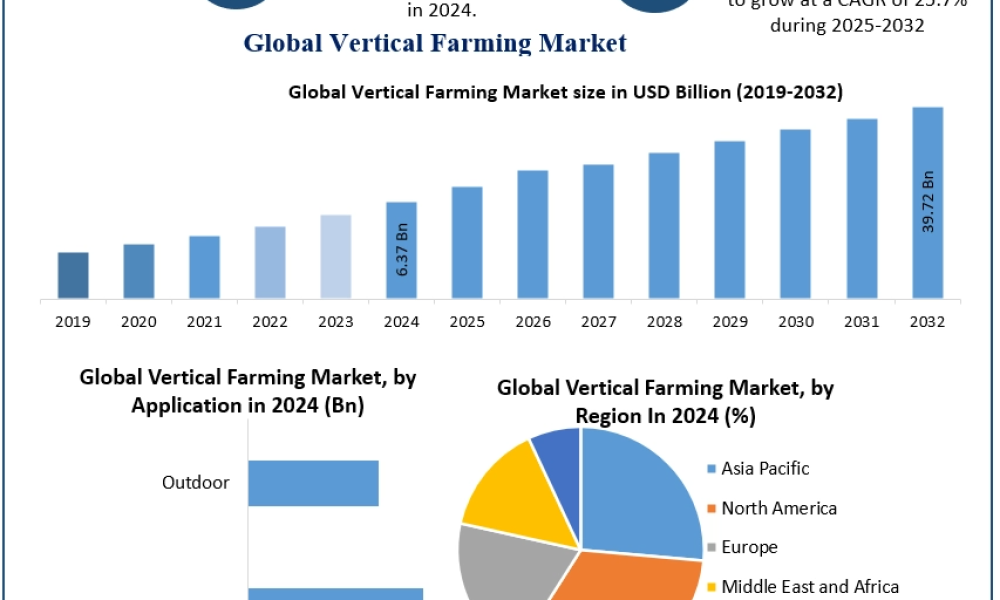
Vertical Farming Market, valued at USD 6.37 billion in 2024, is projected to grow at a robust CAGR of 25.7% from 2025 to 2032, reaching nearly USD 39.72 billion. This rapid growth is driven by increasing urbanization, shrinking arable land, and rising demand for sustainable, locally grown fresh produce. Technological advancements such as LED lighting, automation, and smart monitoring are enhancing operational efficiency and crop yields, making vertical farming a vital solution for future food security.
Key Highlights and Key Insights
- Global vertical farming market valued at USD 6.37 billion in 2024, expected to grow to USD 39.72 billion by 2032, marking a CAGR of 25.7%.
- Dominating Region: North America leads in market share due to advanced technological infrastructure, supportive government policies, and high consumer demand for fresh, sustainably grown produce.
- Asia Pacific is emerging as a rapid growth region, driven by population density, urban expansion, and increasing investments in food production innovations in China, Japan, and Southeast Asia.
- Leading Segment: Hydroponics dominates the growth mechanism segment, appreciated for high efficiency and resource conservation.
- Building-based vertical farming shows fastest growth among structural types due to cost-effectiveness and scalability in urban centers.
- Increasing consumer preference for organic, pesticide-free food and consistent year-round crop availability acts as a major market driver.
Recent Developments
- 2024-2025: Major companies such as AeroFarms, Plenty, Bowery Farming, and Gotham Greens are expanding operations, investing in automation, robotics, and AI technologies to optimize production.
- Governments across the US, Canada, and Europe are rolling out incentives and subsidies to promote vertical farming as part of urban agriculture and food security policies.
- Innovative projects demonstrate integration of vertical farms within smart city infrastructures, combining renewable energy and IoT-based environmental control.
- Advances in LED technology and climate control systems are improving energy efficiency and crop yields, attracting new investments in urban settings.
Market Dynamics
- Growth Drivers:
- Increasing urbanization leading to limited farmland availability, making vertical farming a critical alternative solution.
- Rising consumer awareness regarding food safety, freshness, and environmental sustainability.
- Technological advancements, including IoT, AI, and automated systems, enhancing precision farming and reducing labor costs.
- Growing demand for year-round production of leafy greens, herbs, fruits, and specialty crops.
- Challenges:
- High initial capital investment and operational costs for setting up vertical farming facilities.
- Complexity in managing optimal conditions for a wider variety of crops beyond leafy greens and herbs.
- Energy consumption concerns, although mitigated by renewable energy solutions and efficient lighting.
Regional Analysis
- North America: The largest market with strong venture capital investments, advanced research institutions, and a growing culture supporting local organic food production.
- Asia Pacific: Fastest-growing region owing to dense urban populations, government support to tackle food security challenges, and rapid adoption of innovative agricultural technologies.
- Europe: Steady growth driven by sustainability policies, environmental regulations, and expanding organic food market.
- Latin America and Middle East & Africa: Emerging regions with increasing interest in urban agriculture and government-led sustainability initiatives.
Product Segmentation
By Growth Mechanism:
- Hydroponics (dominant, favored for efficiency and ease of use)
- Aeroponics
- Aquaponics
By Structure:
- Building-based vertical farms (fastest growth, ideal for urban settings)
- Container-based vertical farms (portable, scalable, cost-efficient)
By Application:
- Indoor farming (expanding rapidly due to urban demand and controlled environment benefits)
- Outdoor vertical farming
Ask for Sample to Know US Tariff Impacts on Modular Construction Market @ Sample Link : @https://www.maximizemarketresearch.com/request-sample/15221/
Key Trends
- Rising incorporation of smart sensors and IoT devices for precise nutrient, water, and environmental control.
- Increasing integration of artificial intelligence and robotics to automate planting, monitoring, and harvesting processes.
- Growing emphasis on cultivating a wider variety of crops including fruits like strawberries and high-value herbs.
- Deployment of renewable energy solutions to minimize carbon footprint and operational costs.
- Collaborative urban farming projects linking vertical farms with retail, restaurants, and local communities.
Quote
Vertical farming is revolutionizing urban food production by providing a sustainable, high-yield alternative to traditional agriculture. North America’s leadership is rooted in technological innovation and extensive support for sustainable farming solutions, while Asia Pacific’s rapid urban growth offers enormous scalability potential for this transformative industry.
About Us




