
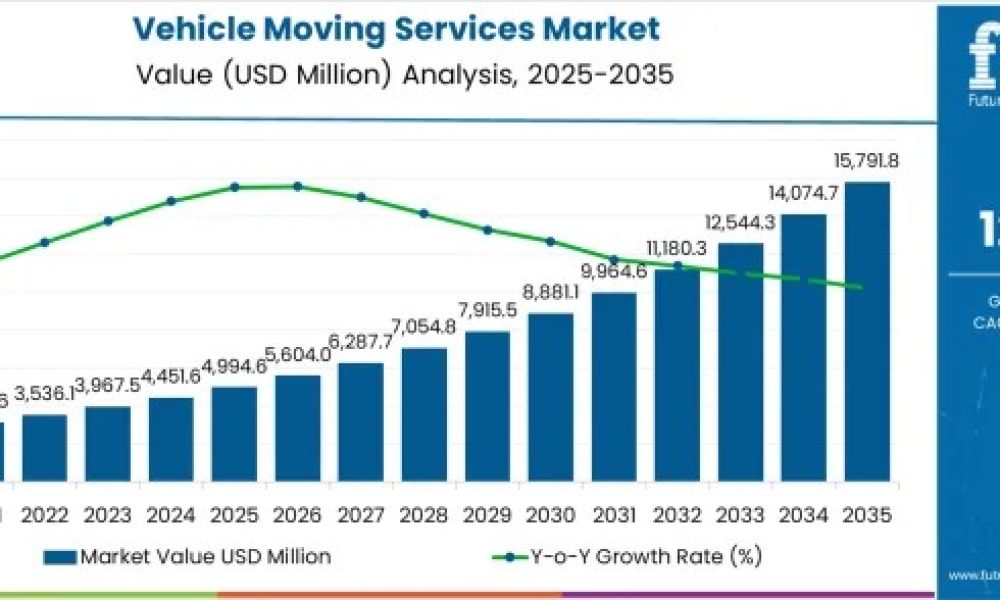
The global vehicle moving services market is entering a phase of accelerated expansion, driven by rising automotive production, growing consumer mobility, and rapid advancements in logistics technology. Valued at USD 4,994.6 million in 2025, the market is projected to reach USD 15,791.8 million by 2035, registering a robust compound annual growth rate (CAGR) of 12.2% over the forecast period. This strong trajectory reflects the increasing strategic importance of reliable, technology-enabled vehicle transportation across automotive manufacturing, relocation services, and e-commerce-driven vehicle sales.
Vehicle moving services play a critical role in modern automotive supply chains, enabling the seamless transport of passenger vehicles, commercial fleets, and specialty automobiles between factories, ports, dealerships, and end users. As vehicle ownership rises globally and distribution networks become more complex, demand for professional, secure, and time-efficient vehicle transportation solutions continues to intensify.
Automotive Manufacturing and Consumer Mobility Fuel Demand
The automobile manufacturing industry, accounting for approximately 45% of total market demand, remains the single largest application segment. With global vehicle production expanding across both established and emerging markets, manufacturers increasingly rely on specialized vehicle moving services to transport finished vehicles from production facilities to dealer networks and export hubs. This dependence is further amplified by the globalization of automotive supply chains, which requires cross-border transportation, regulatory compliance, and precise coordination.
Get access to comprehensive data tables and detailed market insights — request your sample report today!
In parallel, shifting consumer mobility patterns are reshaping demand dynamics. Urbanization, job-related relocations, and lifestyle-driven moves are increasing the need for personal vehicle relocation services. At the same time, the rise of e-commerce and direct-to-consumer automotive sales models is transforming delivery expectations, creating new opportunities for service providers capable of offering door-to-door transport, real-time tracking, and flexible scheduling.
Basic Transportation Services Dominate, While Premium Segments Gain Momentum
By classification, basic transportation services represent the backbone of the industry, accounting for nearly 60% of the market in 2025. These services include standard offerings such as open-carrier transport, enclosed transport, and terminal-to-terminal delivery, which cater to both automotive manufacturers and individual consumers. Their dominance is supported by standardized operating procedures, cost efficiencies achieved through scale, and widespread geographic availability.
However, special transportation services are emerging as a high-growth segment. Encompassing enclosed transport, expedited delivery, white-glove handling, and classic or luxury vehicle transportation, this segment addresses the needs of premium customers and specialized automotive applications. Growing luxury vehicle sales, an expanding classic car market, and heightened consumer expectations for secure, insured transport are driving above-average growth in this category, positioning it as a key value-creation opportunity within the broader market.
Technology Integration Reshapes Service Delivery
Technological advancement is a defining force in the evolution of the vehicle moving services market. The integration of GPS tracking, real-time monitoring, automated scheduling, and route optimization systems is significantly improving operational efficiency and service transparency. These technologies allow providers to optimize carrier utilization, reduce delivery times, and offer customers accurate, real-time updates on vehicle status.
Digital platforms and mobile applications are further enhancing market accessibility by simplifying booking processes, enabling price comparisons, and facilitating seamless communication between service providers and customers. Looking ahead, innovations such as automated vehicle transport solutions, including self-driving trucks and advanced fleet management systems, are expected to further disrupt traditional logistics models and improve cost efficiency.
Asia Pacific Leads Growth as Emerging Markets Surge
Regionally, Asia Pacific represents the fastest-growing market, supported by rapid industrialization, expanding automotive production, and rising vehicle ownership. China, with a projected CAGR of 16.5% through 2035, leads global growth, driven by its position as the world’s largest automotive manufacturing hub, extensive urbanization, and increasing consumer demand for both dealer distribution and personal vehicle relocation services.
India follows closely with 15.3% CAGR, fueled by growing automotive manufacturing capacity, improving logistics infrastructure, and rising disposable incomes. In Europe, Germany stands out with 14.0% CAGR, benefiting from advanced automotive manufacturing, sophisticated logistics networks, and its strategic position as a central European distribution hub. Brazil records 12.8% growth, reflecting domestic automotive expansion and improving transportation infrastructure, while the United States, growing at 11.6%, is driven by interstate relocation trends and the rapid rise of e-commerce vehicle sales.
Personalize Your Experience: Ask for Customization to Meet Your Requirements
Competitive Landscape Focused on Scale, Service Quality, and Technology
The vehicle moving services market features a competitive landscape of approximately 12–15 key players, with the top five accounting for 55–60% of global market share. Competition increasingly centers on service reliability, delivery speed, insurance coverage, and digital capabilities rather than price alone.
Leading providers such as AGS International Movers, Allied Van Lines, Links Moving, and ReloSmart Movers Hong Kong leverage extensive global networks and comprehensive service portfolios to address both consumer and commercial requirements. Other players, including Atlas, Montway Auto Transport, Mayflower, AnyVan, PODS, Lalamove, and United Van Lines, differentiate through flexible service models, technology-driven platforms, and specialized offerings for urban and last-mile vehicle transport.
Outlook
As automotive production scales globally and consumer expectations evolve toward greater transparency, speed, and reliability, the vehicle moving services market is positioned for sustained double-digit growth. Continued investment in digital platforms, fleet modernization, and premium service capabilities will be critical for providers seeking to capitalize on expanding opportunities across manufacturing, logistics, and consumer relocation segments. Comprehensive market intelligence reveals how regional dynamics, technology adoption, and service differentiation will shape competitive advantage in this rapidly evolving global market.
About Future Market Insights (FMI)
Future Market Insights, Inc. (FMI) is an ESOMAR-certified, ISO 9001:2015 market research and consulting organization, trusted by Fortune 500 clients and global enterprises. With operations in the U.S., UK, India, and Dubai, FMI provides data-backed insights and strategic intelligence across 30+ industries and 1200 markets worldwide.



