
The vector network analyzer (VNA) market plays a vital role in the global electronics, telecommunications, aerospace, and defense ecosystems by enabling precise measurement of radio frequency (RF) and microwave components. Vector network analyzers are essential test and measurement instruments used to evaluate network parameters—commonly known as S-parameters—such as reflection, transmission, impedance, and return loss. These measurements are critical for validating the performance, reliability, and compliance of RF components and systems.
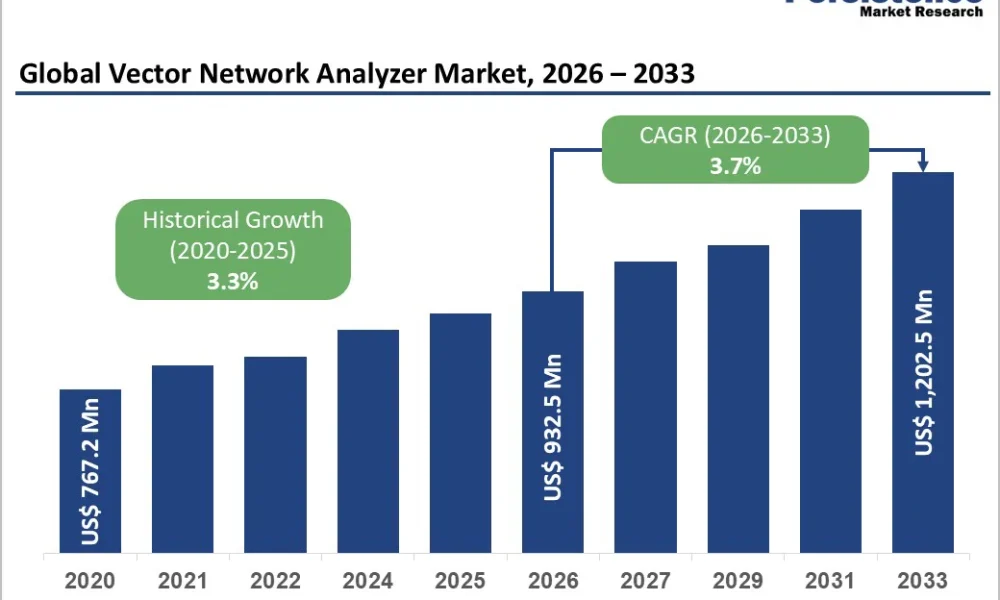
The global vector network analyzer market size is likely to be valued at US$ 932.5 million in 2026 and is expected to reach US$ 1,202.5 million by 2033, growing at a CAGR of 3.7% during the forecast period from 2026 to 2033. Market growth is primarily driven by the rapid rollout of 5G networks, rising demand for RF component characterization in electronics and telecommunications, and continuous advancements in high-frequency measurement technologies. As wireless systems become more complex and operate at higher frequencies, VNAs remain indispensable tools across R&D, manufacturing, and quality assurance environments.
Market Statistics, Growth Drivers, and Leading Segments
The increasing complexity of modern communication systems is pushing demand for highly accurate and repeatable RF testing solutions. Telecommunications providers and equipment manufacturers require precise S-parameter analysis to ensure optimal performance of antennas, filters, amplifiers, and transmission lines used in 5G and emerging wireless standards. At the same time, aerospace and defense applications rely heavily on VNAs to validate radar, satellite, and electronic warfare systems where measurement accuracy is mission critical.
From a segmentation standpoint, the 1 GHz to 5 GHz frequency range dominates the market, holding approximately 35% share in 2026, as it supports widely used bands for Wi-Fi, LTE, and standard communication systems. In terms of application, electronics and telecommunications account for over 50% of market revenue, driven by extensive component validation and system-level testing. Geographically, North America leads the market with an estimated 38% share in 2026, supported by advanced RF research, widespread 5G deployment, and strong R&D activity in the United States.
Key Highlights from the Vector Network Analyzer Market Report
- The global vector network analyzer market is projected to grow from US$ 932.5 million in 2026 to US$ 1,202.5 million by 2033.
- Rising demand for 5G testing and RF component characterization is driving steady market growth.
- North America dominates the market due to advanced telecom infrastructure and strong aerospace and defense R&D.
- Asia Pacific is the fastest-growing region, supported by electronics manufacturing and telecom investments.
- VNAs operating in the 1 GHz to 5 GHz range remain the most widely adopted product category.
- Millimeter-wave and AI-enhanced VNAs present strong future growth opportunities.
Vector Network Analyzer Market Segmentation Analysis
The vector network analyzer market is segmented based on frequency range, application, and end-user industry, reflecting diverse testing requirements across sectors. By frequency range, the market includes VNAs operating below 1 GHz, 1–5 GHz, 6–10 GHz, and above 15 GHz. The 1–5 GHz segment dominates due to its relevance to mainstream wireless technologies, while higher-frequency VNAs are gaining traction in advanced applications such as 5G millimeter-wave testing and automotive radar development.
By application, the market spans electronics and telecommunications, aerospace and defense, automotive, research institutions, and industrial manufacturing. Electronics and telecommunications lead due to large-scale production and validation of RF components. Aerospace and defense represent a high-value segment where precision and reliability are critical. Automotive applications are expanding rapidly as advanced driver-assistance systems (ADAS) and radar-based sensing technologies become standard features in modern vehicles.
Regional Insights and Market Trends
North America remains the leading regional market for vector network analyzers, driven by early adoption of advanced wireless technologies and strong government and private-sector investments in RF research. The United States hosts a concentration of leading test and measurement equipment manufacturers and benefits from sustained defense spending, which supports demand for high-performance VNAs across military and aerospace programs.
Asia Pacific is emerging as the fastest-growing regional market, fueled by increasing electronics manufacturing, rising awareness of advanced test equipment, and growing telecom investments in China and India. The region’s expanding role in global semiconductor and electronics supply chains is accelerating demand for VNAs in both R&D and production environments. Automotive radar development and 5G infrastructure expansion further strengthen growth prospects across Asia Pacific.
Elevate your business strategy with comprehensive market data. Request a sample report now: https://www.persistencemarketresearch.com/samples/14686
Market Drivers Accelerating Industry Growth
One of the primary drivers of the vector network analyzer market is the rapid rollout of 5G networks worldwide. 5G introduces higher frequencies, wider bandwidths, and more complex modulation schemes, all of which require precise RF testing and validation. VNAs are essential for characterizing antennas, filters, and RF front-end modules used in 5G base stations and user devices.
Another key driver is the growing demand for accurate RF characterization in aerospace and defense applications. Radar systems, satellite communications, and electronic warfare platforms depend on precise S-parameter measurements to ensure performance and reliability. As defense systems evolve toward higher frequencies and greater integration, the need for advanced VNAs continues to rise.
Market Restraints Impacting Adoption
Despite steady demand, the vector network analyzer market faces certain challenges. High equipment costs can be a barrier for smaller manufacturers, academic institutions, and emerging-market users. Advanced VNAs, particularly those supporting millimeter-wave frequencies, require significant capital investment, which can limit adoption in cost-sensitive environments.
Another restraint is the growing complexity of RF measurement setups. Operating high-frequency VNAs requires skilled personnel and careful calibration to achieve accurate results. The shortage of experienced RF engineers in some regions can slow adoption and increase training costs. Additionally, competition from alternative testing methods and multifunction instruments may limit market expansion in certain use cases.
Market Opportunities and Future Outlook
The expansion of millimeter-wave testing represents one of the most significant growth opportunities for the vector network analyzer market. As 5G evolves toward higher frequency bands and early research into 6G begins, demand for VNAs capable of operating above 15 GHz is expected to rise sharply. These high-frequency instruments are critical for validating next-generation wireless components and systems.
Another promising opportunity lies in the integration of AI-enhanced analytics within VNAs. Artificial intelligence and machine learning can automate calibration, anomaly detection, and data interpretation, reducing testing time and improving accuracy. AI-driven VNAs are particularly attractive for high-volume manufacturing and complex system validation, where efficiency and consistency are paramount.
Reasons to Buy the Vector Network Analyzer Market Report
✔ Gain detailed insights into current and future market size, trends, and growth forecasts through 2033
✔ Understand key drivers, restraints, and opportunities shaping the global VNA industry
✔ Analyze market segmentation by frequency range, application, and end-user industry
✔ Identify leading and fastest-growing regions for strategic investment
✔ Access competitive intelligence and recent developments from major test equipment vendors
Company Insights: Key Players in the Vector Network Analyzer Market
- Keysight Technologies
- Rohde & Schwarz
- Anritsu Corporation
- Copper Mountain Technologies
- National Instruments
- Tektronix (Fortive Corporation)
- Advantest Corporation
- Boonton Electronics
- Siglent Technologies
- Ceyear Technologies
Recent Developments:
- Leading manufacturers are expanding compact, high-frequency VNAs to support millimeter-wave and automotive radar testing.
- Test equipment vendors are integrating AI-driven features to enhance measurement accuracy, automation, and usability.
Conclusion
The vector network analyzer market remains a cornerstone of the global RF and microwave testing ecosystem, supporting critical applications across telecommunications, aerospace, defense, electronics, and automotive industries. While market growth is moderate, sustained demand from 5G deployment, advanced RF research, and high-frequency system development ensures long-term relevance.
As wireless technologies continue to evolve toward higher frequencies and greater complexity, VNAs will play an increasingly important role in enabling innovation and ensuring performance reliability. Vendors that invest in millimeter-wave capabilities, AI-enhanced analytics, and user-friendly designs will be best positioned to capitalize on emerging opportunities through 2033 and beyond.
Related Reports:




