
The global risk analytics market has become a critical pillar of modern enterprise decision-making as organizations navigate an increasingly complex and uncertain operating environment. Risk analytics involves the use of advanced data analytics, statistical modeling, artificial intelligence (AI), and machine learning to identify, assess, and mitigate financial, operational, regulatory, and strategic risks. These solutions enable organizations to move from reactive risk management to proactive and predictive risk intelligence.
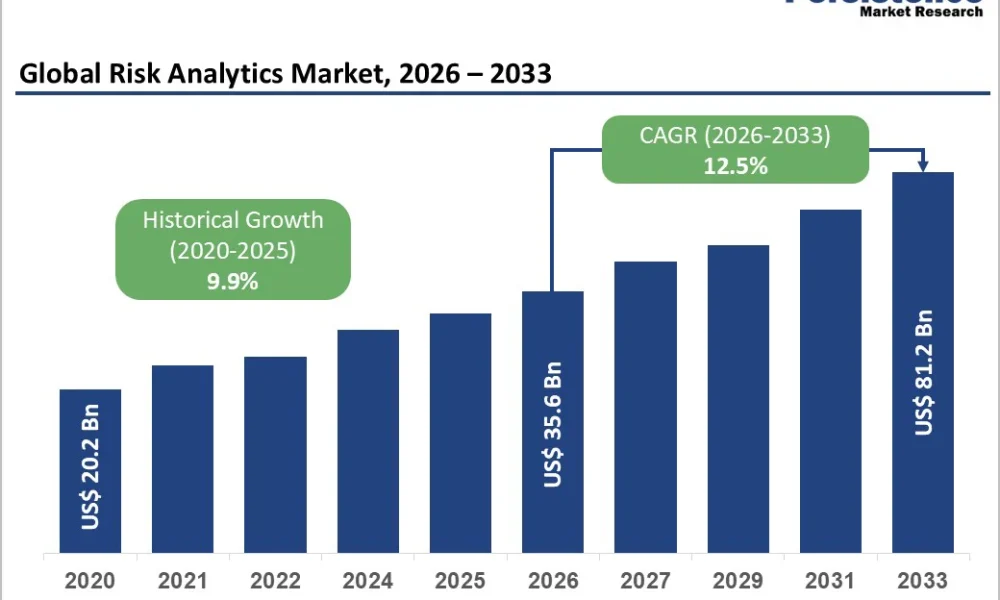
The global risk analytics market is likely to be valued at US$ 35.6 billion in 2026 and is projected to reach US$ 81.2 billion by 2033, growing at a strong CAGR of 12.5% during the forecast period from 2026 to 2033. Market growth is driven by rising regulatory complexity, exponential growth in structured and unstructured data, and accelerating digital transformation across industries. As enterprises face heightened scrutiny around compliance, cybersecurity, and ESG risks, demand for sophisticated risk analytics platforms continues to rise.
Market Statistics, Growth Drivers, and Leading Segments
Organizations across sectors are increasingly relying on risk analytics to manage multifaceted risk landscapes spanning credit, fraud, cyber threats, supply chain disruptions, and climate-related exposures. Regulatory bodies worldwide are enforcing stricter compliance mandates, compelling enterprises to adopt robust analytics solutions that ensure transparency, traceability, and audit readiness. At the same time, real-time analytics capabilities are becoming essential as risk events evolve faster than traditional monitoring systems can handle.
From a segmentation standpoint, risk analytics solutions (software) are expected to dominate the market in 2026, as enterprises prioritize integrated platforms that deliver real-time insights and predictive risk modeling. In terms of deployment, on-premises solutions are projected to hold around 67.6% revenue share in 2026, particularly in highly regulated industries. Geographically, North America leads the market due to advanced analytics adoption and regulatory maturity, while Asia Pacific is expected to register the highest CAGR through 2033, driven by fintech expansion and digital modernization.
Key Highlights from the Risk Analytics Market Report
- The global risk analytics market is projected to grow from US$ 35.6 billion in 2026 to US$ 81.2 billion by 2033.
- Increasing regulatory compliance requirements are a primary driver of market expansion.
- Risk analytics solutions dominate the market, while services represent the fastest-growing segment.
- On-premises deployment remains prevalent, though cloud-based platforms are gaining rapid traction.
- BFSI is the leading vertical due to its high exposure to financial and compliance risks.
- Asia Pacific is expected to witness the fastest growth due to digitization and regulatory modernization.
Risk Analytics Market Segmentation Analysis
The risk analytics market is segmented based on solution type, deployment mode, and industry vertical, each reflecting distinct enterprise requirements. By solution type, the market includes software solutions and professional services. Software platforms dominate due to their ability to deliver automated risk assessment, real-time monitoring, scenario modeling, and regulatory reporting within a unified framework. Services, including consulting, integration, and managed analytics, are expanding rapidly as organizations seek tailored implementations.
By deployment mode, the market is divided into on-premises and cloud-based risk analytics solutions. On-premises deployments remain dominant, particularly in BFSI and government sectors, due to data security and compliance considerations. However, cloud deployment is growing at the fastest pace as enterprises seek scalability, faster deployment, and lower infrastructure costs. Industry-wise, BFSI leads adoption, followed by healthcare, IT & telecom, manufacturing, energy, and retail, each facing distinct operational and regulatory risks.
Elevate your business strategy with comprehensive market data. Request a sample report now: https://www.persistencemarketresearch.com/samples/4801
Regional Insights and Market Trends
North America holds the largest share of the risk analytics market, supported by strong regulatory frameworks, early adoption of advanced analytics, and the presence of leading technology vendors. Financial institutions in the U.S. and Canada are leveraging AI-driven risk analytics to enhance fraud detection, credit risk management, and regulatory compliance in real time.
Asia Pacific is poised to be the fastest-growing region during the forecast period. Rapid digitalization, expanding fintech ecosystems, and evolving regulatory standards in countries such as China, India, and Southeast Asian economies are accelerating adoption. Organizations across the region are investing in cloud-native risk analytics platforms to manage growing data volumes and emerging cyber and ESG risks.
Market Drivers Accelerating Industry Growth
One of the primary drivers of the risk analytics market is the rising complexity of regulatory compliance across global industries. Financial institutions and enterprises must comply with constantly evolving regulations related to data protection, financial reporting, and ESG disclosures. Risk analytics solutions provide automated compliance monitoring, reporting, and audit capabilities, reducing manual effort and regulatory exposure.
Another key driver is the explosion of data generated by digital business models. Organizations are dealing with massive volumes of structured and unstructured data from transactions, customer interactions, IoT systems, and external sources. Advanced analytics tools enable enterprises to transform this data into actionable risk insights, improving decision-making speed and accuracy.
Market Restraints Impacting Adoption
Despite strong growth potential, the risk analytics market faces several challenges. High implementation and integration costs can be a barrier, particularly for small and mid-sized enterprises. Deploying advanced analytics platforms often requires significant upfront investment, skilled personnel, and ongoing maintenance, which can limit adoption.
Data privacy and security concerns also restrain market growth. Handling sensitive financial and personal data increases exposure to cyber threats and compliance risks. Additionally, resistance to organizational change and lack of analytics maturity in some industries can slow the transition from traditional risk management approaches to advanced analytics-driven models.
Market Opportunities and Future Outlook
The increasing adoption of cloud-native and real-time risk analytics platforms presents a significant growth opportunity. Cloud-based solutions offer scalability, flexibility, and faster deployment, making advanced risk analytics accessible to a broader range of organizations. Vendors that deliver secure, compliant, and interoperable cloud solutions are well-positioned to capture emerging demand.
Another major opportunity lies in the integration of AI, machine learning, and ESG-focused risk analytics. As climate risks, social responsibility, and governance transparency gain prominence, organizations require analytics tools capable of modeling long-term, non-financial risks. Providers that incorporate ESG intelligence into their risk platforms will gain a strong competitive advantage.
Reasons to Buy the Risk Analytics Market Report
✔ Gain in-depth insights into market size, trends, and growth forecasts through 2033
✔ Understand key drivers, restraints, and opportunities shaping the global risk analytics landscape
✔ Analyze market segmentation by solution type, deployment mode, and industry vertical
✔ Identify leading and high-growth regions for strategic expansion
✔ Access competitive intelligence and recent developments from major market players
Company Insights: Key Players in the Risk Analytics Market
- SAS Institute Inc.
- IBM Corporation
- Oracle Corporation
- SAP SE
- Moody’s Analytics
- FICO
- Experian plc
- NICE Actimize
- Accenture
- Deloitte
Recent Developments:
- Leading vendors are expanding AI-driven and real-time risk analytics capabilities to address emerging cyber and ESG risks.
- Strategic partnerships between analytics providers and cloud platforms are accelerating the adoption of scalable, cloud-native risk solutions.
Conclusion
The risk analytics market is rapidly evolving as organizations confront growing uncertainty, regulatory pressure, and data complexity. Advanced risk analytics solutions enable enterprises to anticipate threats, ensure compliance, and make informed strategic decisions in real time. As digital transformation deepens across industries, the importance of predictive and prescriptive risk intelligence continues to grow.
With strong demand from BFSI, expanding adoption across other industries, and rising interest in cloud and ESG-focused analytics, the market is poised for sustained double-digit growth through 2033. Enterprises that invest in modern risk analytics platforms will be better equipped to enhance resilience, protect value, and thrive in an increasingly volatile global business environment.
Related Reports:




