
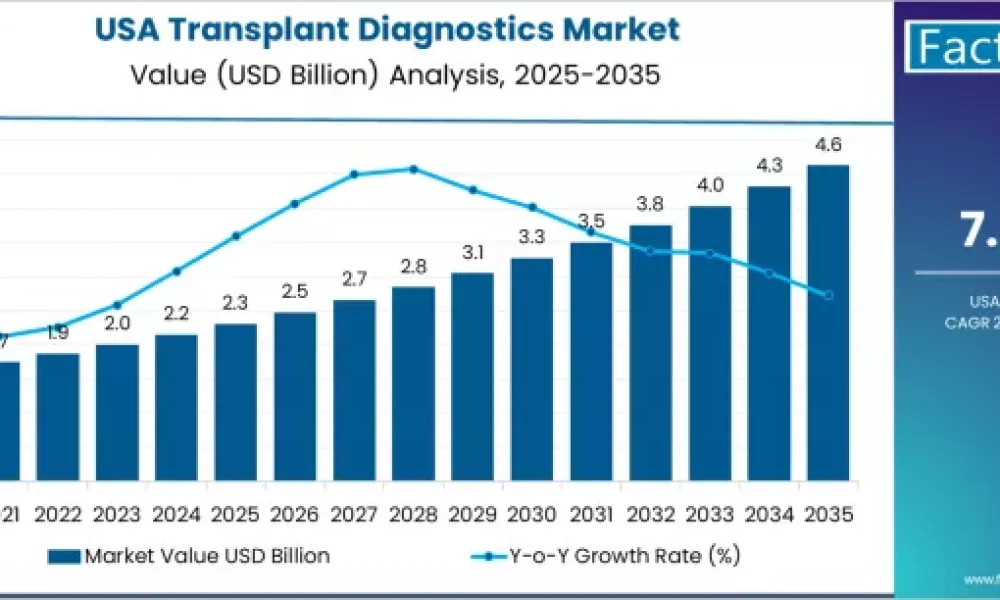
The United States transplant diagnostics market is set for strong and sustained growth, driven by rising organ transplant procedures, advancements in molecular diagnostics, and increasing emphasis on early graft rejection detection. According to Fact.MR, demand for transplant diagnostics in the USA is projected to grow from USD 2.31 billion in 2025 to approximately USD 4.73 billion by 2035, registering an absolute increase of USD 2.42 billion over the forecast period. This reflects a total growth of 104.8%, with the market expanding at a CAGR of 7.20% from 2025 to 2035.
Transplant diagnostics play a critical role in pre- and post-transplant care by enabling accurate donor–recipient matching, monitoring immune response, and detecting early signs of organ rejection—significantly improving long-term transplant outcomes.
To access the complete data tables and in-depth insights, request a Discount On The Report here: https://www.factmr.com/connectus/sample?flag=S&rep_id=12457
Key Market Drivers
Rising Organ Transplant Procedures Across the USA
The growing prevalence of chronic kidney disease, liver failure, heart disease, and lung disorders is increasing demand for organ transplantation nationwide. As transplant volumes rise, so does the need for advanced diagnostic tools that ensure compatibility, reduce rejection risk, and improve patient survival rates.
Advancements in Molecular and Genetic Diagnostics
Rapid progress in molecular testing—such as HLA typing, PCR-based assays, next-generation sequencing (NGS), and donor-derived cell-free DNA (dd-cfDNA) testing—is transforming transplant diagnostics. These technologies enable more precise immune monitoring and earlier detection of graft injury, driving higher adoption across U.S. transplant centers.
Growing Focus on Early Rejection Detection and Personalized Care
Healthcare providers are increasingly prioritizing non-invasive and real-time diagnostic solutions to detect acute and chronic rejection at earlier stages. Personalized immunosuppressive therapy, guided by diagnostic insights, is becoming a standard of care in U.S. transplant medicine.
Favorable Healthcare Infrastructure and Reimbursement Landscape
The United States benefits from a well-established transplant ecosystem, advanced laboratory infrastructure, and supportive reimbursement policies for diagnostic testing. This environment accelerates the adoption of innovative transplant diagnostic platforms.
Market Segmentation Insights
By Product Type
- Molecular Assays & Reagents – Dominant segment due to widespread use in HLA typing and immune monitoring
- Sequencing-Based Diagnostics – Rapid growth driven by precision medicine and genomic analysis
- Non-Invasive Biomarker Tests – Increasing adoption for post-transplant surveillance
By Application
- Pre-Transplant Diagnostics – Donor–recipient matching and compatibility testing
- Post-Transplant Monitoring – Largest and fastest-growing segment due to ongoing rejection surveillance
- Infectious Disease Testing – Critical for immunocompromised transplant patients
By End User
- Hospitals & Transplant Centers – Primary consumers of transplant diagnostics
- Clinical Laboratories – Expanding role in specialized molecular testing
- Research Institutes – Supporting innovation and clinical validation
Market Challenges
Despite strong growth prospects, the U.S. transplant diagnostics market faces certain challenges:
- High Cost of Advanced Diagnostic Tests
- Complex Regulatory Approval Processes
- Limited Awareness of Novel Non-Invasive Technologies
- Need for Skilled Personnel to Interpret Complex Molecular Data
Addressing these challenges through cost optimization, clinician education, and technology standardization will be key to sustained market expansion.
Competitive Landscape
The U.S. transplant diagnostics market is moderately consolidated, with leading players focusing on technological innovation, test accuracy, and faster turnaround times. Companies are investing in AI-driven diagnostics, expanded test menus, and strategic partnerships with transplant centers.
Key Market Players Include:
- CareDx
- Thermo Fisher Scientific
- Roche Diagnostics
- Abbott Laboratories
- Bio-Rad Laboratories
- Illumina
These companies are strengthening their U.S. presence through product launches, acquisitions, and collaborations with healthcare providers.
Future Outlook: Precision Diagnostics at the Core of Transplant Success
Over the next decade, transplant diagnostics in the USA will evolve toward highly precise, minimally invasive, and data-driven solutions. As transplant volumes increase and precision medicine becomes integral to clinical practice, diagnostic technologies will play a central role in improving graft longevity and patient quality of life.
Manufacturers that invest in next-generation molecular diagnostics, automation, and clinical validation will be best positioned to capitalize on the rapidly expanding U.S. transplant diagnostics market.
Have a specific Requirements and Need Assistant on Report Pricing or Limited Budget please contact us – [email protected]
About Fact.MR
Fact.MR is a global market research and consulting firm, trusted by Fortune 500 companies and emerging businesses for reliable insights and strategic intelligence. With a presence across the U.S., UK, India, and Dubai, we deliver data-driven research and tailored consulting solutions across 30+ industries and 1,000+ markets. Backed by deep expertise and advanced analytics, Fact.MR helps organizations uncover opportunities, reduce risks, and make informed decisions for sustainable growth.



