
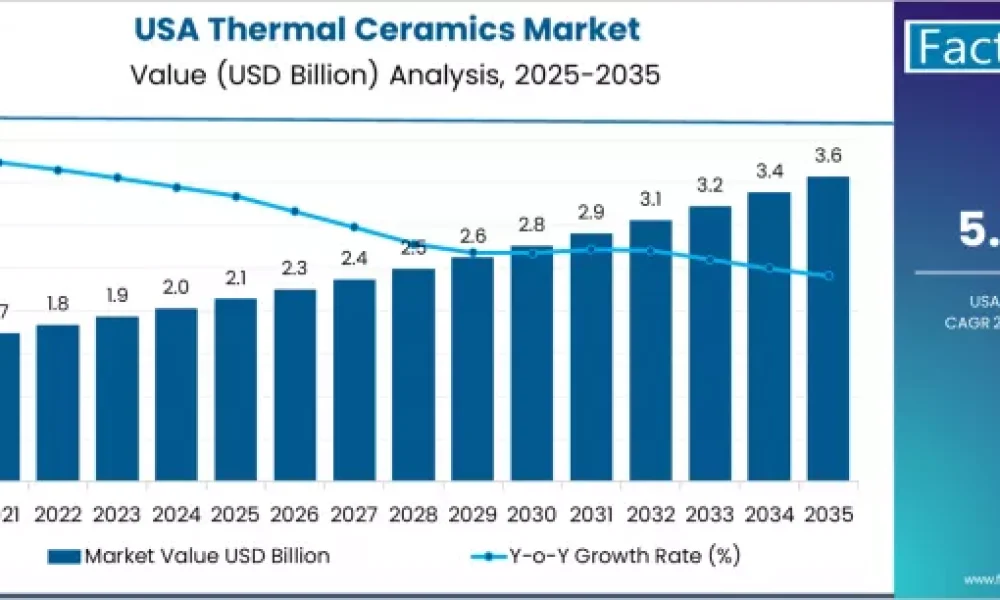
The United States thermal ceramics market is set for steady and sustained growth over the next decade, supported by rising demand for high-temperature insulation, expanding industrial manufacturing, and stricter energy-efficiency regulations. According to a recent analysis by Fact.MR, demand for thermal ceramics in the USA is projected to increase from USD 2.14 billion in 2025 to approximately USD 3.57 billion by 2035, registering an absolute growth of USD 1.43 billion over the forecast period.
This expansion reflects a total growth of 66.8%, with demand expected to rise at a compound annual growth rate (CAGR) of 5.3% from 2025 to 2035. The market outlook is strongly influenced by increased use of thermal ceramics across energy-intensive industries such as metallurgy, petrochemicals, power generation, and aerospace.
To access the complete data tables and in-depth insights, request a Discount On The Report here: https://www.factmr.com/connectus/sample?flag=S&rep_id=12601
Strategic Market Drivers
Industrial Manufacturing and High-Temperature Processing Fuel Demand
Thermal ceramics play a critical role in high-temperature industrial operations, offering superior insulation, heat resistance, and chemical stability. Growth in U.S. steel production, non-ferrous metals, glass manufacturing, and cement industries is driving increased consumption of ceramic fibers, insulating firebricks, and refractory ceramic materials.
Their ability to reduce heat loss and improve process efficiency makes thermal ceramics indispensable in furnaces, kilns, boilers, and reactors.
Energy Efficiency Regulations Accelerate Adoption
Stringent U.S. energy-efficiency and emissions regulations are compelling manufacturers to adopt advanced insulation solutions that lower fuel consumption and carbon emissions. Thermal ceramics provide:
- Exceptional thermal resistance
- Lightweight insulation performance
- Reduced energy loss in high-heat environments
As industries work to meet sustainability targets, the transition toward high-performance thermal ceramics continues to accelerate.
Growth in Power Generation and Renewable Energy Infrastructure
Expansion of power generation capacity, including gas-fired plants, nuclear facilities, and renewable energy systems, is further boosting demand. Thermal ceramics are widely used in turbines, exhaust systems, heat exchangers, and thermal barriers, supporting safe and efficient energy production.
Technological Advancements in Ceramic Materials
Ongoing innovation in low-bio-persistent ceramic fibers, enhanced refractory formulations, and improved manufacturing processes is expanding application scope while addressing environmental and worker safety concerns. These advancements are enabling broader adoption across aerospace, defense, and advanced manufacturing sectors.
Regional Market Insights: United States
The U.S. remains a key global market for thermal ceramics, supported by:
- Strong industrial infrastructure
- Advanced manufacturing capabilities
- Rising investment in energy and defense sectors
States with concentrated industrial activity—including Texas, California, Ohio, Pennsylvania, and Illinois—are leading contributors to market growth.
Market Segmentation Insights
By Product Type
- Ceramic Fibers – Dominant segment due to lightweight structure and superior insulation
- Insulating Firebricks – Widely used in furnaces and kilns
- Refractory Modules & Boards – Growing adoption for high-temperature linings
By Temperature Range
- Below 1,000°C – Used in low-to-medium heat insulation
- 1,000°C–1,600°C – Largest demand across industrial furnaces
- Above 1,600°C – High-growth segment in aerospace and metallurgy
By End-Use Industry
- Metallurgy & Foundries – Largest consumer
- Petrochemical & Chemical Processing
- Power Generation
- Aerospace & Defense
- Glass & Cement Manufacturing
Challenges Impacting Market Growth
Environmental and Health Regulations
Concerns surrounding respirable ceramic fibers have led to stricter regulations, increasing compliance costs for manufacturers.
High Production and Installation Costs
Advanced thermal ceramics require specialized processing and skilled installation, impacting adoption among smaller manufacturers.
Competition from Alternative Insulation Materials
Mineral wool and advanced composite insulation materials pose competitive challenges in some applications.
Competitive Landscape
The U.S. thermal ceramics market is moderately consolidated, with key players focusing on innovation, regulatory compliance, and sustainable material development.
Key Companies Profiled
- Morgan Advanced Materials
- RHI Magnesita
- Unifrax
- Ibiden Co., Ltd.
- HarbisonWalker International
- Saint-Gobain
- 3M
- Luyang Energy-Saving Materials
Manufacturers are investing in eco-friendly ceramic fibers, improved thermal efficiency, and customized insulation solutions for high-performance industries.
Recent Developments
- 2024: Introduction of low-bio-persistent ceramic fiber solutions to meet evolving safety standards
- 2023: Increased use of thermal ceramics in U.S. gas-fired and renewable power plants
- 2022: Major industrial manufacturers upgrade furnace linings with advanced ceramic insulation to reduce energy losses
Future Outlook: Sustained Growth Through Industrial and Energy Transformation
The next decade will witness steady expansion of the U.S. thermal ceramics market, driven by:
- Rising industrial heat-processing demand
- Increasing focus on energy efficiency and emissions reduction
- Growth in power generation and defense manufacturing
- Advancements in sustainable ceramic materials
As U.S. industries prioritize thermal efficiency, durability, and regulatory compliance, demand for thermal ceramics is expected to remain strong through 2035, positioning the market for long-term, resilient growth.
Have a specific Requirements and Need Assistant on Report Pricing or Limited Budget please contact us – [email protected]
About Fact.MR
Fact.MR is a global market research and consulting firm, trusted by Fortune 500 companies and emerging businesses for reliable insights and strategic intelligence. With a presence across the U.S., UK, India, and Dubai, we deliver data-driven research and tailored consulting solutions across 30+ industries and 1,000+ markets. Backed by deep expertise and advanced analytics, Fact.MR helps organizations uncover opportunities, reduce risks, and make informed decisions for sustainable growth.



