
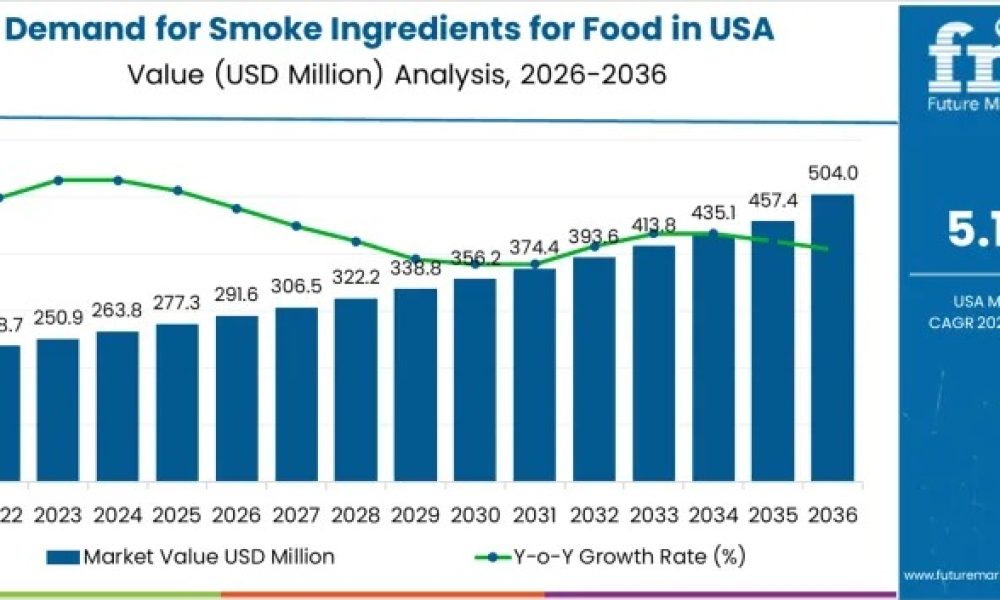
The demand for smoke ingredients for food in the USA is entering a sustained growth phase, supported by evolving consumer taste preferences and innovation in food processing. According to the latest industry analysis, the market is projected to expand from USD 291.6 million in 2026 to USD 504 million by 2036, registering a compound annual growth rate (CAGR) of 5.1% over the forecast period.
Smoke ingredients—ranging from liquid smoke and smoke powders to ultra-refined concentrates—are increasingly adopted across meats, bakery, confectionery, sauces, snacks, and plant-based foods. Their ability to deliver consistent, authentic smoky flavors without traditional smoking methods is making them indispensable for modern food manufacturers focused on efficiency, scalability, and clean labeling.
The U.S. food industry’s shift toward natural flavoring solutions is a central growth driver. Smoke ingredients derived from controlled wood combustion align well with consumer demand for recognizable, minimally processed ingredients. At the same time, rising interest in bold, premium, and artisanal flavor profiles is accelerating their integration across both mass-market and specialty food categories.
Get Exclusive Access To Data Tables, Market Sizing Dashboards, And Analyst Insights. Request Sample Report!
Liquid Smoke Dominates on Versatility and Cost Efficiency
By form, liquid smoke ingredients account for nearly 58% of total U.S. demand, maintaining a clear leadership position. Their dominance is attributed to ease of dosing, uniform flavor dispersion, and adaptability across multiple food matrices. Liquid smoke is widely used in meats, sauces, snacks, bakery, and ready-to-eat foods, enabling manufacturers to replicate smoked flavor profiles while reducing processing time and operational complexity.
Powdered and ultra-refined smoke ingredients collectively make up the remaining share, serving niche applications where dry blending, controlled release, or subtle aroma delivery is required. These formats are gaining traction in seasoning mixes, snack coatings, and specialty formulations.
Bakery and Confectionery Lead Application Demand
From an application standpoint, bakery and confectionery hold the largest share at 42%, reflecting growing experimentation with smoky notes in traditionally sweet or neutral categories. Smoked breads, artisan buns, cakes, chocolates, and candies are increasingly positioned as premium or gourmet offerings, particularly in urban and specialty retail channels.
Other key application segments include dairy, meat and seafood, snacks, and sauces. In each case, smoke ingredients are valued for their ability to enhance aroma, deepen flavor complexity, and improve sensory appeal without the need for physical smoking infrastructure.
Regional Outlook Highlights Strong Momentum in the West and South
Regionally, demand growth is uneven but consistently positive across the U.S.:
- West USA leads with a 5.9% CAGR, supported by a robust food innovation ecosystem, strong clean-label adoption, and consumer openness to gourmet flavors.
- South USA follows at 5.3% CAGR, driven by deep-rooted barbecue traditions and expanding packaged food manufacturing.
- Northeast USA records 4.7% CAGR, reflecting demand for premium, artisanal, and specialty food products.
- Midwest USA grows at 4.1% CAGR, underpinned by its large food processing base and steady demand from snacks and convenience foods.
The West’s emphasis on sustainability, natural sourcing, and premium positioning is making it a key testbed for innovative smoke ingredient formulations, while the South continues to anchor demand in traditional smoked and grilled flavor profiles.
Key Growth Drivers and Market Restraints
The market’s upward trajectory is supported by several structural drivers. Rising consumption of ready-to-eat and convenience foods is increasing reliance on flavor systems that deliver consistency at scale. Smoke ingredients also play a critical role in plant-based and alternative protein products, where they help mimic traditional grilled and meat-like tastes.
However, the industry faces measured challenges. Regulatory scrutiny around certain smoke compounds, health perceptions related to smoked foods, and competition from alternative flavor enhancers can limit adoption in select categories. Despite these factors, ongoing advances in refinement, purification, and clean-label positioning are helping mitigate risks.
Competitive Landscape Focused on Innovation and Clean Labeling
The U.S. smoke ingredients market is moderately consolidated, with leading players emphasizing product customization, safety, and natural sourcing. Key companies include MSK, Redbrook Ingredients Services, FRUTAROM Savory Solutions GmbH (IFF), Besmoke, and Dempsey Corporation. These players are investing in advanced extraction technologies and application-specific solutions to meet evolving manufacturer requirements.
Subscribe for Year-Round Insights → Stay ahead with quarterly and annual data updates!
Outlook Remains Strong Through 2036
As U.S. consumers continue to seek bold, authentic, and differentiated flavor experiences, smoke ingredients are expected to remain a strategic tool for food manufacturers. Their versatility across forms, applications, and regions positions the market for steady expansion, with innovation and clean-label compliance shaping competitive advantage over the next decade.
About Future Market Insights (FMI)
Future Market Insights, Inc. (FMI) is an ESOMAR-certified, ISO 9001:2015 market research and consulting organization, trusted by Fortune 500 clients and global enterprises. With operations in the U.S., UK, India, and Dubai, FMI provides data-backed insights and strategic intelligence across 30+ industries and 1,200 markets worldwide.



