
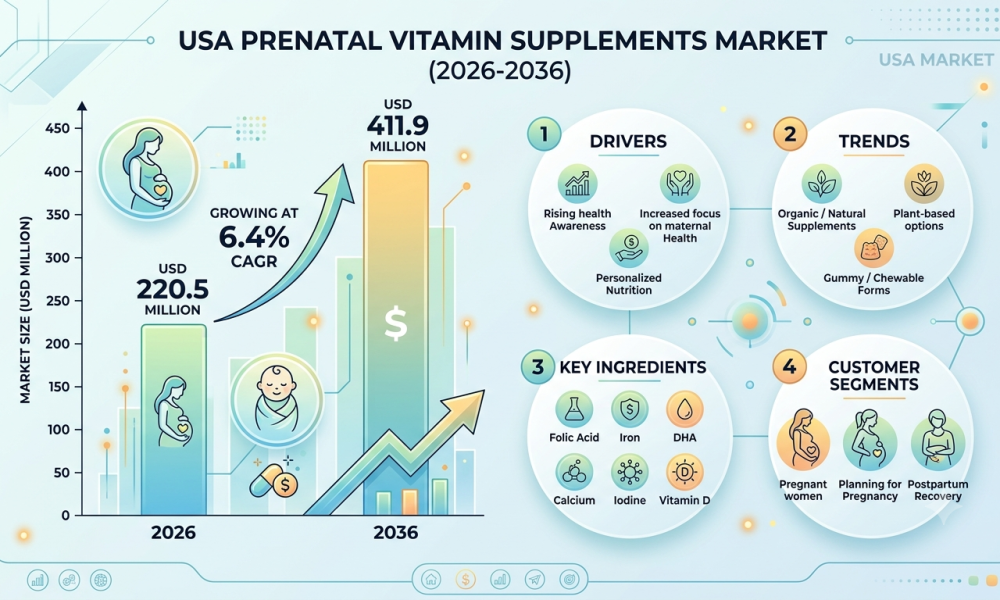
The USA prenatal vitamin supplements market is projected to grow from USD 220.5 million in 2026 to USD 411.9 million by 2036, expanding at a 6.4% CAGR, according to Future Market Insights (FMI). The market is shaped by nutrient requirements during preconception and pregnancy, increasing attention to dose coverage, and consumer demand for convenient formats that can be incorporated into daily routines.
Prenatal supplementation can begin before formal prenatal care. This gives manufacturers a purchase window that starts during preconception and continues through pregnancy. NIH Office of Dietary Supplements data updated in April 2025 showed that 83.8% of pregnant women aged 20 to 40 had dietary iron intake below the Estimated Average Requirement. This documented nutrient gap keeps nutrient coverage and serving compliance central to product selection.
Get detailed market forecasts, competitive benchmarking, and pricing trends: https://www.futuremarketinsights.com/reports/sample/rep-gb-17046
Pharmaceutical Products Lead Product-Type Demand
Pharmaceutical products are expected to account for 34.9% of the market in 2026. Their position reflects dose-led positioning and the role of clinician-guided selection in prenatal supplementation.
However, fitting multiple nutrients into a daily serving creates formulation challenges. Iron and other nutrients can contribute to larger serving sizes and gastrointestinal tolerance issues. These factors can affect whether consumers continue using a product according to its intended serving pattern.
The market includes pharmaceutical products, confectionery products, soft gels, capsules, tablets or pills, gummies, chews, and other formats such as lollipops or hard-boiled candies.
Industry capacity is also developing around formulation inputs. In March 2026, dsm-firmenich completed a USD 10 million upgrade to its Schenectady premix site for dietary supplements and infant formula. The additional USA capacity supports multinutrient premix production used before manufacturers develop finished supplement doses.
Over-the-Counter Supplements Hold a 39.0% Share
Over-the-counter supplements are forecast to account for 39.0% of the sales channel category in 2026. Direct access through pharmacies and retail outlets allows consumers to start supplementation before an appointment and select different dosage formats without a prescription.
CDC guidance updated in June 2026 recommends 400 micrograms of folic acid daily and advises consumers to check folic-acid labels before purchase. This makes label clarity and serving instructions particularly relevant to self-directed purchasing.
Preconception guidance also extends the potential purchasing window. CDC stated in May 2025 that about half of U.S. pregnancies are unintended and recommends 400 micrograms of folic acid daily for women capable of pregnancy. For prenatal supplement brands, this creates a defined nutritional need before pregnancy is clinically confirmed.
Formulation Variability Creates Both Challenges and Opportunities
A major market restraint is the balance between nutrient completeness and ease of daily use. NIH data updated in April 2025 found iron in 89% of 188 prenatal supplements, while gummy formulations often contained no iron. Gummies may make supplementation easier for consumers who have difficulty swallowing tablets, but changing dosage formats can also change the nutrient profile.
This creates an opportunity for concentrated ingredients and palatable dosage forms that reduce swallowing burden while maintaining documented nutrient delivery and clear serving instructions.
The broader dosage-format landscape is already expanding. Pharmavite opened a 225,000-square-foot Ohio facility in May 2025, expanding vitamin gummy production and creating a dedicated gummy innovation center.
Analyst Perspective
“Prenatal supplement economics improve if a formulation delivers the intended nutrient profile without turning daily use into a swallowing or tolerance problem. Brands should evaluate pill burden and dose transparency separately because postpartum health supplements and postnatal health supplements follow different life-stage demand patterns.”
— Nandini Roy Choudhury, Principal Consultant, Future Market Insights
Competitive Landscape
The market includes Glanbia plc, Cargill, Incorporated, Associated British Foods plc, International Flavors & Fragrances Inc., Kerry Group plc, dsm-firmenich, Bunge Global SA, and Darling Ingredients Inc.
Recent developments include Glanbia plc’s August 2025 acquisition of Sweetmix to extend its Health & Nutrition nutritional premix and ingredient platform in Brazil. In March 2026, dsm-firmenich launched ModulaSENSE Bitter, a taste-modulation tool for oral dosage formulations. In February 2026, Associated British Foods plc subsidiary SPI Pharma entered a global distribution partnership with Anek Prayog for Lubripharm Pro.
Access full Report in PDF Format@ https://www.futuremarketinsights.com/reports/brochure/rep-gb-17046
Report Scope
The USA prenatal vitamin supplements market is segmented by product type, sales channel, and region. Product types include pharmaceutical products, confectionery products, soft gels, capsules, tablets or pills, gummies, chews, and other formats. Sales channels include over-the-counter supplements, online sales, drug stores and pharmacies, health and wellness stores, third-party or mass merchandisers, hypermarkets or supermarkets, company websites, and convenience stores.
Explore the Global Prenatal Vitamin Supplements Market Report
For a broader view of market trends, growth opportunities, key segments, and competitive developments across global markets, access the full Prenatal Vitamin Supplements Market report from Future Market Insights:
https://www.futuremarketinsights.com/reports/prenatal-vitamin-supplements-market
About Future Market Insights
Future Market Insights (FMI) provides market intelligence, research, and consulting services across industries. Its research covers market size, growth trends, competitive landscapes, and emerging opportunities to support business and strategic decision-making.



