
The global industrial rubber products market is entering a decade of accelerated transformation, supported by a strong industrial rebound, rising electric vehicle (EV) production, infrastructure investment, and rapid advancements in synthetic rubber materials. According to the latest industry assessment, the market is valued at USD 129.0 billion in 2025 and is projected to reach USD 243.8 billion by 2035, expanding at a 6.6% CAGR.
Growth is visible across all major industrial regions—including APAC, Europe, the USA, and Saudi Arabia—driven by automotive electrification, strategic investments in sustainable materials, and ongoing expansion across manufacturing, energy, and construction sectors.
Industrial Expansion and EV Growth Reinforce Global Momentum
Manufacturing revival across Southeast Asia, Central Europe, and North America continues to play a critical role in market acceleration. Industrial rubber’s core product lines—conveyor belts, molded rubber components, and vibration control systems—saw a significant rise in demand throughout 2024–2025 as industries scaled back to pre-pandemic operational levels.
Subscribe for Year-Round Insights → Stay ahead with quarterly and annual data updates: https://www.futuremarketinsights.com/reports/sample/rep-gb-17190
The automotive sector remains the largest demand generator, accounting for 42% of global market share in 2025. The shift toward electric vehicles is fueling consumption of high-performance hoses, thermal-resistant seals, and noise-dampening systems. Notably, Yokohama Rubber’s USD 380 million expansion in India highlights APAC’s strengthening position in EV-focused rubber manufacturing.
In energy markets, particularly offshore oil and gas in West Africa and the North Sea, demand for endurance-grade rubber linings and tubing is rising. Continental AG’s new heavy-duty mining conveyor belt line, launched in 2024, demonstrates the industry’s focus on specialized, high-performance equipment.
Key Market Statistics (2025–2035)
- Market Size 2025: USD 129.0 B
- Market Forecast 2035: USD 243.8 B
- CAGR: 6.6%
- Leading Type Segment: Conveyor Belts & Hoses (~22%)
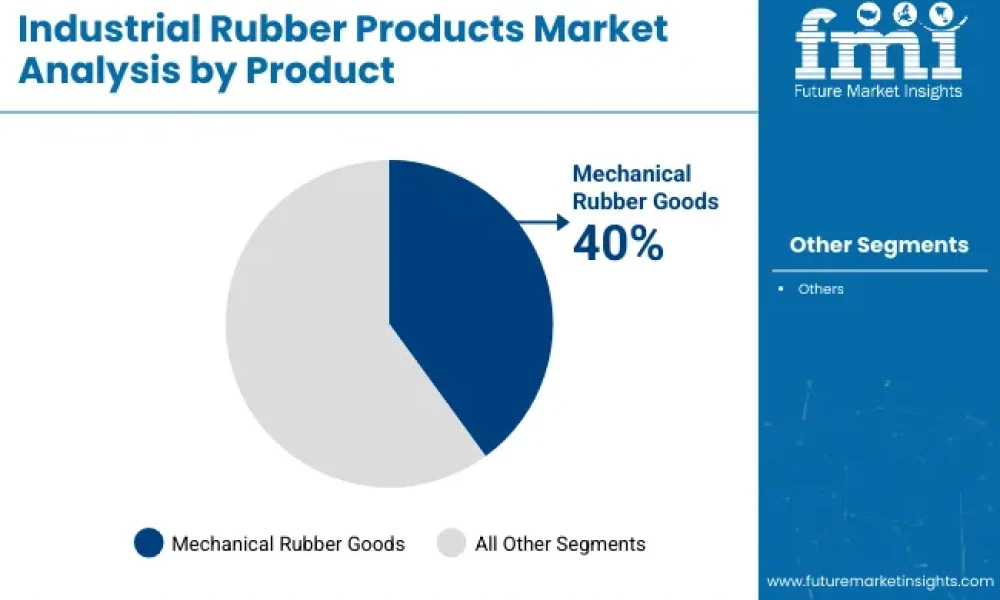
- Largest Product Segment: Mechanical Rubber Goods (40% in 2025; 6.7% CAGR)
- Top End-Use Sector: Automotive (42%; 6.8% CAGR)
- Major Manufacturers: Michelin, Bridgestone, Goodyear, ContiTech, Yokohama Rubber, Titan International, Trelleborg
Synthetic Rubber and Material Innovation Take Center Stage
Higher adoption of EPDM and nitrile rubber (NBR) continues as industries demand compounds with chemical, thermal, and mechanical resilience. These materials are particularly favored for EV batteries, thermal systems, and industrial machinery.
Supply chain stabilization has allowed manufacturers to improve delivery schedules and boost production efficiency. Strategic partnerships have also strengthened innovation pipelines. For example:
- Bridgestone–Shell partnership (2024): Co-developing renewable rubber materials using sustainable feedstocks.
- Michelin acquisition (2024): Expanded presence in the European automotive and machinery segment via a German rubber component firm.
With industries transitioning toward connected equipment, sensor-enabled rubber components for predictive maintenance are expected to shape procurement strategies over the next five years.
Regional Market Highlights: APAC, Europe, USA & Saudi Arabia
APAC
APAC leads global demand due to rapid manufacturing expansion, rising EV production, and strong construction activity. China maintains its position as a rubber manufacturing hub, while India is emerging as a center for cost-efficient, high-performance industrial rubber goods. APAC’s projected growth remains among the highest globally.
Europe
Europe’s growth is driven by strict environmental regulations, accelerated adoption of advanced materials, and strong engineering capabilities. Germany, France, Italy, and the UK are focusing on carbon-neutral production, automation, and recyclable materials. Central Europe remains a hotspot for automotive and machinery rubber components.
USA
The USA market benefits from strong automotive manufacturing, industrial modernization, and stringent EPA and OSHA regulations that push companies toward sustainability and higher product performance. The market is forecast to grow at a 6.6% CAGR, supported by innovations in material engineering and industrial automation.
Saudi Arabia & Middle East
Saudi Arabia’s expanding industrialization, petrochemical investments, and infrastructure megaprojects are increasing demand for high-performance hoses, seals, and vibration isolation components. Efforts under Vision 2030 are encouraging adoption of advanced materials and local manufacturing capabilities.
Need tailored insights? Request report customization to match your specific business objectives: https://www.futuremarketinsights.com/customization-available/rep-gb-17190
Key Investment Opportunities
- Mechanical Rubber Goods – Dominant and Growing
With a 40% market share, this segment benefits from rising automation, machinery upgrades, and EV component demand. Lightweight, durable elastomeric materials are replacing metal components, particularly in OEM applications.
- Automotive — Largest End-Use Sector
EV systems require heat-resistant, chemical-resistant, and vibration-controlled components, opening opportunities for new polymer formulations.
- Energy & Infrastructure
Increasing offshore exploration, renewable energy installations, and large-scale construction projects are boosting rubber product consumption across APAC and the Middle East.
Top Three Strategic Priorities for Market Leaders
- Advance Synthetic Rubber Capabilities
Invest in high-durability, high-temperature compounds for EVs, offshore energy, and heavy machinery. - Leverage Electrification & Green Infrastructure
Design products for noise reduction, vibration isolation, and fluid management in EVs, renewable plants, and smart buildings. - Strengthen Vertical Integration & Regional Partnerships
Collaborate with OEMs, consolidate regional distribution, and secure raw materials to mitigate supply chain disruptions.
Risks to Monitor (2025–2035)
- Supply chain disruptions: Medium probability, high impact
- Raw material volatility: High probability, medium impact
- Advanced material substitutes: Low probability, high impact
Competitive Landscape
Major manufacturers are restructuring their production footprints, investing in automation, and incorporating recyclability into product designs. Partnerships and M&A activities are accelerating to secure regional access.
Recent launches include:
- SuperPro Suspension’s Vertical Pivoting Bush (2025): Improved articulation and NVH reduction.
- Danfoss Power Solutions’ Synflex 3TMH Hose (2025): 40% more flexibility and 10x abrasion resistance, rated for 1 million impulse cycles.
About Future Market Insights (FMI)
Future Market Insights, Inc. (FMI) is an ESOMAR-certified, ISO 9001:2015 market research and consulting organization, trusted by Fortune 500 clients and global enterprises. With operations in the U.S., UK, India, and Dubai, FMI provides data-backed insights and strategic intelligence across 30+ industries and 1200 markets worldwide.
Why Choose FMI: Empowering Decisions that Drive Real-World Outcomes: https://www.futuremarketinsights.com/why-fmi



