
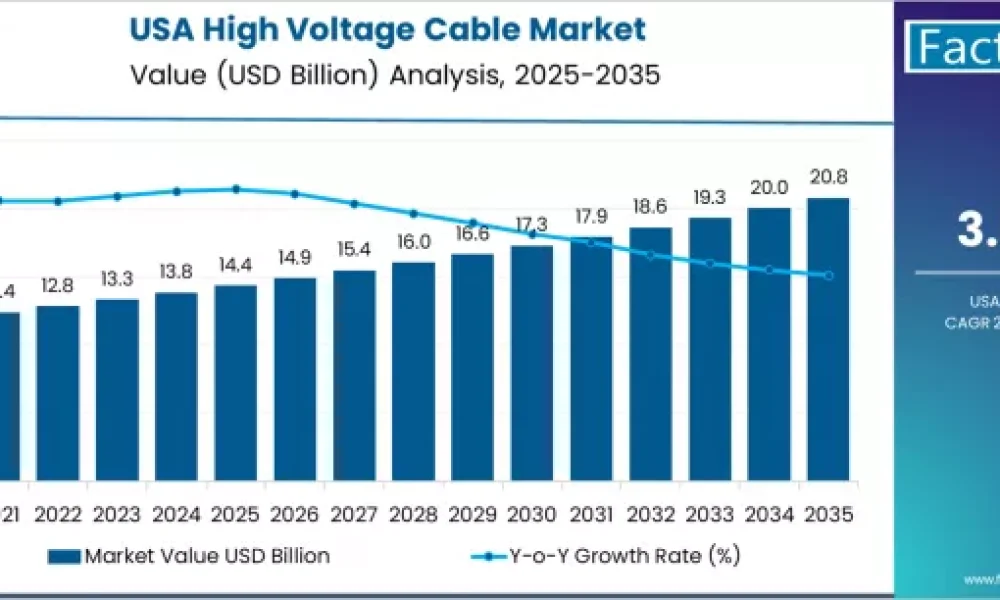
The United States’ demand for high voltage cable is expected to expand by USD 6.41 billion over the course of the forecast period, from USD 14.35 billion in 2025 to roughly USD 20.76 billion by 2035. Demand is expected to increase at a compound annual growth rate (CAGR) of 3.8% between 2025 and 2035, translating to a total rise of 44.7%.
The demand for high voltage cables in the United States is rising steadily as the country upgrades aging power infrastructure, expands renewable energy capacity, and strengthens grid reliability. High voltage cables are essential for efficient transmission of electricity over long distances, supporting utilities, industrial users, renewable power projects, and interconnection networks across regions. With increasing electricity consumption and grid modernization initiatives, high voltage cable deployment is becoming a strategic priority nationwide.
Quick Market Overview (2025–2035)
Market Growth Trend: Strong and sustained
Key Voltage Types: 110 kV–220 kV, 220 kV–500 kV, above 500 kV
Major Applications: Power transmission, renewable energy integration, underground and submarine links
Key End Users: Utilities, energy developers, industrial facilities
Primary Growth Driver: Grid modernization and renewable energy expansion
To access the complete data tables and in-depth insights, request a Discount On The Report here: https://www.factmr.com/connectus/sample?flag=S&rep_id=12604
Market Overview
High voltage cables are designed to transmit electricity efficiently at voltages typically above 110 kV, minimizing transmission losses and ensuring stable power delivery. In the U.S., these cables are increasingly used in both overhead and underground configurations, particularly in urban areas, environmentally sensitive zones, and renewable energy corridors.
The shift toward underground and submarine high voltage cables is gaining momentum due to land constraints, safety considerations, and resilience requirements. At the same time, long-distance transmission projects are expanding to connect renewable energy generation sites with consumption centers.
Key Market Drivers
1. Aging Power Infrastructure Replacement
Much of the U.S. power transmission infrastructure is decades old.
Rising failure rates in aging cables and transmission lines
Increasing maintenance costs and reliability concerns
Need for higher-capacity cables to support modern power loads
Utilities are investing heavily in high voltage cable replacement and upgrades to ensure grid stability and reduce outage risks.
2. Expansion of Renewable Energy Projects
Renewable energy integration is a major growth catalyst.
Large-scale wind and solar projects located far from demand centers
Requirement for long-distance, high-capacity transmission
Offshore wind projects driving demand for submarine high voltage cables
High voltage cables enable efficient power transfer from renewable generation hubs to urban and industrial consumers.
3. Grid Modernization and Smart Grid Development
Modern grid initiatives are accelerating cable demand.
Deployment of smart grids requiring reliable high-capacity transmission
Increased interconnection between regional grids
Integration of energy storage systems and distributed generation
Advanced high voltage cables support improved load management and grid resilience.
4. Rising Electricity Consumption
Growing electricity demand is fueling infrastructure expansion.
Population growth and urbanization
Increased electrification of transportation and industry
Rising data center and digital infrastructure power needs
High voltage cables are critical for meeting future power demand without compromising efficiency.
Market Segmentation Analysis
By Voltage Level
110 kV–220 kV:
Widely used for regional transmission and urban underground networks.220 kV–500 kV:
Common in long-distance transmission and large-scale power projects.Above 500 kV:
Used for ultra-high-capacity transmission and inter-regional power corridors.
By Installation Type
Overhead Cables:
Cost-effective and widely used for long-distance transmission.Underground Cables:
Increasing adoption in urban areas and environmentally sensitive regions.Submarine Cables:
Growing demand driven by offshore wind farms and coastal interconnections.
By End-use Application
Power transmission and distribution
Renewable energy integration
Industrial power supply
Interconnection and grid reinforcement projects
Regional Demand Trends within the USA
West Coast:
High demand due to renewable energy projects and grid upgrades.Midwest:
Strong growth driven by wind energy transmission corridors.Northeast:
Increasing use of underground and submarine cables for urban reliability.Southern States:
Infrastructure expansion supporting industrial growth and population increase.
Challenges and Market Restraints
1. High Installation and Material Costs
Significant capital investment required
High cost of raw materials such as copper and aluminum
2. Complex Regulatory and Permitting Processes
Lengthy approval timelines for transmission projects
Environmental and land-use regulations
3. Technical and Installation Challenges
Skilled labor shortages
Complex underground and submarine installation requirements
Emerging Trends and Opportunities
1. Growth of Underground Transmission Networks
Urbanization is driving demand for safer and visually unobtrusive cable systems.
2. Advancements in Cable Insulation Technology
Improved insulation enhances performance, durability, and thermal resistance.
3. Offshore Wind and Coastal Power Projects
Rising offshore wind investments are creating strong demand for submarine high voltage cables.
4. Public and Private Investment in Grid Expansion
Federal and state-level funding is accelerating transmission infrastructure development.
Competitive Landscape Highlights
Market participants are focusing on:
Development of high-capacity, low-loss cable technologies
Long-term supply contracts with utilities and energy developers
Expansion of manufacturing capacity within the U.S.
Collaboration with EPC firms and grid operators
Future Outlook
The U.S. high voltage cable market is expected to experience strong growth through 2035, supported by grid modernization, renewable energy expansion, and increasing electricity demand. As transmission networks evolve to handle higher loads and integrate diverse energy sources, high voltage cables will remain a critical component of national energy infrastructure.
Manufacturers that prioritize advanced materials, reliable performance, and compliance with regulatory standards will be well positioned to benefit from upcoming transmission investments. With sustained government support and rising private-sector participation, the demand for high voltage cables in the United States is set to remain robust over the next decade.
Have specific requirements or need assistance on report pricing or have a limited budget? Please contact [email protected]
About Fact.MR:
Fact.MR is a global market research and consulting firm, trusted by Fortune 500 companies and emerging businesses for reliable insights and strategic intelligence. With a presence across the U.S., UK, India, and Dubai, we deliver data-driven research and tailored consulting solutions across 30+ industries and 1,000+ markets. Backed by deep expertise and advanced analytics, Fact.MR helps organizations uncover opportunities, reduce risks, and make informed decisions for sustainable growth.



