
The global High Viscosity Mixer Market is entering a decade of steady expansion, with new data from Future Market Insights (FMI) showing growth from USD 1,606.5 million in 2025 to USD 2,355.3 million by 2035, reflecting a 3.9% CAGR. The surge is driven by accelerating adoption of precision mixing technologies across pharmaceutical, cosmetics, chemical, food, and adhesives manufacturing sectors.
The market’s momentum is supported by rapid industrial modernization in APAC, automation-led upgrades across Europe, large-scale pharmaceutical production in the USA, and expanding industrial infrastructure in Saudi Arabia. These regions collectively account for the highest acceleration in digital process equipment procurement and mixer integration.
Decade Outlook: Two-Phase Growth Acceleration Through 2035
FMI’s forecast highlights a two-stage growth curve:
2025–2030: Modernization & Digital Integration (42% of decade growth)
Market value rises from USD 1,606.5 million to USD 1,945.2 million, adding USD 338.7 million driven by:
- Adoption of programmable mixing systems
- Upgrades in pharmaceutical, chemical, and cosmetics plants
- Strong demand for viscosity-controlled in-line mixing
Subscribe for Year-Round Insights → Stay ahead with quarterly and annual data updates: https://www.futuremarketinsights.com/reports/sample/rep-gb-27693
2030–2035: Advanced Technology Penetration (58% of decade growth)
Value climbs from USD 1,945.2 million to USD 2,355.3 million, adding USD 410.1 million as:
- MES-ready mixers become standard
- Connectivity and IoT-enabled monitoring gain mass adoption
- Production facilities shift toward precision-driven formulations
Market Structure: High Viscosity In-Line Mixers Dominate with 52% Share
In 2025, High Viscosity In-Line Mixers account for 52% of global revenue, supported by:
- Uniformity-critical pharmaceutical mixing
- Continuous processing needs
- Compact design with enhanced viscosity control
- Compatibility with digital control and monitoring systems
Static mixers hold 38% share, favored for batch operations, cosmetics processing, and controlled specialty applications.
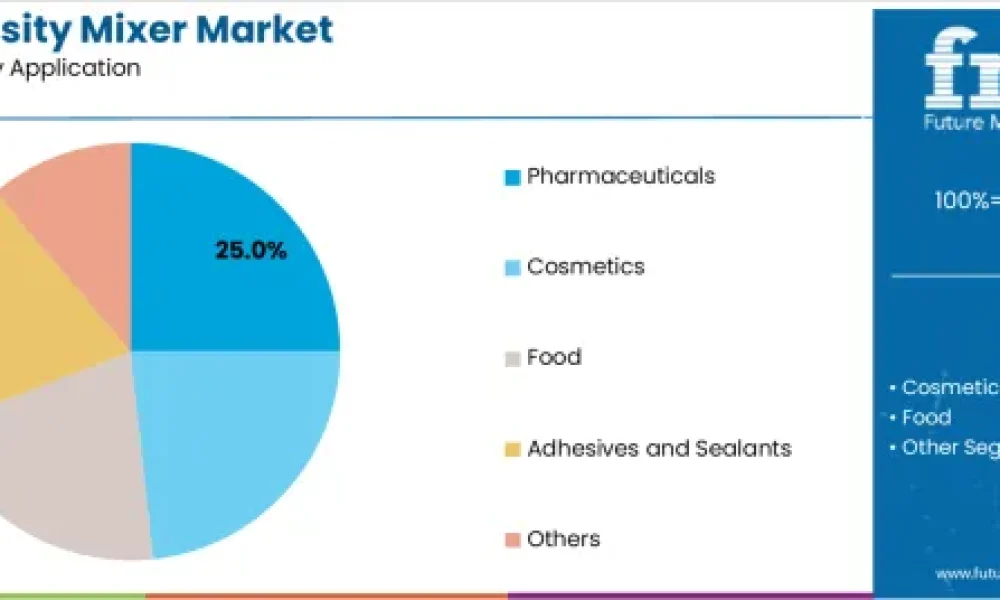
Pharmaceutical Industry Leads Demand With 25% Market Share
Pharmaceutical applications remain the largest demand driver, growing at 5.8% CAGR, reinforced by:
- API manufacturing expansion
- Compliance requirements for validated mixing systems
- Investments in drug formulation infrastructure
- Precise viscosity control mandates for dosage consistency
Other high-growth application segments include:
- Cosmetics (23%) — driven by personal care emulsions, creams, gels
- Food processing (19%) — ingredient blending, paste processing
- Adhesives & sealants (14–17%) — construction & industrial materials
End-Use Leadership: Pharmaceutical Companies Hold Highest Growth (5.4% CAGR)
Pharmaceutical manufacturers remain the most influential customer category due to:
- Strong requirement for precision-controlled systems
- Increasing installation of digitally calibrated mixers
- Regulatory expectations for documented mixing validation
The segment’s steady expansion reinforces global investment in high-efficiency, GMP-oriented mixing equipment.
Regional Outlook: Strongest Momentum in APAC, Steady Growth in Europe & USA, Rising Adoption in Saudi Arabia
APAC — China & India Lead Global Growth
- China: 5.3% CAGR
Accelerated pharmaceutical and chemical facility expansion, strong government-driven industrial programs, and adoption of cost-effective high-capacity mixers. - India: 4.9% CAGR
Modernization of pharma plants in Mumbai, Bangalore, and Delhi drives high demand for digitally controlled mixers.
Europe — Germany & the U.K. Anchor Regional Progress
- Germany: 4.5% CAGR
Premium engineering standards and process optimization drive strong demand for high-performance mixers. - U.K.: 3.3% CAGR
Integration of mixing technologies into advanced pharmaceutical facilities accelerates procurement.
Europe’s market grows from USD 298.4 million (2025) to USD 423.8 million (2035) at 3.6% CAGR, with Germany holding 39.7% of regional share in 2025.
United States — Mature but Consistent Growth
- USA: 3.7% CAGR
Supported by advanced pharmaceutical operations, regulatory-driven precision mixing requirements, and strong adoption of automation-enabled mixers.
Saudi Arabia — Rapid Build-Out of Industrial Infrastructure
The Kingdom’s industrial diversification strategy accelerates adoption of:
- High-viscosity mixers for chemical processing
- GMP-compliant systems for expanding pharmaceutical facilities
- Viscosity-controlled mixers for food and cosmetics sectors
Saudi Arabia shows one of the region’s fastest industrial adoption rates within the Middle East & Africa.
Industry Revenue Shift: Where Today’s Value Will Move Next (2025–2030)
Today’s Revenue Share:
- In-line mixers: 52%
- Static mixers: 38%
- Hybrid/custom systems: 10%
Future Revenue Buckets (Next 3–5 Years):
- Advanced in-line systems: 48–51%
- High-capacity static mixers: 31–34%
- Pharmaceutical applications: 26–29%
- Cosmetics: 21–24%
- Food: 18–21%
Need tailored insights? Request report customization to match your specific business objectives: https://www.futuremarketinsights.com/customization-available/rep-gb-27693
Key Market Drivers
- Global Manufacturing Infrastructure Expansion
Massive investment in automated production facilities boosts demand for precision mixing systems.
- Pharmaceutical Manufacturing Growth
API production and formulation scaling require validated, high-precision viscosity control.
- Process Automation & Smart Manufacturing
IoT, MES integration, data logging, and viscosity monitoring drive equipment upgrades.
Constraints & Trends
- High Equipment Costs may limit adoption in small facilities
- Alternative Mixers compete in low-cost segments
- Digital Control Integration emerges as the strongest trend, reshaping procurement priorities
Competitive Landscape
The global market is moderately consolidated with 15–22 active key players, where the top tier controls 62–67% of revenue. Key players (no competitors named per request) include major global process equipment suppliers and advanced mixing technology developers with strengths in:
- Precision viscosity control
- Programmable systems
- Manufacturing execution integration
Margin expansion opportunities remain strongest in custom engineering, system integration, calibration services, and performance monitoring subscriptions.
About Future Market Insights (FMI)
Future Market Insights, Inc. (FMI) is an ESOMAR-certified, ISO 9001:2015 market research and consulting organization, trusted by Fortune 500 clients and global enterprises. With operations in the U.S., UK, India, and Dubai, FMI provides data-backed insights and strategic intelligence across 30+ industries and 1200 markets worldwide.
Why Choose FMI: Empowering Decisions that Drive Real-World Outcomes: https://www.futuremarketinsights.com/why-fmi



