
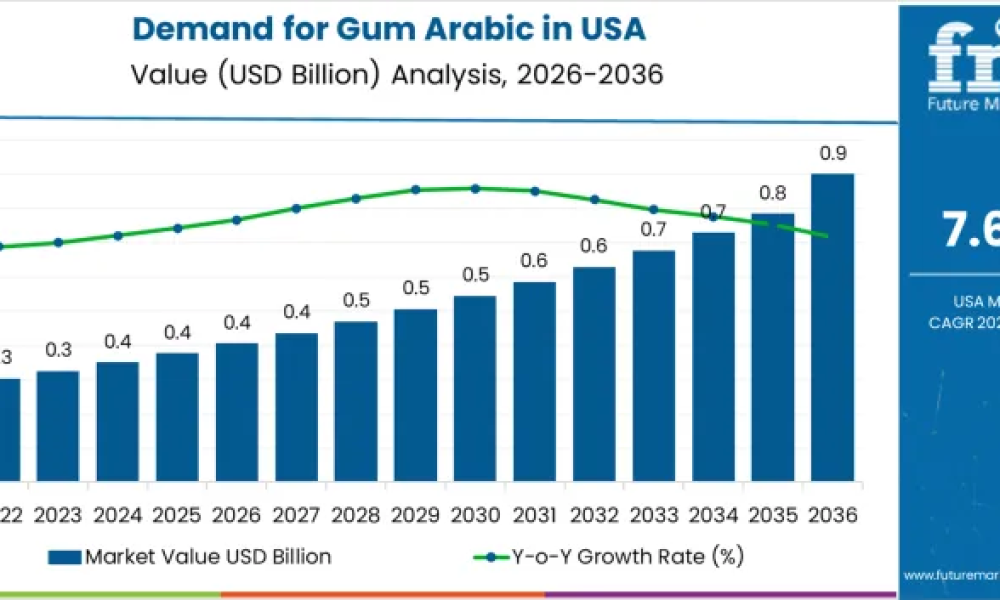
The demand for gum arabic in the USA is witnessing steady growth, with the market valued at USD 0.4 billion in 2026 and projected to reach USD 0.9 billion by 2036, reflecting a robust compound annual growth rate (CAGR) of 7.6%. This surge is fueled by growing consumer preference for natural and clean-label ingredients, particularly in food, beverages, and pharmaceuticals, alongside increasing awareness of sustainable and eco-friendly products.
Organic gum arabic dominates the market, accounting for 65% of total demand. Its widespread adoption is attributed to its purity, natural sourcing, and versatility as an emulsifier and stabilizer across various industries. The food and beverage sector leverages gum arabic for enhancing texture and product stability, while the pharmaceutical industry relies on it for its binding and emulsifying properties in syrups, capsules, and emulsions.
Explore trends before investing – Request a sample report today!
The pharmaceutical sector is the largest consumer, representing 45% of overall demand. Gum arabic’s role as a thickener, stabilizer, and binder makes it essential for formulation consistency and controlled release of active ingredients. In the food and beverage industry, its ability to maintain texture and improve shelf life drives adoption in soft drinks, confectioneries, bakery products, and dietary supplements. Additionally, the printing and textile sectors utilize gum arabic for its film-forming and adhesive properties.
Key Market Statistics
- Market Value (2026): USD 0.4 billion
- Forecast Value (2036): USD 0.9 billion
- CAGR (2026–2036): 7.6%
- Leading Function: Thickener
- Key Growth Regions: West USA, South USA, Northeast USA, Midwest USA
- Top Players: Nexira, Tic Gums Inc., Ingredion, Prodigy AG, Ashland Inc.
Regionally, West USA leads with an 8.7% CAGR, driven by strong food, beverage, and cosmetic industries and high consumer demand for natural ingredients. South USA follows with a 7.8% CAGR, supported by growing food processing and pharmaceutical sectors. Northeast and Midwest USA report steady growth at 7.0% and 6.1% CAGR respectively, with expansion in food manufacturing, pharmaceuticals, and cosmetic applications contributing to market adoption.
Segment-Wise Insights
- By Nature: Organic gum arabic leads with 65% demand, followed by conventional varieties. Its eco-friendly and pesticide-free profile aligns with health-conscious consumer trends.
- By Function: Used primarily as a thickener, gelling agent, fat replacer, and stabilizer.
- By Application: Pharmaceuticals (45%), food and beverages, printing, and textiles.
- By Functionality: Viscosity, solubility, emulsification, film-forming, fat substitution, fiber content, stabilization.
The growing inclination toward plant-based and clean-label products is a primary driver, particularly in functional foods and beverages. Manufacturers are increasingly replacing synthetic additives with natural alternatives like gum arabic, which not only enhance texture and stability but also cater to health-conscious and environmentally aware consumers.
Technological Innovations and Industry Drivers
Advancements in processing, purification, and fractionation are enhancing the consistency and performance of gum arabic in complex formulations. Innovations in synergistic blends with other natural hydrocolloids are expanding its emulsification, foaming, and stabilization capabilities. Custom-tailored grades for beverages, confections, and encapsulation of flavors or active compounds are driving broader application potential. Clean-label formulation improvements are enabling manufacturers to reduce reliance on artificial stabilizers while maintaining product quality, thus accelerating adoption across food, beverage, and pharmaceutical sectors.
Despite these opportunities, the industry faces challenges such as supply volatility due to climatic conditions, competition from alternative hydrocolloids like guar gum and pectin, and the need for strict quality control. Limited awareness among smaller manufacturers and cost fluctuations may also impact market penetration.
Unlock the complete analysis—Get the full report now.
Competitive Landscape
The USA gum arabic market is highly competitive, with major players innovating to meet rising demand for clean-label and natural solutions. Nexira leads with sustainable, high-quality acacia-derived gum arabic, emphasizing eco-friendly and functional formulations. Tic Gums specializes in customized solutions that enhance product texture and stability, while Ingredion offers a wide variety of gum arabic products for global food applications. Prodigy AG focuses on high-quality, natural ingredients for pharmaceutical and food sectors, and Ashland Inc. provides functional solutions across personal care, food, and beverage industries.
As consumer preferences increasingly favor natural, organic, and clean-label products, gum arabic’s relevance is set to grow across multiple industries. From pharmaceuticals to food and beverages, the market is expected to maintain a steady upward trajectory through 2036, driven by innovation, sustainability, and multifunctional applications.
Key Players in USA Gum Arabic Demand
- Nexira
- Tic Gums Inc.
- Ingredion
- Prodigy AG
- Ashland Inc.
About Future Market Insights (FMI)
Future Market Insights, Inc. (FMI) is an ESOMAR-certified, ISO 9001:2015 market research and consulting organization, trusted by Fortune 500 clients and global enterprises. With operations in the U.S., UK, India, and Dubai, FMI provides data-backed insights and strategic intelligence across 30+ industries and 1200 markets worldwide.



