
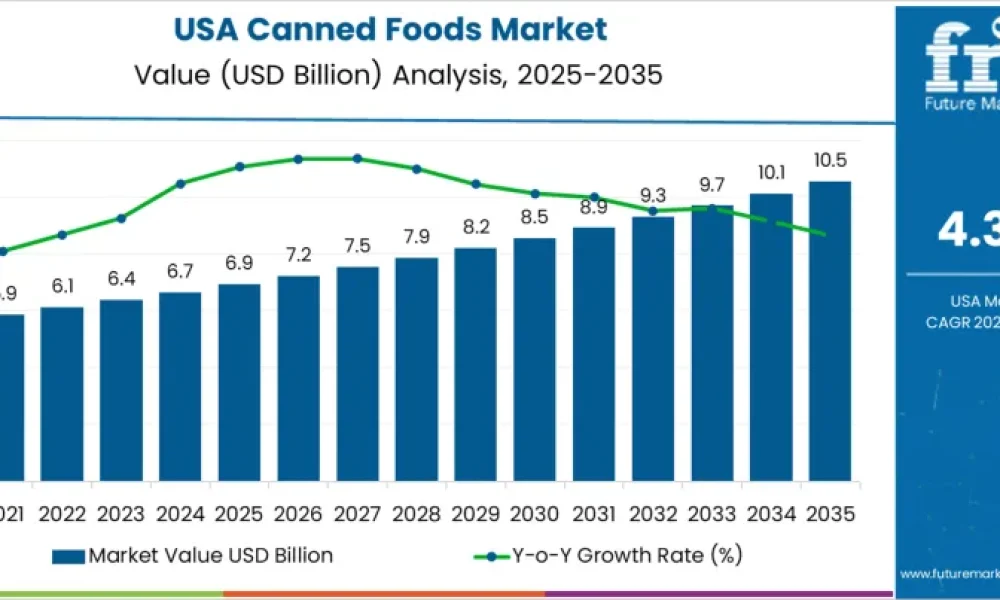
The Demand for canned foods in the United States continues to demonstrate durable growth, supported by evolving consumption habits that prioritize convenience, affordability, and long shelf life. The market is valued at USD 6.9 billion in 2025 and is forecast to reach USD 10.5 billion by 2035, expanding at a compound annual growth rate (CAGR) of 4.3% over the ten-year period.
This growth reflects the sustained relevance of canned foods across households, institutional feeding programs, and foodservice operations. Despite increased availability of fresh and frozen alternatives, canned formats remain essential due to their price stability, reduced food waste, and consistent year-round availability.
Canned Foods Retain Core Role in U.S. Meal Planning
Canned foods continue to serve as foundational pantry staples for American consumers. Products such as canned vegetables, beans, soups, fruits, and ready meals align with the needs of busy households, single-person dwellings, students, and budget-conscious families seeking minimal preparation and reliable nutrition.
Economic uncertainty and inflationary pressures reinforce the appeal of canned foods as cost-efficient meal components. Additionally, emergency preparedness habits, institutional food programs, and disaster-response planning sustain baseline demand, particularly during periods of supply-chain disruption.
Improvements in retort processing, nutrient retention, and flavor preservation have also helped modernize the category, countering outdated perceptions around quality.
Market Snapshot: USA Canned Foods Demand
- Sales Value (2025): USD 6.9 Billion
- Forecast Value (2035): USD 10.5 Billion
- Forecast CAGR (2025–2035): 4.3%
- Leading Product Type: Canned Fruits and Vegetables
- Key Growth Regions: West USA, South USA, Northeast USA
Fruits and Vegetables Lead Product Demand
By product type, canned fruits and vegetables account for the largest share of U.S. demand, representing approximately 37.5% of total market value. High household usage frequency, year-round availability, and versatility in cooking applications support their leadership across both retail and institutional channels.
Canned ready meals follow, driven by demand for heat-and-serve entrées that simplify meal planning. Other categories—including beans, soups, sauces, and broths—remain central to pantry stocking, while canned meat and seafood serve more selective, protein-focused use cases.
Clean-Label and Organic Offerings Gain Momentum
Consumer scrutiny of ingredient lists is reshaping canned food portfolios. Organic canned products now account for an estimated 54.0% of demand, reflecting strong preference for reduced additives, lower sodium content, and transparent sourcing.
Manufacturers are reformulating existing SKUs to include:
- Reduced-sodium and no-salt-added options
- Cleaner ingredient declarations
- BPA-free can linings and recyclable metal packaging
Conventional canned foods continue to maintain relevance, particularly in value-driven segments, but label transparency has become a competitive requirement rather than a differentiator.
Supermarkets and E-commerce Anchor Distribution
Supermarkets and hypermarkets remain the dominant sales channel, accounting for 42.0% of market demand, supported by high product turnover and competitive pricing. E-commerce channels represent 33.0%, driven by subscription models, bundled delivery, and improved logistics for shelf-stable goods.
Canned foods are well-suited for online retail due to low spoilage risk and transport efficiency, enabling consistent demand growth across omnichannel grocery platforms.
Regional Demand Reflects Lifestyle and Storage Needs
Demand for canned foods is geographically diverse, with growth concentrated in regions supported by large distribution networks and consistent reliance on shelf-stable staples.
The West USA leads growth at a 4.9% CAGR, driven by diverse cuisine preferences, emergency preparedness behaviors, and strong retail infrastructure in states such as California, Washington, and Oregon. The South USA follows at 4.4% CAGR, supported by larger household sizes, value-focused purchasing, and integration of canned foods into regional cooking traditions.
The Northeast USA records 3.9% CAGR, reflecting convenience-driven consumption in dense urban areas, while the Midwest USA grows at 3.4% CAGR, sustained by traditional usage patterns, private-label manufacturing, and bulk retail formats.
Competitive Landscape Focuses on Scale and Efficiency
Competition in the U.S. canned foods market centers on cost-efficient production, SKU availability, and national distribution reach. Leading suppliers include Conagra Brands, Inc., Campbell Soup Company, Del Monte Foods, Inc., Kraft Heinz Company, and Bonduelle SA.
Key competitive priorities include:
- Maintaining consistent quality at scale
- Expanding organic and reduced-sodium lines
- Investing in recyclable and sustainable packaging
- Ensuring supply-chain resilience during demand spikes
Conagra Brands holds a leading market position due to its broad portfolio and strong private-label presence, while other players compete through brand loyalty, category specialization, and foodservice penetration.
Request for Sample Report | Customize Report | Purchase Full Report – https://www.futuremarketinsights.com/reports/brochure/rep-gb-29502
Outlook: A Resilient Category with Evolving Relevance
While canned foods face competition from fresh and frozen alternatives, their role as affordable, long-lasting, and dependable meal solutions ensures continued relevance. Growth over the next decade will be shaped by reformulation efforts, clean-label compliance, and alignment with modern dietary expectations rather than volume expansion alone.
As U.S. consumers balance convenience, cost, and nutrition, canned foods are expected to remain a resilient component of the national food system—supporting steady growth through 2035 and beyond.
Contact Us:
Future Market Insights Inc.
Christiana Corporate, 200 Continental Drive,
Suite 401, Newark, Delaware – 19713, USA
T: +1-347-918-3531
For Sales Enquiries: [email protected]



