
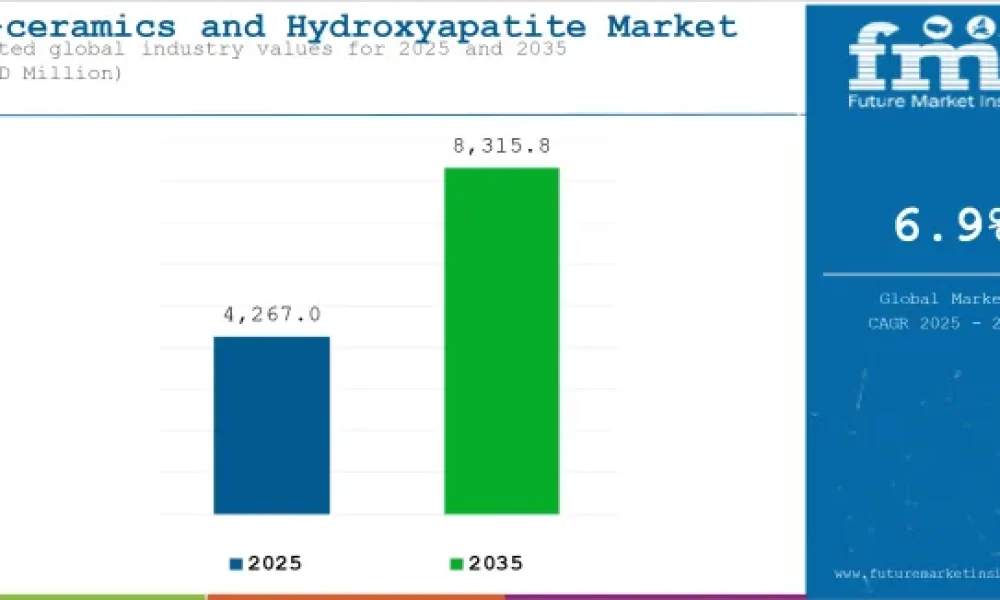
The global bio-ceramics and hydroxyapatite market is entering a decade of significant transformation, propelled by an aging global population, structural healthcare upgrades, and rapid adoption of advanced materials for orthopedic, dental, and regenerative solutions. According to the latest industry outlook, worldwide sales are projected to rise from USD 4,267.0 million in 2025 to USD 8,315.8 million by 2035, reflecting a strong 6.9% CAGR and reinforcing the segment’s emergence as one of the most influential verticals within biomaterials.
This upward trajectory follows the sector’s revenue of USD 3,991.6 million in 2024, with an estimated 6.3% year-over-year growth in 2025. Industry analysts confirm that global demand will accelerate between 2025 and 2035, supported by 6–8% annual growth rooted in rising implant procedures and breakthroughs in high-precision medical manufacturing.
Subscribe for Year-Round Insights → Stay ahead with quarterly and annual data updates: https://www.futuremarketinsights.com/reports/sample/rep-gb-7049
Orthopedics and Dental Applications Fuel Global Momentum
Orthopedic implants continue to anchor market expansion, holding a commanding 44.7% share in 2024. The increasing prevalence of arthritis, osteoporosis, and traumatic injuries underscores the need for durable implant materials that ensure long-term biocompatibility. Hydroxyapatite, which mimics the mineral structure of natural bone, is now indispensable in joint reconstruction and bone grafting, delivering improved integration and reduced implant failure rates.
From hip and knee prosthetics to dental crowns and bridges, alumina-based materials remain dominant due to their hardness, corrosion resistance, and thermal stability. Aluminum oxide maintained the largest share among material types in 2024, accounting for 38.9%, supported by its proven clinical performance and growing adoption across surgical disciplines.
Technology Push: 3D Printing, Nanotechnology, and Coatings
The market is experiencing unprecedented innovation due to the expansion of 3D printing in customized implants, nanotechnology-driven functional improvements, and advanced hydroxyapatite coatings for enhanced bone integration.
Healthcare providers are increasingly turning to 3D-printed hydroxyapatite scaffolds tailored to a patient’s anatomical structure. These implants replicate natural porosity, accelerating recovery times and improving surgical outcomes while reducing material waste—making advanced production more sustainable.
Complementing surgical demand, hydroxyapatite is also gaining ground in skincare, cosmetics, and nutraceuticals, where its regenerative and remineralization properties are reshaping product development pipelines in premium beauty and wellness brands.
Regional Highlights: APAC, Europe, USA & Saudi Arabia Drive Market Leadership
Asia-Pacific (APAC)
APAC remains the fastest-growing region, led by Japan (8.9% CAGR), China (7.6%), and India (6.5%). These markets benefit from the world’s most rapidly aging populations, expanding middle class, and strong healthcare infrastructure investments. Japan’s precision medicine ecosystem has accelerated adoption of hydroxyapatite scaffolds in orthopedic and maxillofacial surgeries, while China’s dual position as both manufacturer and consumer is elevating global production capability.
Europe
Europe is anchored by Germany, the region’s largest and most technically advanced bioceramics hub. With 22% of its population aged 65+, demand for orthopedic reconstruction and dental restoration is surging. German manufacturers such as CeramTec continue to lead globally in engineered bioceramic components for healthcare, dental, and trauma applications.
United States
The U.S. maintains a 4.7% CAGR, driven by a high prevalence of joint disorders, leadership in surgical innovation, and growing public awareness of advanced biomaterials. The nation’s investment in 3D printing and biofabrication is expected to significantly influence global supply chains over the next decade.
Saudi Arabia and GCC
Growing healthcare modernization initiatives and national investment in medical device production position Saudi Arabia as a rising market. Public-private partnerships and medical tourism expansion in the Gulf Cooperation Council (GCC) are expected to boost adoption of high-performance bioceramic implants and coatings.
Need tailored insights? Request report customization to match your specific business objectives: https://www.futuremarketinsights.com/customization-available/rep-gb-7049
Semi-Annual Growth Insights Reinforce Upward Market Trajectory
Annualized half-year analysis reveals consistent performance improvements:
- H1 2024 CAGR: 5.7%
- H2 2024 CAGR: 6.4%
- H1 2025 CAGR: 5.8%
- H2 2025 CAGR: 6.7%
This steady lift is attributed to increasing surgical volumes, post-pandemic recovery in elective procedures, and robust R&D investment.
Sustainability in Focus: Bio-Based Hydroxyapatite Gains Traction
Across major economies, sustainability is becoming a core purchasing criterion. Manufacturers are transitioning toward bio-derived hydroxyapatite sourced from marine shells, natural minerals, and plant-based materials. These eco-friendly alternatives reduce environmental impact and meet rising consumer expectations for responsibly produced medical and cosmetic materials.
Competitive Landscape: Innovation Remains Key Differentiator
The market remains moderately fragmented, with Tier-1 companies such as CoorsTek, Bonesupport AB, Morgan Advanced Materials, CeramTec, Kyocera, and others collectively holding 15–20% of global share. Tier-2 companies, including SofSera, SigmaGraft, and Cam Bioceramics, control 45–50%, focusing on cost-efficient solutions and niche applications.
In February 2024, Cam Bioceramics expanded manufacturing capacity in the Netherlands with a new state-of-the-art facility, enabling higher output of hydroxyapatite powders for orthopedic and dental applications. Earlier, in 2023, the company launched next-generation materials targeting bone tissue engineering, strengthening its presence in regenerative medicine.
Outlook to 2035: A Decade of Opportunity
From 2020 to 2024, the sector sustained 6–8% CAGR, despite pandemic disruptions. Between 2025 and 2035, the market is projected to accelerate to 8–10% CAGR, fueled by:
- Rising bone and dental treatment volumes
- Broader access to advanced healthcare in emerging markets
- Expansion into skincare, nutraceuticals, and veterinary medicine
- AI-enabled customization of implants
- Nanotechnology for enhanced osteoconductivity
With applications rapidly diversifying and technological capabilities expanding, manufacturers are positioned for a decade of transformative growth.
About Future Market Insights (FMI)
Future Market Insights, Inc. (FMI) is an ESOMAR-certified, ISO 9001:2015 market research and consulting organization, trusted by Fortune 500 clients and global enterprises. With operations in the U.S., UK, India, and Dubai, FMI provides data-backed insights and strategic intelligence across 30+ industries and 1200 markets worldwide.
Why Choose FMI: Empowering Decisions that Drive Real-World Outcomes: https://www.futuremarketinsights.com/why-fmi



