
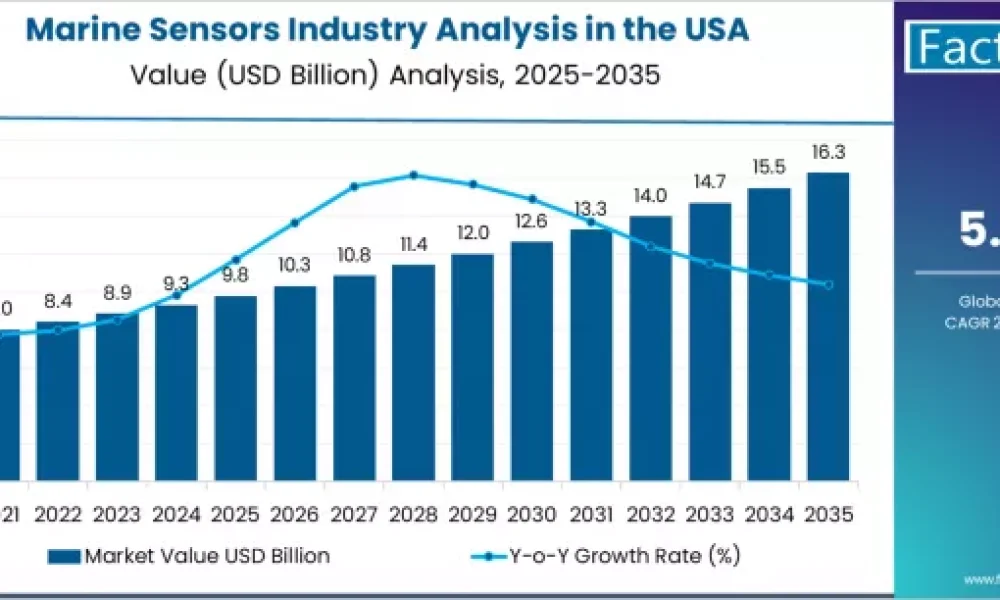
The United States marine sensors industry is projected to grow from approximately USD 9.8 billion in 2025 to around USD 16.3 billion by 2035, at a compound annual growth rate (CAGR) of 5.2%. This strong growth is driven by rising demand for maritime automation, increased offshore energy exploration, and growing investment in naval and commercial vessel sensor systems.
Marine sensors-instruments that measure parameters like flow, pressure, level, environmental chemistry, and acoustic signals-are becoming integral to modern marine operations. As ship operators, energy companies, and defense organizations increasingly rely on high-precision, real-time data, the U.S. marine sensors market is emerging as a critical enabler of operational safety, efficiency, and sustainability.
Key Market Insights at a Glance
2025 Market Value: USD 9.8 billion
2035 Forecast Value: USD 16.3 billion
Forecast CAGR (2025-2035): ~5.2%
Leading Sensor Type (2025): Flow / Level / Pressure Sensors (~48.5% share)
Top Platform (2025): Shipboard Navigation & Automation (~45.2%)
Key Regions in the USA: West, Northeast, South, Midwest
Major Players: Kongsberg Maritime, Teledyne Marine, Thales, Furuno Electric, Garmin, Honeywell
To Access the Complete Data Tables & in-depth Insights, Request a Discount on this report: https://www.factmr.com/connectus/sample?flag=S&rep_id=11496
Market Drivers / Growth Overview
Maritime Automation & Navigation Transformation
U.S. shipping companies and naval operators are increasingly integrating advanced sensor systems to enhance navigation, automation, and vessel intelligence. Shipboard sensors-including flow, pressure, and level types-play a central role in enabling safer and more efficient maritime operations.
Offshore Energy & Subsea Monitoring
As offshore energy (oil, gas, wind) exploration intensifies, demand is growing for robust sensor networks. Marine sensors help monitor subsea pipelines, platforms, and environmental parameters, enabling safer and more informed offshore operations.
Defense & Security Modernization
Naval modernization programs are heavily investing in sensor systems to equip vessels with real-time situational awareness, threat detection, and secure navigation capabilities. Environmental and acoustic sensors are becoming increasingly important in military applications.
Environmental & Scientific Monitoring
Growing interest in oceanographic research, climate monitoring, and maritime environmental regulation is driving demand for environmental sensors that measure water chemistry, temperature, and other ecological parameters.
Technology Advancement & Integration
Improvements in sensor accuracy, miniaturization, and integration are making marine monitoring systems more capable and cost-effective. Suppliers are also embedding real-time data analytics and connectivity, enabling predictive maintenance and smarter marine operations.
Segmental Analysis
By Sensor Type:
Flow / Level / Pressure Sensors dominate due to broad applicability in vessel systems and infrastructure monitoring.
Fact.MR
Acoustic / Sonar & Imaging Sensors are gaining momentum for underwater navigation, object detection, and defense.
Environmental / Chemistry Sensors are increasingly used for ecological monitoring, pollution tracking, and offshore operations.
By Platform:
Shipboard Navigation & Automation (~45.2%) remains the largest application platform, reflecting widespread integration into commercial, naval, and research vessels.
Fact.MR
Offshore Energy & Subsea Monitoring: Sensors installed on platforms and pipelines for real-time data capture.
Research / Autonomous Underwater Vehicles (AUVs) / ROVs: Specialized platforms requiring advanced sensor suites.
By End-User:
Commercial Shipping & Offshore Operators: Leverage sensors for performance, safety, and environmental compliance.
Defense & Security: Naval fleets and coastal defense systems demand high-precision sensors.
Research & Fisheries: Scientific institutions and fisheries use environmental sensors for ecosystem monitoring.
Regional & U.S. Market Insights
The Western United States leads in demand, driven by major ports, offshore infrastructure, and innovation hubs.
Fact.MR
The Northeast also shows strong growth, supported by dense maritime operations, historic shipping centers, and shipbuilding.
Southern states benefit from offshore energy investments, while the Midwest region supports inland marine and freshwater sensor demand.
Competitive Landscape
The U.S. marine sensors market is highly competitive, with several global and specialized providers vying for leadership. Key strategies include:
Expanding R&D on flow, acoustic, and environmental sensors optimized for marine conditions.
Partnering with vessel OEMs, integrators, and defense agencies for bundled sensor system deployments.
Developing compact, low-power, and highly robust sensor modules for offshore and autonomous applications.
Investing in compliance-driven and certified sensor solutions that meet regulatory standards.
Market Outlook & Strategic Insights
By 2035, the marine sensors industry in the USA is expected to reach USD 16.3 billion, driven by continued maritime automation, environmental monitoring, and defense modernization. Strategic priorities for companies include:
Focusing on flow, level, and pressure sensor innovation to capture the largest share.
Developing integrated sensor suites combining acoustic, environmental, and pressure sensing for multi-application use.
Leveraging autonomous platforms such as AUVs and ROVs, targeting growing demand in subsea and research sectors.
Strengthening presence in key U.S. regions via partnerships with shipyards, energy operators, and defense contractors.
Investing in data-enabled sensor systems with predictive analytics and remote maintenance capabilities to boost value.
Organizations that execute on these strategies-while maintaining high reliability, accuracy, and integration capabilities-will be well positioned to capitalize on the rapidly expanding U.S. marine sensors market.
Have specific requirements and need assistance on report pricing or have a limited budget? Please contact [email protected]
Browse Full Report: https://www.factmr.com/report/united-states-marine-sensors-industry-analysis
About Fact.MR:
Fact.MR is a global market research and consulting firm, trusted by Fortune 500 companies and emerging businesses for reliable insights and strategic intelligence. With a presence across the U.S., UK, India, and Dubai, we deliver data-driven research and tailored consulting solutions across 30+ industries and 1,000+ markets. Backed by deep expertise and advanced analytics, Fact.MR helps organizations uncover opportunities, reduce risks, and make informed decisions for sustainable growth.



