

Global Underground Construction Equipment Market: Forecast and Insights (2021–2031)
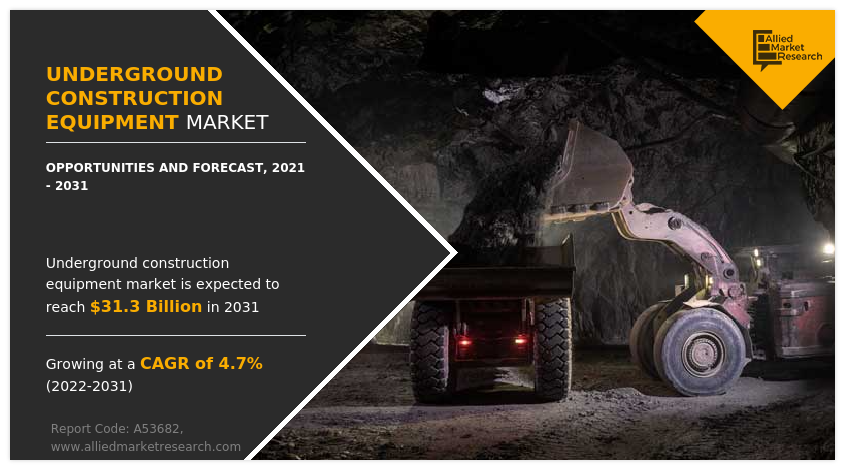
The global underground construction equipment market size at $19.4 billion in 2021, is projected to grow to $31.3 billion by 2031, achieving a compound annual growth rate (CAGR) of 4.7% from 2022 to 2031. This market encompasses specialized machinery designed for construction activities beneath the earth’s surface, including tunneling equipment, piercing tools, vibratory plows, load and haul equipment, underground utility vehicles, dewatering systems, and shotcrete solutions. These machines support critical functions such as tunneling, drilling, hauling, compacting, and dewatering, serving industries like construction, infrastructure, oil and gas, and mining.
𝐃𝐨𝐰𝐧𝐥𝐨𝐚𝐝 𝐏𝐃𝐅 𝐒𝐚𝐦𝐩𝐥𝐞@ https://www.alliedmarketresearch.com/request-sample/A53682
Market Overview
Underground construction equipment is integral to projects requiring subsurface operations, such as tunnel boring, pipeline installation, and mining. The equipment’s applications span multiple sectors, driven by the global demand for infrastructure development, energy exploration, and urbanization. Despite challenges like economic slowdowns and regulatory constraints, the market is poised for growth due to technological advancements, increasing public-private partnerships (PPPs), and rising urban populations.
Market Dynamics
Drivers of Growth
- Public-Private Partnerships (PPPs): The rise in PPPs, particularly in countries like India, China, and African nations, is a significant driver. These joint ventures between governments and private entities facilitate large-scale infrastructure projects, such as highways, railways, and urban transit systems. By leveraging private sector expertise and funding, PPPs enhance project efficiency and drive demand for underground construction equipment market.
- Urbanization and Infrastructure Demand: Rapid urbanization is increasing the need for transportation and infrastructure development. By 2040, the global population is expected to grow by 2 billion, with urban areas expanding by over 40%. This surge necessitates underground infrastructure, such as metro systems and utility tunnels, boosting equipment demand.
- Technological Innovations: Advances in automation and real-time monitoring systems are transforming the industry. For instance, Caterpillar’s onboard weighing systems and real-time feedback mechanisms allow operators to track key performance indicators like production capacity and fuel efficiency. Similarly, Sandvik’s 2020 launch of the autonomous LH514 mining loader and the 2022 introduction of the battery-powered AutoMine® Concept Underground Drill exemplify the shift toward automation. These technologies improve productivity, reduce operational costs, and enable remote equipment management, creating lucrative opportunities for market players.
Restraints
- Economic Slowdowns: The construction sector’s slowdown, particularly during the COVID-19 pandemic, reduced demand for new equipment. Lockdowns in major manufacturing countries like the U.S., Germany, Italy, the UK, and China disrupted production and supply chains, hampering market growth.
- Regulatory and Environmental Challenges: Strict government regulations on carbon emissions and high investment costs pose challenges. Compliance with environmental standards increases production costs, while the capital-intensive nature of underground equipment limits market entry for smaller players.
- Impact of COVID-19: The pandemic significantly disrupted the market in 2020, with lockdowns halting production and reducing demand from key industries. Recovery efforts are ongoing, with manufacturers focusing on workforce safety, supply chain resilience, and innovative operational strategies to navigate post-pandemic challenges.
Opportunities
Technological advancements offer significant growth opportunities. Automation technologies, such as inventory management systems and remote monitoring platforms, streamline operations and reduce costs. Major manufacturers like Komatsu and Epiroc are integrating these technologies to enhance equipment performance, creating a competitive edge. Additionally, the increasing adoption of compact, cost-effective equipment, like Sandvik’s DD322i drill launched in December 2022, supports growth in diverse applications, including small-scale tunneling and mining.
𝐄𝐧𝐪𝐮𝐢𝐫𝐞 𝐁𝐞𝐟𝐨𝐫𝐞 𝐁𝐮𝐲𝐢𝐧𝐠@ https://www.alliedmarketresearch.com/purchase-enquiry/A53682
Segmental Analysis
The underground construction equipment market is segmented by type, solution, application, and region.
By Type
The market includes tunneling equipment, piercing tools, vibratory plows, load and haul equipment, underground utility vehicles, dewatering systems, and shotcrete solutions. In 2021, tunneling equipment held the largest market share due to its critical role in infrastructure projects like railways and highways. Tunnel boring machines (TBMs), used for excavating circular and non-circular tunnels, offer high precision and efficiency, driving their demand. For example, the Hudson Tunnel Project, part of the $11.6 billion Gateway Program in New York City, underscores the importance of TBMs in large-scale infrastructure development.
The shotcrete solutions segment is expected to grow at the fastest CAGR during the forecast period, driven by its use in stabilizing underground structures in mining and tunneling applications.
By Solution
The Underground construction equipment market is divided into products and services. In 2021, the products segment, encompassing machinery like underground loaders, trucks, and TBMs, accounted for the highest revenue share. Major manufacturers like Caterpillar, Epiroc, and Komatsu dominate this segment, offering a wide range of equipment tailored to underground operations.
The services segment, which includes maintenance, repair, replacement parts, and training, is expected to grow steadily. As equipment becomes more complex, demand for aftermarket services is rising, providing manufacturers with additional revenue streams.
By Application
The market serves oil and gas, railway and highway, municipal engineering, underground mining, and other applications. In 2021, the railway and highway segment led in revenue, driven by global infrastructure investments. However, the oil and gas segment is projected to grow at the highest CAGR, fueled by increasing energy demand. For instance, the Energy Information Administration (EIA) predicts a 5.7 million barrels per day rise in global petroleum and liquid fuel demand by 2025, with significant contributions from China and India. Projects like Tanzania’s $3.5 billion crude oil pipeline, set for completion by 2025, further highlight the sector’s growth potential.
By Region
The market is analyzed across North America, Europe, Asia-Pacific, and LAMEA (Latin America, Middle East, and Africa). In 2021, Asia-Pacific held the largest market share and is expected to maintain its dominance through 2031. Rapid economic growth, with Asia’s regional economy expanding by 6% in 2017 and projected to continue growing, drives demand for underground construction equipment. China, a major exporter, benefits from low labor and material costs, enabling competitive pricing. India’s industrial growth and infrastructure investments, such as those supported by Invest India, further bolster the region’s market.
North America and Europe also contribute significantly, driven by infrastructure modernization and mining activities. LAMEA is expected to grow steadily, supported by oil and gas exploration and urban development projects.
Competitive Landscape
Key players in the underground construction equipment market include Caterpillar Inc., China Railway Group Limited, Epiroc AB, Global TBM Company, Herrenknecht AG, Kawasaki Heavy Industries, Ltd., Komatsu Ltd., Mitsubishi Corporation, Sandvik AB, and Sany Group Co., Ltd. These companies employ strategies like product launches and acquisitions to strengthen their market position.
- Product Launches: In December 2022, Sandvik introduced the DD322i, a compact, automated twin-boom drill for underground development and small-scale tunneling. Its versatility and low operational costs make it ideal for confined spaces.
- Acquisitions: In December 2022, Komatsu acquired GHH Group GmbH, a German manufacturer of underground mining and tunneling equipment, expanding its product portfolio and global reach.
Key Benefits for Stakeholders
This underground construction equipment market analysis provides:
- A quantitative evaluation of Underground construction equipment market segments, trends, and dynamics from 2021 to 2031.
- Insights into key drivers, restraints, and opportunities.
- Porter’s Five Forces analysis to assess buyer and supplier dynamics.
- In-depth segmentation to identify high-growth opportunities.
- Regional revenue contributions and market player positioning.
- Comprehensive trends, strategies, and competitive insights.




