
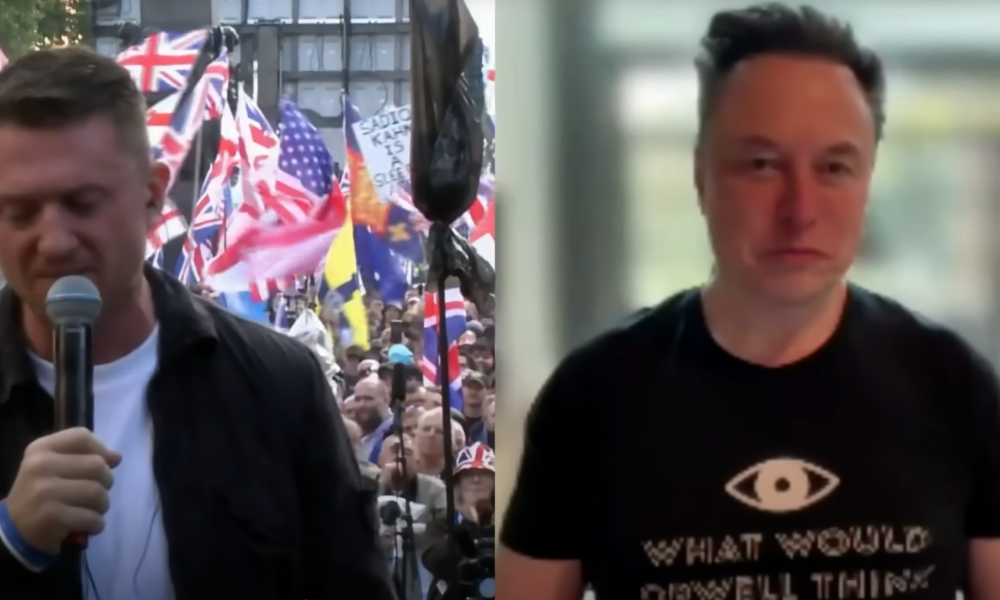
The UK government has once again exposed its double standards. When Donald Trump arrives for his second state visit, thousands are allowed to gather in Parliament Square under the “Stop Trump Coalition” banner. Police liaise with organisers, ensure safety, and even tolerate mockery—Trump baby blimps, satirical signs, and public performances. The protest is presented as a vibrant display of “British democracy.”
But contrast this with the way police dealt with recent Unite the Kingdom demonstrations. Peaceful protesters faced heavy-handed crackdowns, with reports of police violence unleashed against citizens exercising the same right to assembly. In Trump’s case, the state bends over backwards to accommodate dissent; in domestic cases where the message cuts closer to home, it responds with batons and suppression.
It raises an uncomfortable question: is protest in Britain only tolerated when it targets foreign leaders? When grievances are directed at Downing Street or challenge establishment policies, the democratic mask slips and the iron fist comes out.
This selective policing shows not a commitment to free speech, but a cynical calculation. The government gains diplomatic cover by showcasing protest against Trump—while quietly criminalising the very same freedoms when aimed at its own failures.
What experts/reports say about freedom of expression & two-tier policing in the UK
The Commons Library’s report on the 2024 summer riots notes that “some commentators have accused the police of ‘two-tier policing’ in their response to the riots”, meaning that “political pressure leads the police to act more leniently to protests … associated with left-wing causes, compared to those involving right-wing causes.” House of Commons Library
In that same report, it’s emphasised that this allegation (of two-tier policing) predates the riots. It has been applied also in the policing of Black Lives Matter protests during COVID-19 restrictions. House of Commons Library
Graham Wettone, former Met public order specialist, says that there are “tiers” in policing response — but not based on political favouritism. He states:
“Of course there are — because you make operational decisions appropriate to the severity of the situation. But there are not tiers based on preference or favouritism.” The Guardian
Ruth Ehrlich, Head of Policy and Campaigns at Liberty, warns against equating legitimate protest with destructive movements. She argues:
“Politicians and media should not be equating legitimate protest movements – calling for social progress and social justice – with what we are seeing today. Which is really Islamaphobic and racist movements that are causing destruction up and down the country.” The Independent
In the Devon & Cornwall Police & Crime Commissioner’s “Two-tier Policing Insight Report 2024”, it is noted that although high-profile political figures (e.g. Suella Braverman, Nigel Farage) have voiced concerns, the report itself did not conclude that two-tier policing was an established issue. devonandcornwall-pcc.gov.uk
In that same report, PM Keir Starmer is quoted as saying:
“There is no two-tier policing” and “There is policing without fear or favour – exactly as it should be, exactly what I would expect and require. So that is a non-issue.” devonandcornwall-pcc.gov.uk
Also from the report, former Home Secretary Priti Patel said:
“That is not correct. It is not correct” in response to claims that two-tier policing exists. devonandcornwall-pcc.gov.uk
Metropolitan Police Commissioner Sir Mark Rowley described accusations of two-tier policing as:
“Complete nonsense”. He said: “We operate independently under the law without fear or favour.” devonandcornwall-pcc.gov.uk
Experts warn that the concept of two-tier policing can be very simplistic and misleading, because policing outcomes depend heavily on context: threat level, intelligence, scale, public safety risk. Wettone argues that what often looks like disparate treatment is better explained by these operational differences. Police Oracle+2Policing Insight+2
There is concern from human rights / civil liberties groups that freedom of expression and the right to protest are being under pressure by new laws and policing powers. For example, changes in the Public Order Act and its interpretation are seen to give police broader discretion, which could be used to suppress protest. Policing Insight+2Police Oracle+2
The HMICFRS inspection “Activism and Impartiality in Policing” found that “most police officers and staff told us they believe they do act with impartiality.” hmicfrs.justiceinspectorates.gov.uk
That same inspection, however, flagged that there is a risk from political interference: forces need to pay “close attention to the risk of political interference.” devonandcornwall-pcc.gov.uk+1
Experts in policing insight argue that the capacity of forces — training, officer numbers, equipment — is stretched. This means that slower or more cautious responses are sometimes due to logistical constraints rather than conscious bias. Policing Insight
Some analysts stress that public perception matters: even when policing is legally defensible and operationally justified, if people believe there is bias, it damages trust. The “impression of two-tier policing” is significant even if not conclusively proven. Nigel Farage is quoted:
“The impression of two-tier policing has become widespread” after what he sees as “soft policing of Black Lives Matter protests.” Sky News+2The Independent+2
There is criticism of political leaders who themselves frame protestors in binary terms (good vs bad), which may fuel perceptions of unequal policing. Ruth Ehrlich (Liberty) for example: warning that “politicians and media should not be equating legitimate protest movements … with … destructive movements …” The Independent
Some commentators assert that actions taken at protests (arrests, force, etc) have been more visible and scrutinised when the protestor group is from a minority or left-wing cause. But experts like Wettone emphasize many arrests have also been made in pro-Palestinian, climate, BLM protests when criminal or public order thresholds are breached. Police Oracle+2Sky News+2
The Devon & Cornwall report points out that misinformation via social media can distort public understanding of how policing decisions are made, leading to exaggerated or inaccurate claims of two-tier policing. devonandcornwall-pcc.gov.uk
Freedom of expression is legally protected under European Convention on Human Rights (ECHR), including ECHR articles on assembly, speech, etc. Experts remind that there are legal limits (hate speech, incitement, public order) but those limits must be clearly defined and fairly applied. The Independent
Clifford Stott, professor of social psychology and crowd behaviour, has argued that when police respond with force (or are perceived to), crowds often view it as “illegitimate police use of force”, which increases tension. He says peaceful protesters believe they have a right to express their views, and when that is disrupted, conflicts can escalate. Wikipedia
Experts assert that transparency and oversight are essential: better data, monitoring, independent reviews are repeatedly called for — both to clarify whether two-tier policing is in fact happening, and to maintain public confidence. Reports like those from HMICFRS and Police & Crime Commissioner offices recommend updating guidance, improving training, and ensuring decisions are explainable.
The hypocrisy is glaring: a country that lectures others on liberty and human rights cannot even apply the same standard to its own citizens.




