
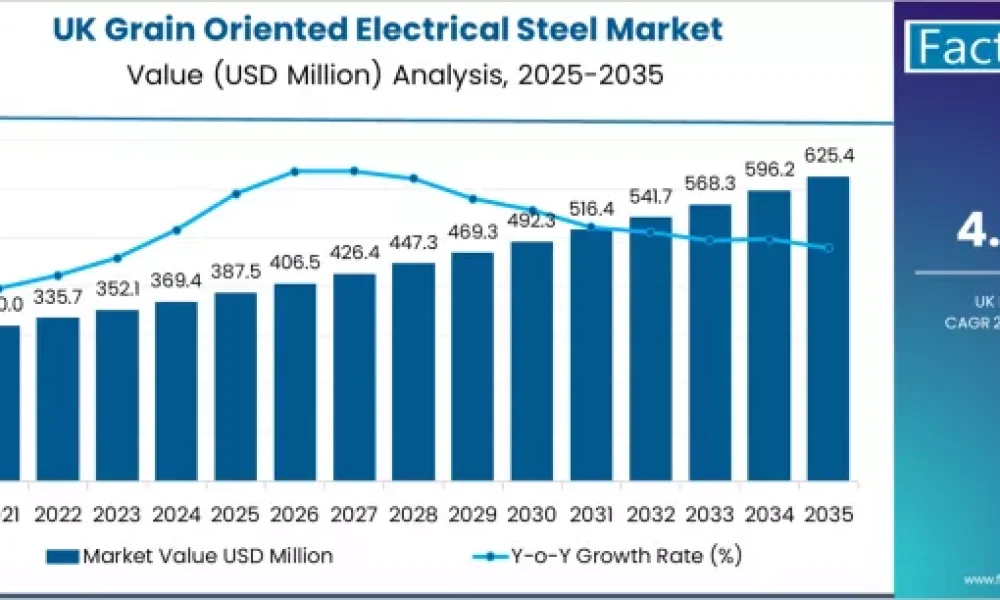
The UK’s demand for grain-oriented electrical steel is expected to increase at a compound annual growth rate (CAGR) of 4.9% between 2025 and 2035, from USD 387.5 million in 2025 to roughly USD 625.4 million.
Grain oriented electrical steel (GOES) is a specialized high-silicon electrical steel with a highly aligned grain structure that offers excellent magnetic properties, low core loss, and high permeability. It is a critical material in the production of electrical transformers, reactors, generators, and other electromagnetic applications where efficiency and reduced energy loss are vital. In the UK, demand for GOES is closely tied to power infrastructure modernization, renewable energy integration, electric vehicle (EV) charging infrastructure, and industrial electrification.
The United Kingdom’s energy transition, ambitious net-zero targets, and increasing electrification across industries are driving robust growth in demand for high-performance electrical steels — particularly GOES — which support energy efficiency improvements and reduced operational costs in electrical equipment.
Quick Stats (2025–2035)
Estimated Market Value 2025: ~USD 320 million
Forecast Market Value 2035: ~USD 570 million
Projected CAGR (2025–2035): ~5.9%
Largest End-Use Segment (2025): Power transformers
Key Growth Drivers: Energy efficiency regulations, grid modernization, renewable integration
High-Growth Adjacent Segment: Electric vehicle charging & power electronics
To access the complete data tables and in-depth insights, request a Discount On The Report here: https://www.factmr.com/connectus/sample?flag=S&rep_id=12439
What Is Grain Oriented Electrical Steel?
Grain oriented electrical steel is a type of silicon-rich steel that has been processed (cold-rolled and annealed) in a way that aligns the grain structure along the rolling direction. This orientation dramatically enhances magnetic properties in that direction, resulting in:
High magnetic permeability
Low hysteresis and core losses
Improved energy efficiency in AC magnetic circuits
Superior performance in transformer cores and large electrical machines
Because of these characteristics, GOES is preferred for applications where magnetic performance is critical and energy losses must be minimized.
Market Drivers in the UK
1. Power Grid Modernization & Efficiency Standards
The UK is investing in grid upgrades to enhance reliability, reduce losses, and support distributed generation. Modern transformers and power grid components require high-efficiency materials like GOES to meet stringent energy performance norms.
2. Renewable Energy Integration
Integration of wind, solar, and other renewable sources into the UK grid requires advanced transformers and power conditioning equipment. GOES helps in constructing high-efficiency transformers that handle variable load and power quality challenges posed by renewables.
3. Electrification & Decarbonization Initiatives
The UK’s net-zero emissions commitments are accelerating electrification of transportation, heating, and industrial processes. This increases demand for efficient electrical equipment — including transformers, reactors, and motors — that use GOES for reduced energy losses.
4. Industrial Growth & Energy-Intensive Sectors
Energy-intensive industries such as manufacturing, chemicals, and mining in the UK are adopting energy-efficient electrical infrastructure to cut operating costs. GOES-based components contribute directly to lower energy consumption.
5. Expansion of Electric Vehicle Ecosystem
Widespread adoption of electric vehicles (EVs) is driving demand for EV charging stations, substations, and power electronics hardware. These systems often incorporate GOES in transformer cores and other electromagnetic components to improve efficiency and reduce heat generation.
Market Segmentation & Insights
By Application
Power Transformers
Largest application segment in 2025 due to extensive use in distribution and transmission networks.
GOES helps reduce core losses and improve transformer efficiency, a key criterion in grid and industrial applications.
Distribution Transformers
Widely used in residential and commercial distribution; GOES improves voltage regulation and operational efficiency.
Industrial & Commercial Transformers
Medium and large industrial transformers demand higher grades of GOES for performance and energy savings.
Electric Machines & Power Electronics
Growing use in generators, large motors, frequency converters, and EV charging infrastructure.
Demand is increasing as manufacturing and electrification intensify.
By Grade / Material Type
M2 / M4 / M5 High-Permeability Grades: Popular for general transformer and industrial applications due to balanced performance and cost.
Ultra-High-Permeability / Low-Loss Grades: Preferred for premium, low-loss transformer cores in utility and renewable energy applications.
Specialty GOES Variants: Tailored for niche or high-performance applications like compact power electronics modules.
By End User / Industry
Utilities & Power Generation: Largest end users due to ongoing network upgrades and transformer replacement programs.
Industrial & Manufacturing: Strong consumption tied to factory electrification and industrial automation.
Construction & Infrastructure: GOES is critical in building electrical systems with efficient power distribution networks.
Transport & Mobility: Growth in EV infrastructure and rail electrification supports high-efficiency steel demand.
Regional Dynamics in the UK
England: Major share driven by dense population, urban infrastructure, and high industrial activity.
Scotland & Wales: Growth in renewable energy projects and grid modernization supports GOES demand.
Northern Ireland: Expanding electrification and utility upgrades contribute to steady demand.
Across regions, demand is supported by a robust network of power utilities, industrial clusters, and infrastructure projects requiring high-efficiency electrical materials.
Challenges & Market Restraints
Raw Material Price Volatility
Fluctuations in crude steel and silicon prices influence GOES production costs, affecting pricing and margins.
Competition from Alternative Materials
In some power electronics and machine applications, non-oriented electrical steels or soft magnetic composites can be used, though they often offer lower efficiency than GOES for core-loss sensitive applications.
Manufacturing Complexity
GOES production involves specialized processing, precise control over grain orientation, and rigorous quality control — requiring high technical capability and capital investment.
Supply Chain Dependencies
Dependencies on upstream raw material suppliers and international trade dynamics can affect lead times and availability.
Opportunities & Strategic Directions
1. Local/Regional Manufacturing Investments
Encouraging local production of GOES and related steel grades can reduce supply chain risks and enhance responsiveness to domestic demand.
2. Advanced GOES Grade Development
Innovation in ultra-low loss, high permeability, and application-specific GOES grades can help manufacturers meet stricter energy efficiency targets in power and electronics sectors.
3. Collaboration with Renewables & EV Stakeholders
Partnerships with renewable project developers, EV infrastructure companies, and utility providers can accelerate GOES adoption in key electrification projects.
4. Value-Added Services & Engineering Support
Providing design, consulting, and customization services for transformer/core design using GOES can differentiate suppliers and build long-term customer relationships.
5. Circular Economy & Recycled Steel
Integrating recycled steel content into GOES production and improving material recovery practices can support sustainability goals and appeal to eco-conscious industries.
Outlook (2025–2035)
The demand for grain oriented electrical steel in the UK is forecast to grow steadily from an estimated USD 320 million in 2025 to approximately USD 570 million by 2035, at a projected CAGR of around 5.9%. Growth will be driven by ongoing investments in power grid upgrades, renewable energy integration, industrial electrification, expansion of EV infrastructure, and the need for energy-efficient electrical equipment.
Utilities and large industrial consumers will remain the primary demand centers, while emerging end-use segments such as power electronics and mobility applications will expand the market’s base. Innovation in material grades, localized production strategies, and strong industry partnerships will be key factors shaping future market dynamics.
Overall, GOES is positioned as a foundational material in the UK’s ongoing energy transition, offering performance advantages that align with national goals for efficiency, sustainability, and electrification. Suppliers and manufacturers that align with evolving energy and industrial trends are likely to capture the greatest growth opportunities through 2035.
Have specific requirements or need assistance on report pricing or have a limited budget? Please contact [email protected]
About Fact.MR:
Fact.MR is a global market research and consulting firm, trusted by Fortune 500 companies and emerging businesses for reliable insights and strategic intelligence. With a presence across the U.S., UK, India, and Dubai, we deliver data-driven research and tailored consulting solutions across 30+ industries and 1,000+ markets. Backed by deep expertise and advanced analytics, Fact.MR helps organizations uncover opportunities, reduce risks, and make informed decisions for sustainable growth.



