
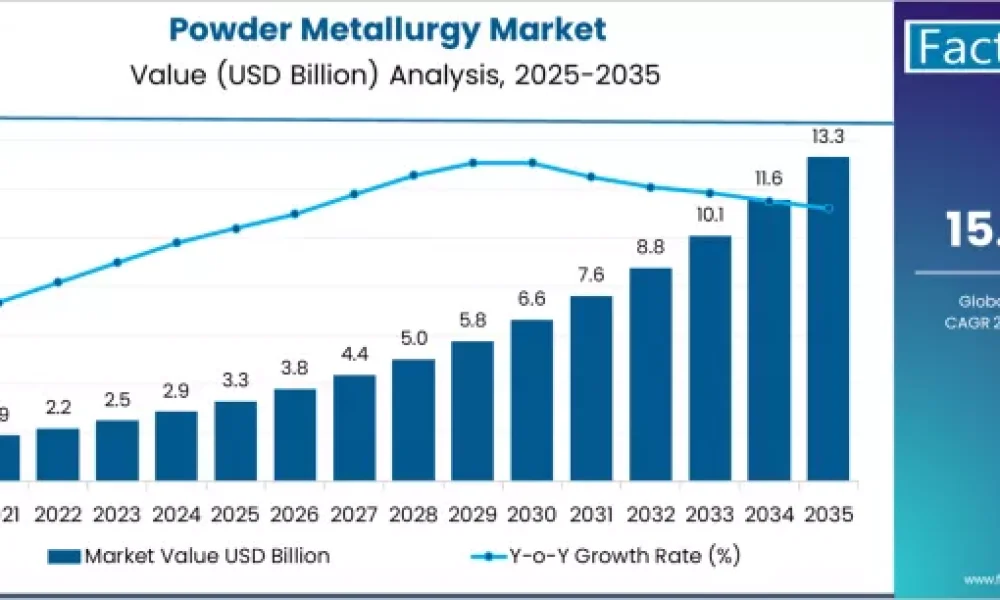
With a compound annual growth rate (CAGR) of 15.0%, the global powder metallurgy market is expected to increase from USD 3.3 billion in 2025 to USD 13.3 billion by 2035, adding USD 10.0 billion in new revenue.
The powder metallurgy (PM) market is entering a phase of strong expansion, driven by rising demand for lightweight components, precision manufacturing, and high-performance materials across key industries such as automotive, aerospace, medical devices, and industrial machinery. Powder metallurgy enables the production of complex, high-strength metal components while minimizing material waste and improving efficiency. As industries continue to focus on sustainability, performance, and cost-effectiveness, PM is increasingly becoming an essential manufacturing technology.
Quick Stats (2025–2035)
Estimated Market Size in 2025: Around USD 3.3 billion
Projected Market Size in 2035: About USD 13.3 billion
Growth Rate (CAGR 2025–2035): Approximately 15%
Leading Technology in 2025: Metal Injection Molding (largest share)
Top End-Use Industry: Automotive
Fastest-Growing Material Category: Titanium, aluminum, and high-performance alloy powders
To access the complete data tables and in-depth insights, request a Discount On The Report here: https://www.factmr.com/connectus/sample?flag=S&rep_id=12388
What Powder Metallurgy Is & Why It Matters
Powder metallurgy is a manufacturing process in which metal powders are compacted, shaped, and sintered to form highly precise metal components. It is widely used because it offers:
Near-net shape production with minimal finishing required
Complex geometries that traditional casting or machining cannot easily achieve
High material utilization, reducing waste significantly
Consistent quality, especially useful for mass production
Compatibility with modern processes, such as additive manufacturing
These benefits make PM a preferred choice for industries seeking strength, precision, and efficiency.
Market Drivers
1. Automotive Lightweighting & Efficiency Demands
Automakers are under pressure to improve fuel efficiency and reduce emissions. Powder metallurgy allows the production of lightweight transmission components, gears, bearings, and structural parts with excellent dimensional accuracy. The rise of electric vehicles adds additional demand for lightweight and high-strength components, further increasing PM adoption.
2. Growth of Additive Manufacturing (Metal 3D Printing)
Metal additive manufacturing relies heavily on fine metal powders — directly supporting PM industry growth. Aerospace, healthcare, and custom engineering sectors increasingly rely on metal 3D printing for lightweight, complex, and high-performance components, boosting demand for PM-grade powders and processes.
3. Rising Use in Aerospace & High-Performance Sectors
Aerospace applications require materials that are lightweight, durable, and capable of withstanding high temperatures. Powder metallurgy meets these needs, making it suitable for turbine components, structural fittings, and high-strength specialty parts. Its design flexibility also supports advanced engineering requirements in defense and aviation.
4. Medical Implants & Precision Components
Medical devices increasingly rely on powder metallurgy for producing orthopedic implants, dental components, and surgical tools. Titanium and biocompatible alloy powders used in PM offer superior performance, customization, and reliability.
5. Sustainability & Waste Reduction
PM reduces scrap material, consumes less energy, and produces parts more efficiently than traditional machining. As industries move toward environmentally responsible manufacturing, PM offers a path to achieving sustainability targets.
Market Segmentation
By Process
Metal Injection Molding (MIM): Major share due to high precision and suitability for mass production.
Press & Sinter: Widely used for automotive and industrial parts where cost-effective, high-volume production is required.
Additive Manufacturing: The fastest-growing segment, crucial for custom and complex parts.
Hot Isostatic Pressing (HIP): Used for high-strength, high-density components in aerospace and defense.
By Material
Steel & Ferrous Powders: Most widely used due to cost-effectiveness and versatility.
Aluminum & Titanium Powders: High-performance, lightweight applications in aerospace, EVs, and medical.
Superalloy Powders: Used for extreme environments and advanced performance needs.
By End Use Industry
Automotive: Largest share due to demand for gears, bearings, and drivetrain components.
Aerospace & Defense: High-performance structural and engine parts.
Healthcare: Implants, prosthetics, surgical instruments.
Industrial Machinery: Precision-engineered parts for heavy-duty machinery and tools.
Challenges
Despite strong growth potential, the PM market faces certain challenges:
High cost of specialized metal powders, especially titanium and alloy variations
Expensive manufacturing equipment required for advanced PM technologies
Need for strict quality control, especially in aerospace and medical applications
Competition from traditional methods in applications where PM advantages are not critical
Opportunities Ahead
1. EV Components and Electrification
Electric vehicles require high-strength, lightweight components — a perfect fit for PM-produced parts such as motor components, housings, and heat-resistant structures.
2. Expansion of Additive Manufacturing
As 3D printing becomes more mainstream, demand for PM-grade metal powders and hybrid processes will surge.
3. Increasing Use in Medical & Healthcare Industries
The growing need for personalized implants and biocompatible devices creates strong long-term opportunities for PM.
4. Advanced Alloys & Specialty Powders
Development of high-performance materials offers new revenue streams for powder producers.
Market Outlook (2025–2035)
The powder metallurgy market is set for robust expansion throughout the next decade. With a strong push toward lightweighting, precision engineering, advanced materials, and sustainable manufacturing, PM is transitioning from a niche process to a mainstream industrial technology. Industries that prioritize efficiency and performance — especially automotive, aerospace, and medical — will continue driving significant growth in the market.
Have specific requirements or need assistance on report pricing or have a limited budget? Please contact [email protected]
About Fact.MR:
Fact.MR is a global market research and consulting firm, trusted by Fortune 500 companies and emerging businesses for reliable insights and strategic intelligence. With a presence across the U.S., UK, India, and Dubai, we deliver data-driven research and tailored consulting solutions across 30+ industries and 1,000+ markets. Backed by deep expertise and advanced analytics, Fact.MR helps organizations uncover opportunities, reduce risks, and make informed decisions for sustainable growth.



