
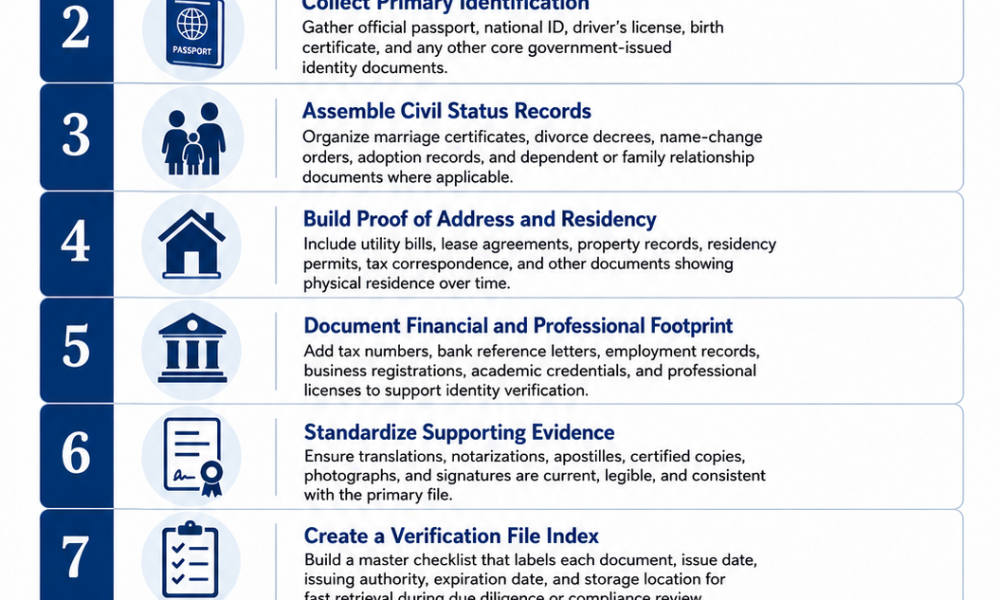
Detailed Checklist for Organizing Real Life Events, Official Documents, Professional Records, and Periodic Consistency Reviews for Lawful Identity Planning
WASHINGTON, DC, June 19, 2026
Building a verification-ready legal identity file requires discipline, accuracy, and a clear refusal to fabricate life stories, because modern banks, border systems, tax authorities, and government agencies increasingly compare identity records across digital verification environments.
A lawful identity file may support second citizenship, legal name changes, residence planning, tax registration, banking passports, and international mobility, but every element must be linked to a single truthful person through official, verifiable documentation.
The objective is not to create a “bulletproof legend” because fabricated relationships, invented employment, false education records, or fictional life events can lead to serious immigration, banking, tax, and criminal consequences when institutional verification begins.
Lawful identity planning begins with verified truth.
The first step is to define the lawful purpose of the identity file, such as second citizenship, residence planning, banking onboarding, legal name continuity, family office administration, tax classification, or relocation readiness.
That purpose should be clearly stated because advisers, banks, and government authorities may need to understand why documents are being organized, which records are current, and how older records relate to the present profile.
A credible identity file does not rely on storytelling; it relies on real documents, accurate dates, professional confirmations, and a timeline that can be verified through official or institutional channels.
This foundation matters because a truthful, well-organized profile can withstand routine review, while a fabricated legend may collapse as soon as one institution checks a school, employer, passport, or tax record.
Step one: define the legal status being supported.
The identity file should begin by identifying which legal status or statuses are being supported, because citizenship, residence, tax identity, corporate authority, and banking access each require different records.
A second citizenship file may require birth records, naturalization certificates, descent documents, investment approval letters, or passport records, while a residence file may require leases, permits, utility bills, and evidence of physical presence.
A banking file may require source-of-wealth records, tax numbers, proof of address, beneficial ownership charts, and professional references, while a legal name file requires official name-change documents and continuity records.
The status definition prevents confusion because the client is not trying to create a fictional identity, but organizing real evidence around a lawful status recognized by a government or regulated institution.
Step two: gather civil identity documents.
Civil identity documents form the foundation of every lawful identity profile because they establish name, date of birth, place of birth, parentage where relevant, nationality, marital history, and legal continuity.
The file should include birth certificates, current passports, expired passports where relevant, citizenship certificates, marriage records, divorce decrees, adoption records, legal name-change orders, and any official corrections issued by competent authorities.
Each record should be checked for spelling, dates, document numbers, issuing authority, translation accuracy, and consistency with the client’s current passport and tax records.
If a civil document contains an error, the correction should be made through the issuing authority, not through private explanations, because unsupported differences can create credibility problems during later verification.
Step three: Organize citizenship and passport records.
Citizenship and passport records should be arranged chronologically so advisers can see when each nationality was acquired, how it was obtained, and which documents prove the legal basis.
The file may include citizenship-by-descent approvals, naturalization certificates, citizenship-by-investment approval letters where lawful, passport issuance records, dual nationality explanations, and renewal history.
The U.S. State Department’s guidance on passport and visa fraud demonstrates why travel-document records must remain accurate, official, and consistent across all applications, renewals, and institutional uses.
A second passport can support lawful mobility, but it should never be treated as a separate persona, because every passport belongs to the same person and must be integrated into one coherent identity profile.
Step four: build a real-life event timeline.
A life-event timeline should organize real events in chronological order, including birth, education, employment, business activity, marriage, divorce, relocation, citizenship changes, residence moves, and major financial milestones.
The timeline should not be written as a fictional backstory, because its purpose is to help banks, advisers, immigration counsel, and trustees understand the client’s actual history without receiving contradictory explanations.
Each major event should be linked to documents, such as school records, employment contracts, tax filings, business sale agreements, residence permits, property records, or official family documents.
When a period of life is complicated or contains gaps, the solution is a truthful explanation supported by available records, not inventing relationships, jobs, or addresses to make the file appear smoother.
Step five: document education honestly.
Education records may matter for immigration, professional licensing, banking due diligence, investor review, board appointments, or public credibility, making accuracy essential for any verification-ready identity file.
The file should include transcripts, diplomas, certificates, credential evaluations, professional training records, and licensing confirmations where relevant to the client’s international profile.
A client should never fabricate degrees, inflate credentials, or invent attendance at institutions because education claims are often easy to verify through registrars, licensing boards, and credentialing agencies.
A modest education history supported by real documents is far stronger than an impressive but unverifiable claim that exposes the client to reputational and legal risk.
Step six: document employment and professional history.
Employment and professional history should be supported by reliable records because banks, tax advisers, immigration authorities, and financial institutions often link personal identity to source-of-wealth reviews.
Useful records may include employment contracts, pay statements, tax filings, employer letters, professional licenses, company records, board appointments, partnership agreements, consulting contracts, and business ownership documents.
The file should show how the client earned income, built businesses, accumulated assets, and transitioned between roles, especially if wealth later moved into banking, trust, or citizenship planning structures.
False employment claims create long-term risk because professional references, tax records, public filings, and company registries can expose unsupported statements during verification.
Step seven: connect the source of wealth to the timeline.
Source-of-wealth documentation should align with the life-event timeline because institutions need to understand not only who the client is, but also how assets were created, received, or transferred.
Records may include business sale agreements, dividend records, inheritance documents, property sale contracts, brokerage statements, investment reports, loan agreements, trust distribution records, and tax returns.
A banking passport can help organize this material, and guidance on how a universal tax identification number works explains why tax identity and financial records must connect clearly across institutions.
The client should be able to explain how wealth moved from origin to current accounts without relying on vague statements, because unclear source-of-wealth records often trigger deeper due diligence.
Step eight: document residence history accurately.
Residence history should reflect where the client actually lived, held lawful residence rights, maintained tax connections, or used official addresses for banking, immigration, business, or family purposes.
The file may include leases, deeds, utility bills, residence permits, tax registrations, school records, insurance policies, medical registrations, local identification cards, and professional adviser confirmations.
Privacy can still be protected because sensitive addresses do not need to be shared unnecessarily, but institutions entitled to residence evidence must receive accurate information when required.
Artificial residence claims can create tax, immigration, and banking problems because institutions may compare address declarations against account activity, travel history, family records, and supporting documents.
Step nine: synchronize legal name records.
Legal name changes should be handled as continuity records, not identity breaks, because former names, current names, and official transition documents must remain connected inside a secure historical file.
The file should include the name-change order, updated passport, tax updates, banking notifications, insurance changes, property title updates, corporate filings, and any professional licensing updates affected by the change.
A lawful name change can support privacy, family changes, personal safety, or professional reasons, but it does not erase prior obligations or old records that may still need to be explained.
The strongest approach keeps former-name records secured and clearly marked, ensuring that old documents do not circulate as current records while remaining available for legitimate verification.
Step ten: coordinate travel-document use.
Travel documents should be coordinated carefully because airlines, immigration authorities, visa systems, banks, and insurers may compare names, passport numbers, and nationality records across applications and travel records.
Clients with more than one citizenship should maintain a passport-use matrix showing which passport is used for which country, which visas or residence permits attach to each document, and which rules apply to dual nationals.
Resources explaining electronic passport security show why modern passports operate within a broader verification ecosystem that includes chips, machine-readable zones, and official identity records.
The goal is not to manipulate travel records, but to prevent lawful multi-passport use from creating unnecessary confusion through mismatched bookings, expired documents, or unsupported explanations.
Step eleven: create a tax identity map.
A tax identity map should identify tax residence, tax identification numbers, foreign account reporting duties, business reporting obligations, trust connections, and any citizenship-based tax rules that apply.
This map should distinguish citizenship, residence, tax residence, mailing address, business address, and temporary travel location because each category may create different obligations.
The tax file should include tax returns, adviser letters where appropriate, residency analysis, foreign account reporting records, and forms provided to banks or investment platforms.
A client should not treat different passports as separate tax lives, because tax authorities usually examine the real person, actual residence, and beneficial ownership behind the accounts.
Step twelve: align banking and entity records.
Banking and entity records should match the identity file because private banks, trustees, custodians, and investment platforms may compare passports, addresses, tax numbers, and beneficial ownership records.
The file should include bank reference letters, account purpose summaries, proof of address, source-of-funds records, entity charts, trust summaries, director records, shareholder registers, and authorized signatory documents.
If the client controls companies, trusts, or foundations, every record should accurately identify the same person, even when public exposure is reduced through lawful structuring.
A mismatch between personal identity records and entity records can lead to account delays, heightened due diligence, and unnecessary circulation of sensitive documents.
Step thirteen: Prepare third-party verification sources.
Third-party verification should be planned by identifying which institutions can confirm civil records, education, employment, residence, citizenship, tax status, professional licensing, and source of wealth.
This does not mean coaching people to support a story, because legitimate verification depends on real institutions confirming real facts within their authority.
A university may confirm attendance; an employer may confirm dates of employment; a lawyer may confirm representation; an accountant may confirm tax records; and a bank may confirm relationship history.
Professional references should be truthful, limited, and carefully drafted so they support verified facts rather than broad claims that the reference provider cannot responsibly confirm.
Step fourteen: secure every document channel.
A verification-ready identity file contains sensitive information, including passports, signatures, tax numbers, bank statements, family records, addresses, legal documents, and personal history records.
These records should be stored in encrypted digital systems, securely backed up, protected by strong authentication, and shared only with authorized advisers or institutions that need them.
Advisers should use secure portals where possible and avoid forwarding full identity files through casual email chains, personal messaging apps, or shared folders with broad access.
Document security protects privacy because the same records that support lawful verification can also create identity theft, fraud, and personal security risks if exposed.
Step fifteen: test the file for consistency.
Testing the identity file should be a compliance review, not a rehearsal for deception, because the purpose is to identify contradictions before banks, governments, or advisers discover them.
The review should compare passports, tax forms, evidence of residence, employment records, dates of education, corporate filings, banking records, family documents, and source-of-wealth statements.
The test should ask whether every major claim has supporting evidence, whether old records are separated from current records, and whether all documents point to a single truthful person.
If a conflict appears, the correct response is to correct records or document the truthful explanation, not to create new false details to cover the inconsistency.
Step sixteen: update the file after every material change.
A legal identity file should be updated after a passport renewal, new citizenship, a residence change, a legal name change, marriage, divorce, a business sale, a trust restructuring, a tax status change, or a major banking transition.
Old records should be preserved securely because historical continuity may be needed, but they should be clearly marked so that outdated addresses, expired passports, or former names are not used accidentally.
Banks, trustees, tax advisers, corporate registries, insurers, and immigration counsel should be updated through proper channels when material facts change.
A file that is accurate today can become risky later if routine life changes are not reflected across every institution that relies on the identity profile.
Step seventeen: Review the file annually.
An annual identity review should confirm that passports remain valid, residence records are current, tax forms match reality, professional records remain accurate, and banking files reflect the client’s current circumstances.
The review should also identify outdated documents, unused accounts, dormant entities, old addresses, expired permits, and professional references that should be replaced or archived.
For family offices, the annual review should include dependents, spouses, trustees, authorized signers, and family governance records, as identity consistency often depends on multiple people.
Regular review prevents small administrative errors from growing into major credibility issues during immigration, banking, investment, or tax scrutiny.
Step eighteen: define who may access the file.
Access rules are essential because not every adviser, vendor, assistant, family member, or service provider needs to see the entire identity file.
A lawyer may need civil records, a banker may need source-of-wealth documents, a tax adviser may need residency records, and a relocation consultant may need only limited identification details.
Controlled disclosure protects privacy by ensuring that the right institution receives accurate information while unnecessary parties receive nothing beyond their specific lawful role.
This approach is more secure than secrecy because the file remains verifiable while exposure is reduced through disciplined access management.
Step nineteen: Avoid legend-building shortcuts.
Clients should avoid any provider who offers fabricated life stories, invented employment histories, false education records, fake addresses, hidden passports, or guaranteed verification outcomes.
Those shortcuts may appear useful temporarily, but they can fail when institutions compare documents, contact third parties, review tax records, or apply digital identity screening.
A lawful identity file should make verification easier for the proper institutions and harder for criminals or unauthorized individuals to misuse personal information.
The safest strategy is always to rely on official documentation, accurate timelines, real professional records, and controlled disclosure rather than fabricated backstories or unsupported claims.
Step twenty: treat credibility as the core protection.
The strongest identity file is not bulletproof because it is complex, strong, truthful, organized, secure, and consistent across every lawful use.
Credibility protects travel, banking, citizenship planning, residence applications, family office administration, and asset protection because institutions respond better to records they can understand.
A client with accurate documents and a coherent history can usually answer legitimate questions calmly, while a client relying on a constructed legend may face escalating scrutiny after the first inconsistency appears.
In international identity planning, credibility is the ultimate privacy tool because it reduces friction, limits repeated requests for documents, and preserves lawful access over time.
The lawful checklist is documentation, verification, and maintenance.
A step-by-step process for building a verification-ready legal identity file begins with defining the lawful status, gathering civil documents, organizing real timelines, and connecting financial records to verifiable history.
It continues through residence evidence, tax mapping, banking alignment, secure storage, third-party verification readiness, annual reviews, and disciplined updates after every material change.
The process should never involve creating alternative life stories because fabricated legends do not withstand scrutiny by modern banking, border, tax, and digital identity systems.
For clients seeking privacy, mobility, and international credibility, the strongest identity profile is not a legend at all, but a truthful file that is documented, verifiable, and maintained with professional discipline.




