
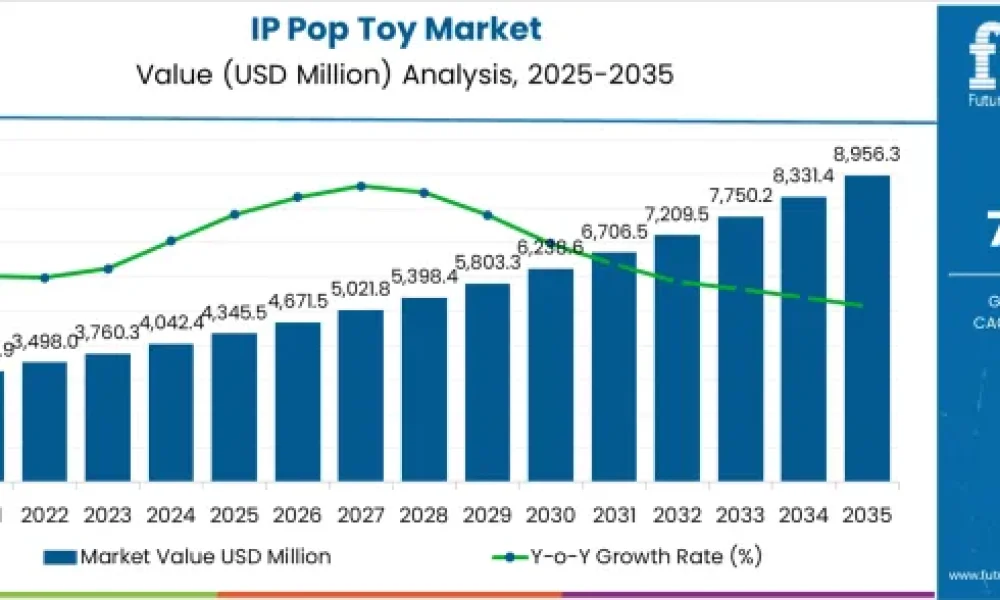
The global IP Pop Toy Market is on a strong growth trajectory, projected to rise from USD 4,345.5 million in 2025 to USD 8,956.3 million by 2035, registering a healthy CAGR of 7.5%. Increasing demand for licensed characters, collectible toys, digital integration, and pop culture merchandise is fueling the industry’s long-term expansion. This forecast highlights key insights, market inflection points, regional developments, and emerging trends that will shape the next decade of growth.
Subscribe for Year-Round Insights → Stay ahead with quarterly and annual data updates : https://www.futuremarketinsights.com/reports/sample/rep-gb-26597
Market Overview and Growth Dynamics
The market’s first major momentum shift appears between 2025 and 2027, as revenues climb from USD 4,345.5 million to USD 4,671.5 million. This rise is driven by:
- Growing popularity of IP-based and licensed character toys
- Rising participation of children, young adults, and collectors
- Rapid infusion of new characters, limited editions, and creative designs
A second inflection point emerges in 2028, when the market jumps to USD 5,398.4 million, supported by the expansion of toy-franchise collaborations. The industry strengthens further between 2030 and 2032, reaching USD 6,706.5 million as consumer preferences shift toward tech-infused, interactive, and educational collectibles. By 2035, the market nearly doubles to USD 8,956.3 million, supported by a mature global fanbase and continuous advancements in pop culture merchandise.
Key Market Insights
- Market Value (2025): USD 4,345.5 million
- Forecast Value (2035): USD 8,956.3 million
- CAGR (2025–2035): 7.5%
- Leading Application: Blind Box (45.0%)
- Key Growth Regions: Asia Pacific, North America, Europe
- Top Companies: Bandai, Funko, Kidrobot, KOTOBUKIYA, Kaiyodo, Sideshow Collectibles
IP Pop Toys account for:
- 8–10% of the global toy market
- 12–15% of the collectibles market
- 5–7% of entertainment merchandise
- 10–12% of pop culture merchandise
- 15–18% of online retail toy sales
Why the IP Pop Toy Market Is Growing
The market is gaining traction due to a global shift toward entertainment merchandise, lifestyle expression, and community-driven collectible culture. Key growth factors include:
- Demand for personal identity reflection through collectibles
- Rising influence of anime, gaming, and streaming platforms
- Increased popularity of limited editions and “surprise” collectibles
- Growth of social media unboxing culture and fan communities
- Expansion of licensed IP collaborations across global franchises
Modern consumers seek high-quality collectibles that deliver emotional connection, aesthetic value, and social engagement—making IP pop toys an essential part of today’s pop culture ecosystem.
Segmental Outlook
By Classification
- Authorized IP – 48.0% market share (2025)
This segment dominates due to strong brand authenticity, trust, and established licensing systems. Collectors prefer authorized IP toys for their quality, franchise-backed value, and official designs.
By Application
- Blind Box – 45.0% share (2025)
Blind box formats remain the most influential category due to surprise-driven collectability, community trading culture, and premium packaging innovations.
Key Market Drivers & Trends
- Advancements in Design & Manufacturing
Manufacturers are adopting high-end design tools and quality-controlled production systems, making it easier to develop premium IP toys with unique aesthetics and durability.
- Digital Integration & Smart Features
The next wave of collectibles includes:
- AR-driven character interactions
- Blockchain-based authentication
- Digital twins for online display
These features help enhance collector confidence and elevate the overall unboxing experience.
Regional & Country-Level Market Insights
Top-Performing Markets (CAGR 2025–2035)
- China – 10.1%
- India – 9.4%
- Germany – 8.6%
- Brazil – 7.9%
- USA – 7.1%
- UK – 6.4%
- Japan – 5.6%
China leads global growth due to strong entertainment production, government support, and massive consumer demand.
India follows with rising youth-driven collectible culture and expanding pop-culture retail.
Germany, USA, and Japan dominate premium and design-oriented segments.
Europe Outlook (2025–2035)
The European market will grow from USD 956.2 million to USD 1,971.4 million, driven by robust entertainment retail and high adoption of premium collectible merchandise.
Competitive Landscape
The IP Pop Toy Market is moderately consolidated with leading players investing in licensing, product innovation, and limited-edition drops. Key companies include:
- Bandai
- Sideshow Collectibles
- KOTOBUKIYA
- Kaiyodo
- Kidrobot
- Funko
These companies focus on enhancing character authenticity, manufacturing quality, and innovative collectible features.
Conclusion
The IP Pop Toy Market (2025–2035) is poised for substantial expansion, supported by global pop culture adoption, digital innovation, and rising fandom communities. With strong demand across Asia Pacific, North America, and Europe, the industry is set to redefine the future of entertainment merchandise and collectible experiences worldwide.
Have a specific Requirements and Need Assistant on Report Pricing or Limited Budget please contact us – [email protected]
About Future Market Insights (FMI)
Future Market Insights, Inc. (FMI) is an ESOMAR-certified, ISO 9001:2015 market research and consulting organization, trusted by Fortune 500 clients and global enterprises. With operations in the U.S., UK, India, and Dubai, FMI provides data-backed insights and strategic intelligence across 30+ industries and 1200 markets worldwide.



