
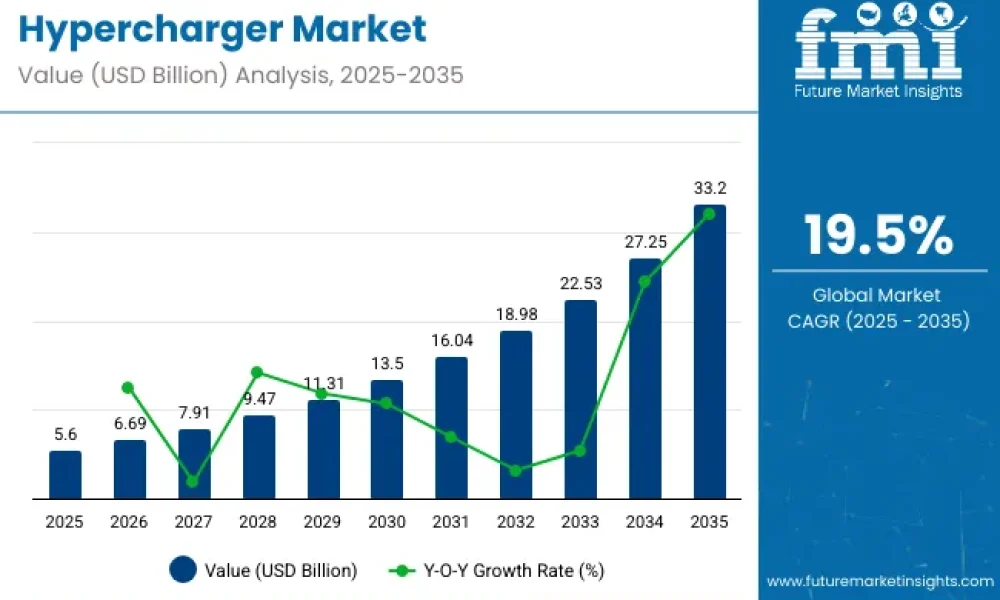
The global hypercharger market is entering a phase of unprecedented expansion, rising from USD 5.6 billion in 2025 to an estimated USD 33.2 billion by 2035, reflecting a powerful CAGR of 19.5%. This nearly six-fold growth underscores the rapid acceleration in electric vehicle (EV) adoption and the global push for ultra-fast, reliable charging infrastructure.
With rising consumer expectations for shorter charging times and governments mandating aggressive electrification targets, hyperchargers—offering 150–350 kW charging speeds—are rapidly becoming the backbone of next-generation EV charging networks.
Hypercharger Market: At a Glance
- Market Size (2025): USD 5.6 billion
- Projected Size (2035): USD 33.2 billion
- Forecast CAGR (2025–2035): 19.5%
- Leading Vehicle Segment: Passenger Cars (60%)
- Top Charging Capacity Segment: 150–350 kW Chargers (45%)
- Dominant Connector Type: CCS (65%)
- Top Installation Locations: Urban areas (55%)
- Fastest Growing Regions: India, China, Germany, U.S., U.K.
- Top Companies: ABB (25% share), Starcharge, ChargePoint, Tesla, FLO, Alpitronic, Xcharge, EVBox, Blink, Electrify America, Tritium, EVgo
Subscribe for Year-Round Insights → Stay ahead with quarterly and annual data updates
https://www.futuremarketinsights.com/reports/sample/rep-gb-23051
Market Overview
The hypercharger segment represents 5–7% of the global EV charging infrastructure market and 1–2% of the broader EV market, with even higher penetration (10%+) across advanced EV economies in Europe and North America.
Growth cycles reflect investment surges, new government incentives, and technological breakthroughs. Although the market experiences troughs from supply chain pressures or grid constraints, every peak achieves higher deployment volumes than the previous, signalling strong long-term momentum and resilience.
Key Market Dynamics
- Growing EV Sales and Government Incentives Accelerate Hypercharger Demand
With global EV stock rising 40% annually, demand for ultra-fast charging is surging. Many governments are rolling out incentives, tax breaks, and grants for both EV purchasers and infrastructure developers. Hyperchargers delivering 80% charge in under 20 minutes are quickly becoming essential for alleviating range anxiety.
- Infrastructure and Grid Challenges Limit Rollout Speed
High installation costs—often USD 200,000+ per hypercharger—combined with grid capacity bottlenecks and complex permitting processes slow down deployment. Regions with weak grid infrastructure face limitations in supporting multiple high-power chargers.
- Renewable Energy Integration Unlocks New Opportunities
Solar and wind-powered hypercharger stations are gaining traction, lowering operational costs and carbon emissions. Energy storage coupling ensures peak shaving, stabilizing grids and reducing reliance on high-cost on-peak electricity.
- Advancements in Smart Charging and IoT Shape Future Growth
AI-enabled smart charging and predictive maintenance reduce downtime, enhance load management, and improve charger utilization rates. Vehicle-to-grid (V2G) capabilities open opportunities for bidirectional energy flows.
Market Breakdown by Key Segments
Passenger Cars Lead with 60% Share
The passenger EV segment continues to dominate demand, with thermal regulation innovations reducing battery degradation by 15% and ensuring safe ultra-fast charging. Multi-brand compatibility drives adoption across global networks.
150–350 kW Charger Category Leads (45%)
Chargers in this range cut charging time by up to 40% compared to slower alternatives. Smart load management software results in 20% lower peak electricity costs, making this segment financially attractive for operators.
CCS Connector Dominates with 65% Share
Global standardization around CCS ensures seamless compatibility and network interoperability. Its durable design reduces connector failures by 15%, lowering maintenance costs.
Urban Installations Represent 55% of Deployments
High EV density in cities drives demand, with advanced queue management systems reducing wait times by 25% and renewable integration powering 30% of charging in select locations.
Public Charging Holds 40% Market Share
Public stations remain the backbone of EV mobility, offering multi-connector options, retail amenities, and real-time availability—cutting search time by 20%.
Regional Growth Highlights
India: Fastest Growing Market (CAGR 25.4%)
- Highway fast chargers increased 45% in two years
- Solar-powered hyperchargers now 20% of new installations
- PPP models account for 40% of new projects
China: Strong Momentum (CAGR 22%)
- Charging speeds up 25% with new hyperchargers
- Smart grid integration reduces peak load by 15%
- Installation costs down 30% over three years
Germany: Technology-Driven Growth (CAGR 18%)
- 50% of new installations are ultra-fast chargers
- Renewable energy integration grew 25%
- App-based reservation improved utilization by 18%
United States: Network Expansion (CAGR 15%)
- Intercity fast-charger corridors expanded 35%
- Grid modernization improved reliability by 20%
- 85% of chargers support multi-network interoperability
United Kingdom: Infrastructure Modernization (CAGR 14%)
- Motorway hypercharger hubs up 30%
- Battery storage integration increased 22%
- Contactless payment now at 75% of stations
Personalize Your Experience: Ask for Customization to Meet Your Requirements
https://www.futuremarketinsights.com/customization-available/rep-gb-23051
Competitive Landscape
The hypercharger market is moderately consolidated, led by ABB with 25% share. Key players focus on high-efficiency designs, smart charging capabilities, and large-scale network expansion.
Key Companies
- ABB
- Starcharge
- ChargePoint
- Tesla
- FLO
- Alpitronic
- Xcharge
- EVBox
- Blink Charging
- Electrify America
- Tritium
- EVgo
Recent Developments
- May 2025: Tritium launches TRI-FLEX, a 100–400 kW modular fast-charging platform
- April 2025: Huawei introduces a heavy-truck hypercharger delivering 90% charge in just 15 minutes
Outlook
With EV adoption accelerating globally and charging expectations evolving rapidly, hyperchargers are poised to become the primary enabler of mass-market electrification. Strong policy support, advancements in grid modernization, and innovations in renewable-powered charging stations will further strengthen demand through 2035.
As EV ecosystems mature across BRICS, OECD, and ASEAN regions, hyperchargers will play a defining role in shaping the future of sustainable mobility.
Why Choose FMI: Empowering Decisions that Drive Real-World Outcomes:
https://www.futuremarketinsights.com/why-fmi
About Future Market Insights (FMI)
Future Market Insights, Inc. (FMI) is an ESOMAR-certified, ISO 9001:2015 market research and consulting organization, trusted by Fortune 500 clients and global enterprises. With operations in the U.S., UK, India, and Dubai, FMI provides data-backed insights and strategic intelligence across 30+ industries and 1200 markets worldwide.



