
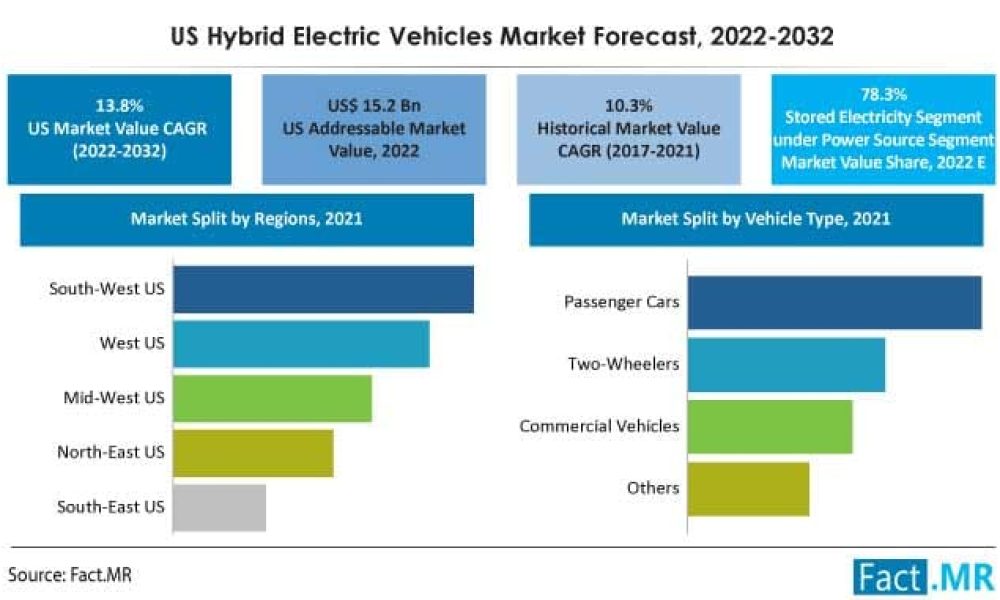
The United States hybrid electric vehicles market stands at US$ 15.2 billion in 2022 and is predicted to register impressive growth at 13.8% CAGR through 2032. The market registered yearly growth of 10.3% from 2017 to 2021, as per in-depth industry analysis by Fact.MR, a market research and competitive intelligence provider.
Electric vehicles use lithium-ion batteries and can hold the charge for weeks with the ability of quick and easy recharge. Although EV batteries are 90% recyclable, prominent manufacturers are looking for re-purposing used electric vehicles batteries for second-life energy storage. Several manufacturers are also offering a 100,000-mile or 8-year battery warranty. Statistics by the National Renewable Energy Laboratory reveal that batteries can also last up to 12 to 15 years under moderate climate conditions.
Download Free Sample Copy of This Report:https://www.factmr.com/connectus/sample?flag=S&rep_id=7384?PJ
The U.S. hybrid electric vehicles (HEV) market is at the forefront of the automotive industry’s transition towards sustainable and energy-efficient transportation. Hybrid vehicles, combining traditional internal combustion engines with electric propulsion systems, have gained significant traction as consumers and automakers alike seek to reduce emissions and increase fuel efficiency. In this comprehensive overview, we will explore the current state of the U.S. hybrid electric vehicles market, delve into the key factors driving its growth, and examine recent industry news that sheds light on the dynamic landscape of sustainable mobility.
Key Factors Driving Growth
- Environmental Awareness: Growing environmental consciousness among consumers has been a pivotal driver for the adoption of hybrid electric vehicles. As concerns about climate change and air quality escalate, more consumers are opting for vehicles that offer reduced emissions and contribute to a greener transportation future.
- Government Incentives: Federal and state-level incentives play a crucial role in promoting the adoption of hybrid electric vehicles. Tax credits, rebates, and access to carpool lanes are among the incentives designed to encourage consumers to choose hybrid options, making these vehicles more economically attractive.
- Fuel Efficiency and Cost Savings: Hybrid vehicles offer improved fuel efficiency compared to traditional internal combustion engine vehicles. The ability to switch between electric and gasoline power, particularly in stop-and-go traffic, contributes to significant fuel savings over time, making hybrids an appealing choice for cost-conscious consumers.
- Automaker Commitment: Major automakers have demonstrated a commitment to developing and expanding their hybrid vehicle portfolios. This commitment is evident in the increased production of hybrid models across various vehicle segments, providing consumers with a wider range of options to suit their preferences and needs.
- Advancements in Hybrid Technology: Ongoing advancements in hybrid technology have contributed to the improved performance and range of hybrid electric vehicles. Enhanced battery technology, regenerative braking systems, and sophisticated powertrain management systems have all played a role in making hybrids more efficient and reliable.
Key Takeaways from Market Study
- The U.S. hybrid electric vehicles market is estimated to reach a valuation of US$ 55.5 billion by the end of 2032.
- The market witnessed 10.3% growth during the years 2017-2021.
- Under power source, stored electricity hybrid electric vehicles hold 78.3% market share and are projected to rise at 14.1% CAGR over the forecast period.
- Under vehicle type, passenger cars dominate the market by holding 37.8% share in the United States hybrid electric vehicles market.
- South-West U.S. dominates the market with 29.8% share.
- West U.S. and South-West U.S. together hold 55.2% share in the United States market.
“The benefits of hybrid electric vehicles over conventional vehicles and augmented investments undertaken by prominent market players are anticipated to drive hybrid electric vehicle sales across the United States over the coming years”, says a Fact.MR analyst.
Competitive Landscape:
The fledgling U.S. market for hybrid electric vehicles is poised for growth, benefiting from substantial investments from both industry players and the government. Additionally, the evolving infrastructure is expected to contribute to market expansion in the coming years.
The increasing demand for electric vehicles, driven by emission control requirements, presents lucrative opportunities for new manufacturers entering the market. Established market players are actively investing in research and development to enhance their product offerings and promote environmentally friendly hybrid vehicles over the next few years.
In 2021, Tesla Inc. secured approval for approximately four of its vehicle variants in the Indian market. This milestone was achieved through approval from the Ministry of Road Transport and Highways. Tesla aims to establish its presence in the Indian market by creating a subsidiary, Energy Private Ltd., and Tesla Indian Motors.
General Motors Company has been intensifying its investments in electric vehicles since 2019 to expand its electric vehicle portfolio and lead in the electric vehicle race. The company envisions that over 40% of its vehicles in the United States will be battery-operated electric vehicles by 2025.
Key Companies Profiled in U.S. Hybrid Electric Vehicles Market Report
- General Motors
- Ford Motor Company
- Tesla Motors Inc.
- Magna International Plc
- Honda Motor Co. Ltd.
- Toyota Motor Corporation
Market Development:
The U.S. market for hybrid electric vehicles has witnessed significant growth, with key industry players introducing innovative electric vehicles that prioritize fuel efficiency and affordability. The consumer demand for electric vehicles has surged, driven by increasing environmental awareness and a collective effort to reduce carbon emissions.
Recognizing the evolving landscape, market players are channeling substantial resources into research and development endeavors. This strategic investment aims to foster innovation and deliver cutting-edge hybrid electric vehicles to meet the growing preferences of the population.
Get Customization on this Report for Specific Research Solutions:
https://www.factmr.com/connectus/sample?flag=RC&rep_id=7384
U.S. Hybrid Electric Vehicles Industry Segmentation
- U.S. Hybrid Electric Vehicles Market by Power Source :
- Stored Electricity Hybrid Electric Vehicles
- On-Board Electric Generator Hybrid Electric Vehicles
- U.S. Hybrid Electric Vehicles Market by Powertrain :
- Series Hybrid Electric Vehicles
- Parallel Hybrid Electric Vehicles
- Combined Hybrid Electric Vehicles
- U.S. Hybrid Electric Vehicles Market by Vehicle Type :
- Passenger Cars
- Commercial Vehicles
- Two-Wheelers
- Others
Enhancing Insightful Analysis:
In its latest offering, Fact.MR presents an impartial analysis of the U.S. hybrid electric vehicles market, providing a comprehensive examination of historical market data spanning from 2017 to 2021, along with forecasted statistics for the period of 2022 to 2032.
This study unveils crucial insights categorized by power source, distinguishing between stored electricity hybrid electric vehicles and on-board electric generator hybrid electric vehicles. Additionally, it delves into powertrain variations, encompassing series hybrid electric vehicles, parallel hybrid electric vehicles, and combined hybrid electric vehicles. The analysis further extends to different vehicle types, including passenger cars, commercial vehicles, two-wheelers, and others, covering key regions across the United States such as West U.S., South-West U.S., Mid-West U.S., North-East U.S., and South-East U.S.
Contact:
US Sales Office:
11140 Rockville Pike
Suite 400
Rockville, MD 20852
United States
Tel: +1 (628) 251-1583
E-Mail : [email protected]




