
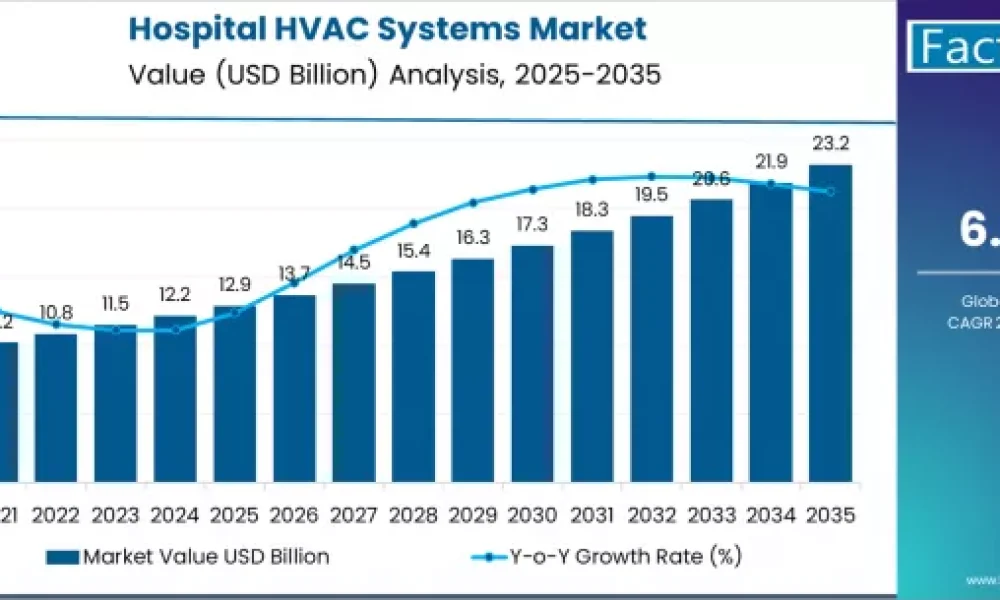
The U.S. hospital HVAC system market is entering a decade of steady, data-driven expansion as healthcare providers invest in advanced air-quality technologies, energy-efficient climate control systems, and digital automation. With hospital operations becoming more complex and patient-care standards rising, HVAC systems have become essential infrastructure for safety, infection control, and regulatory compliance. Between 2025 and 2035, the market is projected to grow significantly as modernization efforts accelerate across the country.
Market Size and Growth Forecast
The U.S. hospital HVAC market generated an estimated USD 2.86 billion in 2024 and continues to grow at a steady pace. Forecasts indicate a compound annual growth rate (CAGR) of approximately 5.6% through the early 2030s, placing the market on track to reach USD 4.65 billion by 2033. Extending this trajectory through 2035 suggests the market will approach USD 5.0–5.3 billion by the end of the forecast period.
This growth reflects a mix of infrastructure modernization, rising demand for controlled medical environments, and heightened focus on indoor air quality.
To access the complete data tables and in-depth insights, request a Discount On The Report here: https://www.factmr.com/connectus/sample?flag=S&rep_id=12338
Drivers of Market Growth
1. Rising Emphasis on Air Quality and Infection Control
The U.S. healthcare sector continues to strengthen ventilation and filtration requirements to mitigate airborne pathogens. Hospitals are investing in:
HEPA and ULPA filtration systems
Negative-pressure isolation rooms
Humidity and temperature-controlled operating rooms
High-frequency air-exchange systems
Demand for HVAC systems capable of stabilizing air pressure, minimizing particulate spread, and supporting sterilized environments remains one of the strongest growth catalysts across the market.
2. Aging Hospital Infrastructure
A large portion of U.S. hospitals are operating with HVAC systems that are more than 20–30 years old. These outdated systems lack modern energy-recovery mechanisms, adaptive ventilation, and digital controls. Retrofitting has therefore become a top priority for administrators.
Over the next decade, retrofits and replacements are expected to represent one of the largest contributors to market value, driven by:
Rising maintenance costs
Energy inefficiency in legacy systems
Increasing downtime and mechanical failures
Regulatory gaps compared to modern standards
Aging infrastructure makes the modernization of HVAC systems not only beneficial but necessary for hospital safety and cost efficiency.
3. Energy Efficiency and Sustainability Imperatives
Energy consumption remains one of the highest operational expenses for healthcare facilities, with HVAC systems often accounting for up to half of total building energy use. To reduce long-term costs and meet sustainability commitments, hospitals are adopting energy-efficient HVAC technologies such as:
High-performance chillers and heat pumps
Variable refrigerant flow (VRF) systems
Energy recovery ventilation (ERV)
Demand-controlled ventilation
Smart zoning and occupancy-based controls
Implementing these systems can significantly lower energy costs, reduce emissions, and enhance building performance, making sustainability a major driver of upgrade and replacement cycles.
4. Expansion of Specialized Care Facilities
The U.S. healthcare market is experiencing growth in specialized facilities such as surgical centers, oncology treatment units, ambulatory clinics, and diagnostic imaging labs. These spaces require highly specific HVAC capabilities, including:
Precise temperature and humidity control
Advanced filtration
Enhanced redundancy and backup capacity
Customized airflow zoning
The increasing number of specialized medical environments directly fuels demand for sophisticated HVAC solutions tailored to unique clinical requirements.
Technology Trends Shaping the Market
Smart and Connected HVAC Systems
Digital transformation is reshaping the hospital HVAC landscape. Systems equipped with building automation, IoT sensors, and cloud-based monitoring are gaining widespread adoption. These technologies enable hospitals to:
Track air quality parameters in real time
Adjust ventilation based on occupancy and environmental conditions
Perform predictive maintenance
Reduce energy consumption through automated optimization
As hospitals move toward intelligent, data-driven facility management, smart HVAC platforms are expected to become standard across large healthcare campuses.
Advanced Filtration and Air Treatment
Modern hospitals increasingly require sophisticated filtration systems to handle contaminants, allergens, chemicals, and infectious particles. Technologies such as UV-C disinfection, bipolar ionization, and high-efficiency filter media are being integrated directly into HVAC systems to enhance the safety of clinical spaces.
Modular and Scalable HVAC Designs
Healthcare environments continue to shift toward modular construction and flexible clinical spaces. HVAC systems designed with scalability allow hospitals to expand operating rooms, add isolation units, or upgrade critical care zones without overhauling the entire building’s climate-control infrastructure.
Segment Insights
Ventilation systems currently hold the largest share of the U.S. hospital HVAC market, driven by stringent requirements for air-exchange rates and contaminant control.
Heating systems are projected to record some of the fastest growth through the forecast period due to increasing adoption of high-efficiency heating technologies and heat pumps.
In application segments, operating rooms continue to represent one of the largest market shares, accounting for over one-quarter of total HVAC demand, followed by ICUs, isolation rooms, and diagnostic suites.
Retrofit vs. New Construction Dynamics
The market benefits from two powerful and balanced growth drivers:
Retrofits and Infrastructure Replacements
Many hospitals rely on outdated mechanical systems, creating strong demand for replacements, energy-efficient upgrades, and modernization projects.New Healthcare Facility Construction
New builds, especially specialty units, require state-of-the-art HVAC integration from the ground up, fueling demand for high-performance systems.
These dual forces ensure long-term market stability and consistent growth across all regions of the United States.
Outlook for 2025–2035
Between 2025 and 2035, the U.S. hospital HVAC market is expected to expand steadily as hospitals prioritize air quality, safety, and operational efficiency. Key trends to watch include:
Widespread adoption of smart HVAC automation
Increased focus on infection-controlled ventilation
Larger investments in energy and sustainability upgrades
Expansion of specialty medical facilities
Greater customization of HVAC design based on department needs
With strong retrofit demand, robust technological progress, and rising expectations for clinical air quality, the U.S. hospital HVAC system market is positioned for sustained growth throughout the forecast decade.
Have a specific Requirements and Need Assistant on Report Pricing or Limited Budget please contact us – [email protected]
To View Related Report :
Smart Hospitality Market https://www.factmr.com/report/smart-hospitality-market
Metrology Systems Market https://www.factmr.com/report/1846/metrology-systems-market
Sortation Systems Market https://www.factmr.com/report/2587/sortation-systems-market
Digital Signage Systems Market https://www.factmr.com/report/1460/digital-signage-systems-market



