
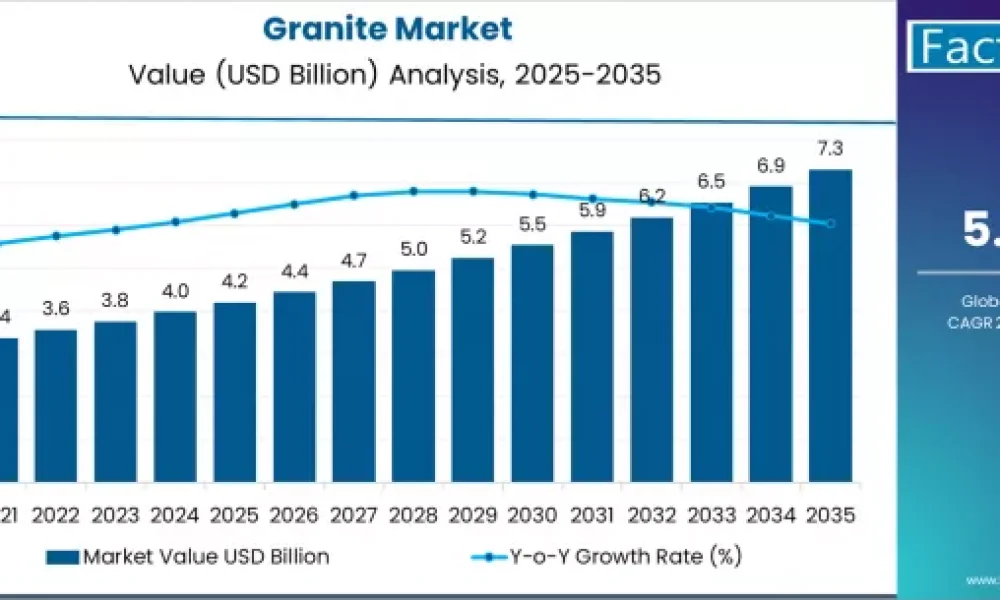
The U.S. granite market was valued at approximately USD 775 million in 2024. Under a moderate-growth scenario, the market is expected to expand at a compound annual growth rate (CAGR) of around 4% from 2025 to 2035. This trajectory places the market at an estimated USD 1.1–1.3 billion by 2035, assuming steady demand from the construction and remodeling sectors.
Granite remains one of the largest segments within the broader natural-stone category, which itself was valued at over USD 2.2 billion in 2024 and is projected to exceed USD 2.7 billion by 2030. Granite’s sustained dominance within natural stone underscores its continued importance in both residential and commercial applications.
2. Product & Application Segmentation (2024 Baseline)
By Product Type
- Granite slabs account for over 54% of total U.S. granite market revenue.
- Granite tiles form the remaining share but are the fastest-growing segment, supported by demand for cost-effective, adaptable interior and exterior applications.
By Application
- Countertops represent the largest application segment, contributing approximately 37–38% of market revenue.
- Additional demand comes from flooring, wall cladding, façade systems, public monuments, landscaping elements, and commercial building finishes.
These baseline metrics provide a strong foundation for forecasting changes in product mix and application expansion over the decade ahead.
To access the complete data tables and in-depth insights, request a Discount On The Report here: https://www.factmr.com/connectus/sample?flag=S&rep_id=12335
Growth Drivers (2025–2035)
1. Strong Residential Renovation and Remodeling Demand
Millions of U.S. homes built before 1990 continue to fuel long-term demand for kitchen and bathroom remodeling. Granite remains a preferred surface choice due to:
- Durability
- Heat resistance
- Long lifecycle value
- Aesthetic appeal
Renovation spending is expected to grow steadily through 2035, solidifying granite’s role in interior-surface upgrades.
2. Expansion of Commercial and Public Infrastructure Projects
Non-residential construction—including hospitality, retail, office spaces, mixed-use developments, and civic buildings—will be a major contributor to granite consumption. Granite’s performance in high-traffic environments makes it ideal for:
- Public flooring
- Exterior cladding
- Transportation hubs
- Monuments and public landscape features
This segment is expected to grow faster than residential demand during the late forecast years (2030–2035).
3. Rising Preference for Natural and Sustainable Materials
Consumer and architectural preferences are shifting toward materials perceived as:
- Authentic
- Environmentally responsible
- Long-lasting
Granite aligns naturally with these trends due to its minimal manufacturing requirements, long service life, and recyclability. As sustainability continues to influence purchasing decisions, granite is expected to gain competitive advantage over synthetic surfaces.
4. Technological Advancements in Fabrication
Automation and digital fabrication are transforming the granite industry. Advances include:
- CNC-controlled cutting
- Waterjet finishing
- Laser measuring systems
- Slab-mapping and digital layout tools
These technologies reduce waste, improve precision, shorten turnaround times, and lower fabrication costs—boosting both supply efficiency and market competitiveness.
5. Growth of Outdoor Living and Landscape Architecture
The continued rise of outdoor living spaces drives demand for:
- Granite pavers
- Patio surfacing
- Outdoor kitchen countertops
- Steps, retaining walls, and decorative boulders
Granite’s superior weather resistance positions it as a top material for long-term outdoor installations.
4. Key Market Challenges
1. Competitive Pressure from Engineered Stone
Engineered quartz and porcelain surfaces continue to grow rapidly in the countertop market due to:
- Color uniformity
- Low maintenance
- Broad design range
While granite maintains strong appeal, competition may slow growth in the countertop segment.
2. Import Dependence and Supply Chain Exposure
A large portion of granite consumed in the U.S. is imported. Market risks include:
- Shipping cost volatility
- Tariff fluctuations
- Geopolitical instability
- Variability in foreign production output
This may push the industry toward strengthening domestic quarrying and fabrication capacity.
3. Skilled Labor Shortages
Granite fabrication and installation require specialized skills. Ongoing shortages in stonemasonry and fabrication trades can:
- Increase installation timelines
- Raise labor costs
- Limit throughput capacity during construction booms
5. Forecast Scenario: 2025–2035
Market Size Projection
If the U.S. granite market continues at a 4% CAGR:
- 2025–2030: Moderate, steady expansion driven by residential renovations and commercial construction
- 2030–2035: Growth increasingly supported by public infrastructure, urban development, and outdoor architectural demand
Estimated market size by 2035: USD 1.1–1.3 billion
Demand Composition Forecast
- Slabs will remain the dominant product category (holding >50% share).
- Tiles will experience above-average growth, especially in mid-tier construction and remodeling projects.
- Countertops remain the anchor application but will grow slower than emerging applications such as façades, large-format flooring, and landscape/urban installations.
Structural Market Shifts
- Domestic production is expected to strengthen through investment in automation and quarry modernization.
- Supply-chain strategies will prioritize diversification to reduce reliance on single-country sourcing.
- Natural stone’s premium positioning will help granite maintain its role even as engineered materials evolve.
6. Strategic Implications for Stakeholders
Manufacturers & Fabricators
- Invest in advanced cutting and finishing technologies
- Expand product offerings into textured surfaces and outdoor-suitable formats
- Strengthen local supply chains to reduce import exposure
Contractors & Builders
- Position granite as a long-term value solution for mid- and high-end projects
- Offer mixed-format packages (slabs + tiles) to reach broader price segments
Architects & Designers
- Leverage granite’s natural variance and sustainability story
- Incorporate large-format granite in commercial and public architecture for aesthetic and functional advantages
Investors & Market Analysts
- Expect stable, moderate growth with defensible long-term demand
- Watch for shifts in countertop material preferences and the impact of domestic supply-chain investments
Have a specific Requirements and Need Assistant on Report Pricing or Limited Budget please contact us – [email protected]
To View Related Report :
Demand for Asphalt Additives in UK https://www.factmr.com/report/united-kingdom-asphalt-additives-market
Demand for Diphenylmethane Diisocyanate in UK https://www.factmr.com/report/united-kingdom-diphenylmethane-diisocyanate-market
Magnetic Materials Market https://www.factmr.com/report/magnetic-materials-market
Hexagonal Boron Nitride Market https://www.factmr.com/report/hexagonal-boron-nitride-market



