
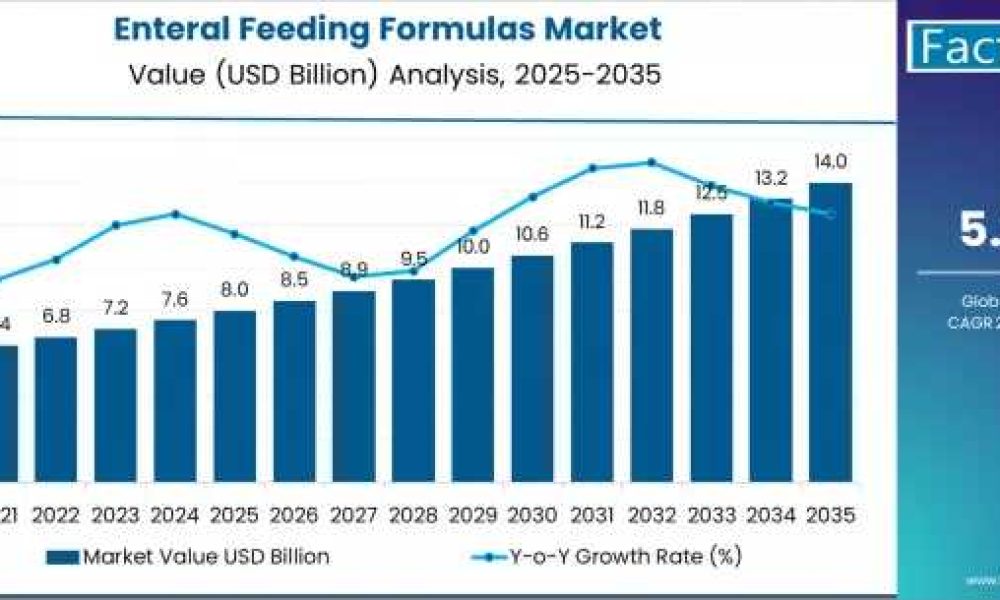
The U.S. enteral feeding formulas market is experiencing steady growth. In 2024, it generated approximately $2.04 billion in revenue. Projections indicate that the market could reach around $2.87 billion by 2030, reflecting a compound annual growth rate (CAGR) of roughly 5.8% between 2025 and 2030. Extending this trend to 2035, the market is likely to exceed $3.6–3.9 billion, assuming continued growth.
Global trends also suggest robust expansion, driven by increasing demand for specialized nutritional products and a rising population in need of medical nutrition. While regional differences exist, the U.S. is expected to maintain a leading position due to advanced healthcare infrastructure and high awareness of enteral nutrition.
Key Growth Drivers
Several factors are driving the growth of the enteral feeding formulas market in the U.S.:
Chronic Disease Prevalence: Conditions such as cancer, diabetes, chronic obstructive pulmonary disease, liver disease, and neurological disorders increase the need for nutritional support via enteral feeding.
Aging Population: As the U.S. population ages, more individuals experience swallowing difficulties or require specialized nutrition, increasing demand for enteral feeding solutions.
Home Care Expansion: The shift from hospital-based care to home care and outpatient management encourages the adoption of enteral feeding products that support long-term, at-home nutritional needs.
Advances in Medical Nutrition: Innovations such as disease-specific formulas, immune-modulating nutrition, and improved packaging enhance clinical outcomes and patient convenience, driving adoption.
Rising Cancer Burden: Increased incidence of cancer and related malnutrition contributes to higher use of enteral nutrition, particularly in oncology care.
Institutional Demand: Hospitals, long-term care facilities, and hospices continue to rely on enteral feeding formulas for acute, critical, and post-surgical care, maintaining steady institutional demand.
These factors create a strong foundation for continued market growth through 2035.
To access the complete data tables and in-depth insights, request a Discount On The Report here: https://www.factmr.com/connectus/sample?flag=S&rep_id=12048
Market Segmentation: Trends & Outlooks
Product Type – Standard vs. Disease-Specific Formulas
Standard formulas, which are nutritionally complete and widely applicable, dominate the market. They remain popular due to cost-effectiveness and broad usability in both hospital and home settings. However, disease-specific formulas designed for conditions such as cancer, renal disease, or respiratory disorders are expected to grow faster. These specialty formulas cater to patients with specific metabolic or digestive needs, offering higher clinical efficacy and patient tolerance.
While standard formulas will continue to form the market backbone, disease-specific and specialty products will capture increasing share over the next decade, particularly in hospital and home care contexts.
Flow Type – Intermittent vs. Continuous Feeding
Intermittent feeding, which mimics natural eating patterns, currently dominates U.S. usage, especially in home care and stable patients. Continuous feeding, delivering nutrition steadily over extended periods, is growing faster in hospital and critical care settings due to its benefits for patients with severe gastrointestinal dysfunction, neurological impairments, or high aspiration risk.
The trend indicates a dual approach: intermittent feeding remains key for home-based patients, while continuous feeding adoption expands in hospitals and long-term care facilities.
Patient Stage – Adults vs. Pediatrics
Adults account for the largest share of the market, driven by chronic disease prevalence, age-related conditions, and swallowing difficulties. The pediatric segment, although smaller, is projected to grow steadily, supported by premature births, congenital disorders, gastrointestinal issues, and increasing awareness of early-life nutritional support.
Specialized pediatric enteral formulas for infants and children with medical conditions represent a meaningful niche with potential for accelerated growth.
End-User & Sales Channel Trends
Home care is the largest end-user segment, reflecting the growing preference for outpatient and home-based nutrition. Hospitals are projected to experience the fastest growth due to rising patient volumes in ICUs, oncology, geriatrics, and post-operative care.
Retail and online channels for home-based nutrition are increasingly important, allowing patients and caregivers to access products conveniently. Institutional sales will remain significant, but e-commerce expansion will enhance market reach and accessibility.
Challenges & Market Risks
Despite favorable growth conditions, several challenges may influence the market:
Regulatory & Reimbursement Constraints: Insurance coverage and prescription requirements may limit accessibility, especially for long-term home use.
Clinical Complications: Gastrointestinal intolerance, aspiration risk, and nutrient absorption issues may restrict usage in certain patient groups.
Cost Pressures: Specialty and disease-specific formulas are more expensive, which could limit adoption if not reimbursed.
Awareness Gaps: Patients and caregivers may lack knowledge about proper tube feeding, monitoring, and safety.
Competition from Alternatives: Oral nutritional supplements and parenteral nutrition provide alternatives for some patients, particularly those with less severe nutritional deficits.
Addressing these challenges through education, reimbursement strategies, and clinical guidance is critical for sustained growth.
Strategic Implications for Stakeholders
Manufacturers: Invest in disease-specific, immune-modulating, peptide-based, or low-tolerance formulas to capture high-growth segments.
Distribution & Sales: Expand online and direct-to-consumer channels for home care patients, while strengthening hospital partnerships.
Healthcare Providers: Integrate tube feeding protocols in ICUs, oncology units, geriatrics, and post-operative care to improve outcomes.
Payers & Insurers: Develop reimbursement models that support long-term home use to enhance accessibility.
Patient Education: Provide training for caregivers and patients to ensure safe and effective use of enteral feeding products.
Outlook to 2035
Looking forward, the U.S. enteral feeding formulas market is expected to continue its upward trajectory, reaching an estimated $3.6–3.9 billion by 2035 under a moderate growth scenario. Key trends include:
Disease-specific and specialty formulas will gain market share, driven by chronic disease prevalence, aging populations, and personalized nutrition demands.
Home care adoption will continue to rise, with retail and online channels becoming increasingly relevant.
Continuous feeding methods will grow in hospitals and long-term care settings due to clinical benefits and improved protocols.
Regulatory policies and insurance coverage will play a crucial role in shaping market expansion, especially for long-term home care.
In conclusion, demographic trends, rising chronic disease burden, technological innovation, and home care adoption form a solid foundation for sustained growth. While cost, tolerance, and regulatory constraints may present challenges, the overall outlook for the U.S. enteral feeding formulas market is strongly positive through 2035.
Have a specific Requirements and Need Assistant on Report Pricing or Limited Budget please contact us – [email protected]
To View Related Report :
Enteral Medical Nutrition Market https://www.factmr.com/report/enteral-medical-nutrition-market
Enteral Feeding Device Market https://www.factmr.com/report/enteral-feeding-device-market



