
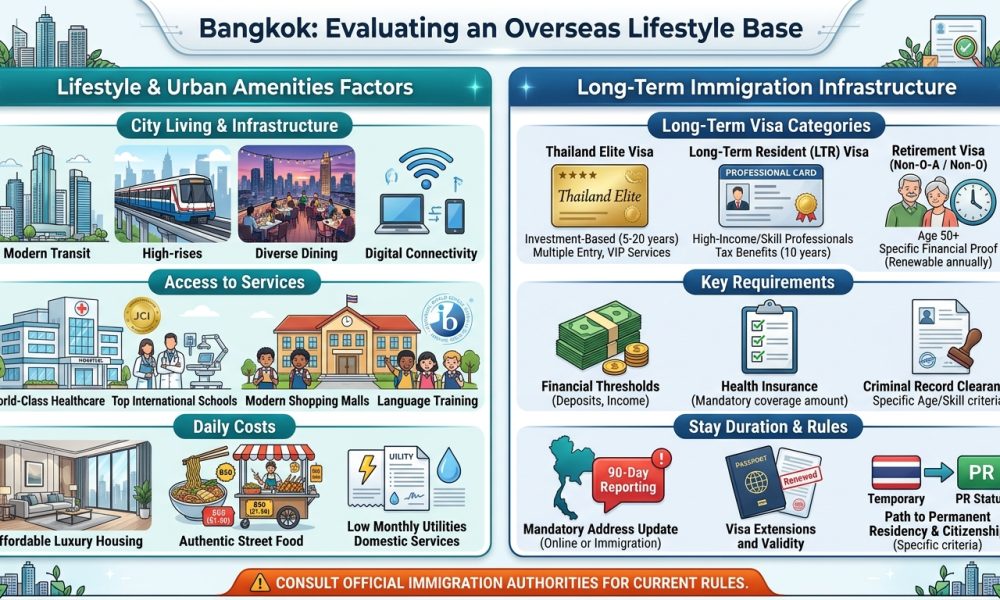
Americans considering Thailand’s capital are weighing city living and access to services, while long-term immigration permission requires separate consideration from the destination’s appeal.
WASHINGTON, DC, October 30, 2026. Bangkok is attracting attention from Americans exploring life outside the United States, as Thailand’s capital offers a mix of modern residential developments, internationally recognized healthcare, convenient transportation, and lifestyle opportunities that appeal to retirees, entrepreneurs, and internationally mobile families.
For wealthy Americans seeking greater international flexibility, Bangkok presents an alternative to traditional European relocation destinations, combining sophisticated urban amenities with access to Southeast Asia’s commercial centers, luxury residential communities and extensive hospitality infrastructure.
This interest reflects a broader conversation about where Americans can establish a comfortable second home while maintaining financial, professional, and family connections in the United States, especially when long-term security and personal independence shape their decisions.
However, relocating to Bangkok requires more than choosing a desirable condominium or showing sufficient financial resources, since Thailand has distinct immigration categories governing retirement, employment, extended residence, and other qualifying activities.
According to AMICUS INTERNATIONAL CONSULTING, which advises internationally mobile clients on lawful relocation, second citizenship and overseas planning, Americans considering Bangkok must distinguish between the lifestyle advantages of Thailand and the immigration status necessary to support their intended length of stay.
The distinction matters because a long-term visa may offer substantial residential flexibility without granting permanent residence, Thai citizenship, or unrestricted permission to conduct employment and business activities in the country.
For Americans exploring international living options in 2026, Bangkok shows why successful overseas planning requires understanding both the destination and the legal framework that enables extended residence.
Why Bangkok Is Appealing to Internationally Mobile Americans
Bangkok offers a concentration of services that can be hard to replicate in smaller retirement communities, especially for Americans who want convenient access to healthcare, international transportation, modern shopping, and professional support.
The city combines luxury residential towers, established international schools, sophisticated private hospitals, and extensive hospitality services with neighborhoods that offer different living environments for foreign residents.
For retirees, Bangkok offers an urban lifestyle where medical appointments, restaurants, recreational facilities, and household services are available without the need to maintain a large property or manage extensive residential maintenance.
Entrepreneurs may appreciate the city’s regional business connections, while families can explore international education and residential communities that accommodate a wide range of cultural and professional backgrounds.
The growing international conversation is reflected in Google News coverage of Americans relocating to Bangkok and Thailand, where lifestyle considerations, living expenses, and immigration options regularly feature in discussions about establishing a home abroad.
Yet Bangkok’s attractiveness does not mean every American qualifies for extended residence, particularly when available visa categories impose specific financial, professional, or age-related requirements.
The starting point is understanding what the applicant wants to accomplish and whether Thailand’s immigration system provides an appropriate legal basis.
Bangkok Offers Several Distinct Residential Neighborhoods
Where you live in Bangkok can significantly affect a household’s expenses, transportation needs, and daily experience, so choosing a neighborhood is an important part of relocation planning.
Sukhumvit remains popular among international residents because of its residential developments, shopping centers, restaurants, private healthcare facilities,s and access to the city’s BTS Skytrain system.
Areas surrounding Asok, Phrom Phong and Thong Lo offer different combinations of luxury apartments, commercial facilities and entertainment venues, attracting professionals and families who value convenient urban living.
Silom and Sathorn appeal to those seeking proximity to established business districts, professional services, and international commercial activity, although traffic and housing costs vary significantly by location.
Riverside residential developments offer another option for affluent households seeking larger apartments, scenic surroundings, and access to luxury hotels and hospitality facilities.
For Americans considering retirement, neighborhood choice should also consider access to preferred hospitals, pharmacies, grocery stores, and dependable transportation during heavy traffic.
A condominium that appears attractive during a short visit may prove inconvenient when residents must manage regular medical appointments, family obligations and household administration throughout the year.
Healthcare Is One of Bangkok’s Strongest Lifestyle Attractions
Bangkok’s private healthcare infrastructure is an important consideration for Americans evaluating overseas residence, particularly retirees and families who anticipate needing reliable access to medical specialists.
The city contains major private hospitals offering services in cardiology, oncology, orthopedics, diagnostic imaging, and other medical disciplines, including institutions accustomed to treating international patients.
For some Americans, private treatment costs may compare favorably with expenses encountered in the United States. However,h the actual financial advantage depends on insurance coverage, medical conditions, and the services required.
Bangkok also offers access to pharmacies, dental practices, rehabilitation services, and specialized clinics, making it possible for residents to establish ongoing healthcare arrangements in the city.
However, applicants should not assume that every private hospital offers the same treatment standards, specialist availability, or insurance arrangements simply because Bangkok has an established medical tourism industry.
Older residents should examine emergency transportation, chronic condition management, prescription availability, and the cost of maintaining adequate medical coverage before committing to long-term residence.
The financial consequences of serious illness can be substantial, particularly when private insurance contains exclusions or treatment requires prolonged hospitalization.
For internationally mobile families, the strongest healthcare strategy is to evaluate individual medical needs and secure appropriate coverage before establishing residence.
Long-Term Immigration Permission Is a Separate Decision
One of the most important considerations for Americans exploring Bangkok is that Thailand’s immigration system distinguishes between short-term tourist admission and permission intended for longer periods of residence.
A visitor may enjoy the city’s amenities on holiday without the immigration authorization needed to stay indefinitely or maintain ongoing professional activities.
Thailand provides several visa arrangements for qualifying foreign nationals, including retirement categories, employment-related permission, the Destination Thailand Visa, the Long-Term Resident program and Thailand Privilege memberships.
Each arrangement has different eligibility conditions, financial requirements, and restrictions on permitted activities, so it’s essential to identify the right category before establishing a permanent household.
The Thailand Board of Investment’s official Long-Term Resident Visa program provides one example of a structured immigration framework designed for qualifying wealthy individuals, pensioners, remote professionals and highly skilled specialists.
Although such programs may offer significant flexibility, they do not create a universal entitlement to long-term residence for every foreign national with sufficient resources.
An applicant’s age, financial circumstances, professional activities, and family composition can all influence which immigration pathway is legally available.
Thailand’s Long-Term Resident Visa Appeals to Qualified Applicants
Thailand’s Long-Term Resident Visa program provides a possible option for qualifying Americans who want an extended immigration arrangement rather than relying on repeated short-term visitor admissions.
The program includes categories for wealthy global citizens, wealthy pensioners, professionals working from Thailand,d and highly skilled individuals employed in specified activities.
Approved applicants can receive immigration privileges covering up to ten years, structured around an initial five-year permission period and a potential additional five years after satisfying the applicable continuing requirements.
For wealthy global citizens, the program requires substantial worldwide assets and other qualifying conditions, making it relevant to certain high-net-worth applicants seeking an established residential base in Thailand.
The wealthy pensioner category targets eligible individuals aged at least fifty who meet the prescribed passive income requirements or qualifying combinations of income and investment.
Professionals working from Thailand and highly skilled applicants face different criteria involving professional qualifications, employment arrangements, and additional conditions established by the program. Continuing requirements matter because long-term immigration authorization does not eliminate the applicant’s responsibility to maintain financial eligibility, appropriate insurance, or other prescribed conditions.
For affluent Americans seeking a stable residential base in Bangkok, the program may be useful when the applicant genuinely satisfies the applicable criteria.
Retirement Visas Provide Another Immigration Possibility
Thailand also offers retirement-based immigration arrangements for qualifying foreign nationals, making these categories relevant to Americans who have reached the applicable age and possess sufficient financial resources.
Retirement permission generally requires applicants to be at least fifty years old, meet financial conditions, and comply with administrative requirements set by Thai immigration authorities.
For certain annual retirement extensions, applicants may qualify through a monthly income of at least 65,000 Thai baht, a qualifying Thai bank deposit of 800,000 baht,t or an accepted combination under the applicable rules.
The precise evidence and maintenance requirements depend on the immigration category and whether the person is applying for a visa overseas or seeking an extension within Thailand.
Retirement arrangements also include restrictions on employment, so holders should not assume they can undertake local professional activities simply because they have permission to remain in Thailand.
For Americans who have stopped working and want to establish a comfortable overseas residence, retirement-based permission may be more relevant than programs designed for active professionals.
However, applicants should review renewal requirements and the consequences of changing financial circumstances before relying on retirement immigration status as the foundation of a long-term plan.
Thailand Privilege Offers Extended Residence Through Membership
Thailand Privilege offers another option for qualifying foreign nationals seeking extended stays through membership arrangements tied to immigration privileges and additional services.
Different membership categories provide different validity periods and benefits, making the arrangement attractive to individuals who prioritize convenience and long-term access to Thailand.
For affluent Americans, the appeal may involve reducing the need to rely on frequent short-term visitor admissions while maintaining a residential base in Bangkok.
However, payment for a membership does not constitute the purchase of Thai citizenship or establish an unconditional right to permanent residence.
Participants must comply with the applicable immigration conditions and should not assume that membership provides unrestricted permission to work for Thai companies or conduct local business activities.
Evaluate the program’s financial value against alternative immigration categories, especially when the applicant qualifies for another form of residence authorization.
For some individuals, the membership arrangement may offer practical advantages, while others may find that retirement or professional residence categories better match their circumstances.
The Destination Thailand Visa Has Different Conditions
Thailand’s Destination Thailand Visa has attracted additional interest among remote workers, freelancers, and applicants participating in qualifying activities connected with Thai culture, education, or medical treatment.
The visa generally provides five-year multiple-entry validity, with permission to stay up to 180 days per entry and a potential extension of up to another 180 days under applicable conditions.
However, the distinction between visa validity and permitted duration of stay matters because holding a five-year visa does not grant unrestricted continuous residence for five years.
The program also has specific eligibility requirements, including evidence of the applicant’s qualifying activities and financial circumstances.
Remote professionals should understand that authorization under this category does not automatically permit employment by Thai companies or providing services to local clients.
Families should also consider whether dependent arrangements and educational plans fit the conditions of the selected immigration category.
The Destination Thailand Visa can serve legitimate purposes for qualifying applicants, but it should not be presented as interchangeable with permanent residence or a conventional retirement arrangement.
Bangkok’s Cost of Living Requires Realistic Comparisons
Bangkok is frequently associated with affordable overseas living, but the actual financial experience depends heavily on neighborhood selection, housing standards, transportation habits, and household expectations.
An American accustomed to luxury accommodation may find attractive condominium options in Bangkok, although premium properties in desirable neighborhoods can command substantial rents and associated charges.
International schools, private medical insurance, imported consumer goods,s and frequent overseas travel can also increase household expenses beyond the figures commonly featured in general cost-of-living comparisons.
For retirees living comfortably but without extensive professional commitments, everyday expenses may be manageable when housing and lifestyle choices are aligned with a realistic budget.
Affluent families maintaining property in the United States should consider the combined cost of two households rather than evaluating Bangkok based only on local rent and restaurant prices.
Currency fluctuations can also affect purchasing power, particularly when income or retirement distributions originate in American dollars while household expenses are paid in Thai baht.
The most reliable approach is to prepare an annual budget that reflects the family’s actual spending habits, healthcare needs, and anticipated travel schedule.
Bangkok’s Transportation System Supports Urban Living
Bangkok’s BTS Skytrain and MRT systems provide important transportation options for residents who want to avoid relying exclusively on private vehicles in a city known for significant road congestion.
Living near a convenient station can improve access to commercial districts, shopping facilities, restaurants,s and professional appointments, particularly when daily activities are concentrated along established transit routes.
For retirees, proximity to public transportation may reduce the need to purchase and maintain a vehicle while supporting a more manageable urban lifestyle.
Families should nevertheless evaluate whether schools, medical facilities and residential buildings are conveniently connected to the relevant routes rather than assuming that all parts of Bangkok offer equivalent public transportation access.
Taxi services and app-based transportation offer additional options. Still, travel times can vary considerably depending on traffic, weather, and the time of day. A residence’s location can therefore affect everyday satisfaction more than the property’s size or luxury features.
International Schools Influence Family Relocation Decisions
Bangkok offers international education options for families who want to maintain American, British, or other recognized educational programs while living outside the United States.
For internationally mobile households, these institutions can support continuity when children are expected to return to American schools or pursue university studies abroad.
However, tuition can represent a substantial expense, particularly when multiple children require international education, school transportation, and extracurricular activities.
Parents should assess admission requirements, curriculum differences, and school locations before choosing a residence, since commuting across Bangkok can be difficult during peak traffic periods.
Parents must also ensure that their children’s immigration arrangements support the intended educational activities, particularly when the principal applicant holds a visa category with restrictions affecting dependent status.
A successful family relocation requires coordinating immigration permission, educational continuity, and practical household arrangements, not treating school selection as a secondary consideration.
Bangkok’s Climate and Air Quality Deserve Attention
Bangkok’s tropical climate can appeal to Americans seeking warm weather year-round, but they should consider seasonal conditions before committing to permanent residence.
High temperatures and humidity can influence outdoor activity, while seasonal rainfall may create transportation delays and localized flooding in certain neighborhoods.
Air pollution is another practical concern, especially during periods when fine particulate matter reaches levels that may affect people with respiratory or cardiovascular conditions.
Residents should consider building filtration systems, indoor air quality, and their ability to adjust outdoor activities when pollution levels are elevated.
For families with children or elderly relatives, these environmental considerations can become important components of residential planning. Visiting Bangkok during a favorable travel season may therefore differ from living in the city year-round.
Banking and Financial Planning Remain Important
Americans establishing a residence in Bangkok may require Thai banking services to manage rent, utilities, healthcare expenses, and other ordinary household obligations.
Banks may request passports, immigration documents, residential information, and evidence concerning employment or the source of funds, depending on the institution and the applicant’s circumstances.
A valid long-term visa does not guarantee that every financial institution will approve an account application, particularly when additional compliance procedures apply to foreign customers.
American citizens should also understand that overseas residence does not automatically remove federal tax obligations or reporting requirements associated with foreign financial accounts.
Thailand’s tax treatment of foreign-sourced income and the circumstances creating tax residence require separate professional examination, particularly when individuals spend substantial periods in the country.
For affluent Americans transferring funds internationally, appropriate documentation, lawful financial arrangements, and qualified tax advice can help prevent avoidable complications.
The goal should be reliable access to financial services, not the assumption that moving money overseas automatically provides privacy or eliminates legitimate reporting responsibilities.
Residential Privacy Is Part of the Planning Conversation
For some wealthy Americans, personal privacy and security influence the decision to maintain a residence outside the United States, particularly when they prefer a lower public profile.
Bangkok offers professionally managed residential developments where controlled building access, private parking and on-site security services may support household privacy.
However, the level of Protection varies between properties, so it’s important to evaluate building management, security arrangements, and neighborhood conditions independently.
Living in a foreign country does not eliminate legal Identification requirements, and residents must continue complying with immigration, banking, telecommunications, and other applicable administrative procedures.
For individuals who travel frequently or maintain substantial international assets, protecting personal information should involve reasonable data security practices and accurate documentation, not promises of complete anonymity.
A well-planned overseas residence can provide greater personal discretion while remaining fully consistent with the destination country’s laws.
Bangkok Residence Does Not Automatically Lead to Thai Citizenship
One of the most consequential misunderstandings in international relocation is assuming that extended residence will eventually lead to citizenship or another national passport without additional legal requirements.
Thailand’s nationality and immigration systems distinguish between temporary stay permission, permanent residence, and citizenship, with separate procedures governing each legal status.
Individuals holding retirement visas, Thailand Privilege memberships or other long-term immigration authorizations should not assume that participation automatically establishes eligibility for naturalization.
Thailand maintains specific nationality requirements, including conditions involving residence, language ability, and other statutory qualifications for ordinary naturalization applicants. Some immigration categories may better support eventual permanent residence applications than others, and early legal assessment matters when nationality is the ultimate objective.
AMICUS INTERNATIONAL CONSULTING advises that Americans considering lawful second passport and citizenship planning should distinguish the practical benefits of long-term residence from the separate legal procedures required to acquire another nationality.
For individuals primarily interested in living comfortably in Bangkok, an appropriate long-term visa may meet their objectives without requiring them to pursue Thai citizenship.
Family Members May Face Separate Immigration Conditions
Americans planning to relocate with spouses, children, or dependent relatives should check whether the chosen immigration arrangement allows qualifying family members to obtain appropriate permission.
Dependent eligibility can vary between programs, including differences involving age limits, financial evidence, family relationships and supporting documentation.
An immigration category suitable for a retired individual may not provide the same practical arrangements for a spouse who intends to work or children who require long-term educational permission.
Families should also consider how changes in the principal applicant’s status could affect dependent residence, particularly when immigration permission is linked to continuing employment or financial eligibility.
Planning these arrangements before relocating can reduce disruption and help ensure every family member has the documentation needed to remain legally in Thailand.
Five Questions Americans Should Ask Before Moving to Bangkok
Before establishing a long-term residence in Thailand’s capital, Americans can improve their decision-making by identifying the legal and practical conditions that will determine whether the arrangement remains sustainable.
1. Which Immigration Category Fits the Intended Lifestyle?
Applicants should determine whether retirement, employment, remote professional activity, or another recognized purpose provides an appropriate legal basis for their intended stay.
2. How Long Can the Applicant Remain Legally?
Examine visa validity, permitted duration of each stay, extension requirements, and reporting obligations separately because they do not necessarily provide equivalent immigration rights.
3. Can the Household Afford the Preferred Lifestyle?
Include housing, medical insurance, education, transportation, domestic services, and international travel in a realistic annual budget before making significant commitments.
4. Will Family Members Qualify for Appropriate Status?
Spouses and children may require separate documentation or immigration approval, making family eligibility essential when evaluating the suitability of a long-term residence program.
5. Is Permanent Residence or Citizenship an Actual Objective?
Applicants should decide whether they want to live in Bangkok or eventually pursue a different legal status, recognizing that these objectives may require substantially different planning.
A Trial Residence Can Reveal the Reality of Bangkok Living
Americans considering Bangkok may benefit from spending an extended period in the city under appropriate immigration permission before committing to property purchases or other major financial arrangements.
An apartment that looks ideal on holiday may feel different when residents must navigate daily traffic, seasonal weather, medical appointments, and everyday household responsibilities.
A trial period can also help individuals compare neighborhoods, evaluate transportation routes,s and determine whether the city’s pace of life suits their personal preferences.
Families may discover that a residence near a preferred international school or hospital offers greater practical value than a luxury property located farther from essential services.
For retirees, experiencing Bangkok’s different seasons can offer insight into heat, rainfall, air quality, and the everyday demands of urban living.
The objective is to evaluate the city as a genuine long-term home rather than relying solely on impressions formed during a short vacation.
Bangkok’s Appeal Reflects a Broader International Lifestyle Shift
Interest in Bangkok illustrates how international relocation increasingly involves personal lifestyle considerations alongside financial security, business opportunities, and long-term residential flexibility.
For some Americans, the city may provide an attractive retirement environment supported by private healthcare, international transportation and access to a wide range of services.
For others, Bangkok may serve as a regional base for professional activities, international travel, or family connections throughout Southeast Asia.
The right arrangement depends on whether the individual qualifies for a suitable immigration category and can meet the conditions attached to that authorization.
Bangkok’s international appeal does not change the importance of lawful residence, sound financial planning, or compliance with Thailand’s immigration and administrative requirements.
The Future of Bangkok Relocation Depends on Realistic Planning
Bangkok offers Americans an opportunity to explore a sophisticated urban lifestyle within Southeast Asia, combining residential choice, medical services and convenient international connections.
However, the destination’s quality should not overshadow the importance of choosing an immigration arrangement that reflects the applicant’s age, financial resources, family circumstances, and intended activities.
A retirement visa may meet one person’s needs, while another may qualify for the Long-Term Resident program or an alternative immigration category better suited to professional responsibilities.
Families should also evaluate healthcare, housing, education, financial compliance, and the sustainability of living outside the United States.
For Americans whose eventual objective involves permanent residence or another nationality,ththey shouldexamine the relevant legal requirements iindependentlyof tthe attractivenessof living in Bangkok.
The strongest overseas lifestyle plan is not simply choosing a desirable city, but establishing a lawful, financially sustainable, and dependable residence that supports how an individual or family actually intends to live.
For internationally mobile Americans considering Bangkok in 2026, the opportunity lies in combining the benefits of a modern Asian capital with immigration arrangements that provide realistic long-term flexibility, personal security and a stable foundation for life abroad.




