
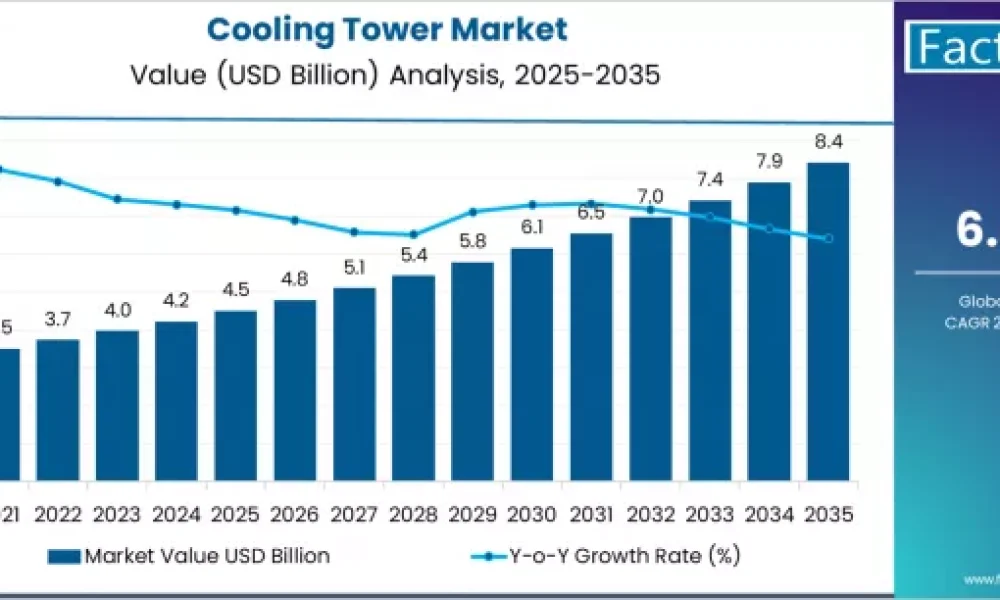
The U.S. cooling tower market is set for robust expansion from 2025 to 2035, driven by growing industrial activities, rising power generation capacity, and increasing demand for efficient thermal management systems. Cooling towers, essential for heat dissipation in industrial, HVAC, and power generation applications, are witnessing significant adoption due to their role in improving energy efficiency, operational reliability, and water conservation. This report provides insights into market size, growth drivers, material preferences, technology trends, and strategic considerations for industry stakeholders.
Market Size and Growth
The U.S. cooling tower market is projected to grow from approximately USD 4.5 billion in 2025 to around USD 8.4 billion by 2035, reflecting a compound annual growth rate (CAGR) of about 6.4%. This growth trajectory indicates an increasing emphasis on sustainable cooling solutions across industrial and commercial sectors, fueled by rising environmental regulations and demand for energy-efficient systems.
Growing emphasis on energy-efficient cooling solutions, expanding data center infrastructure requirements, and rising adoption of water conservation technologies creates expanding opportunities for advanced cooling tower designs and sustainable heat rejection innovations. Rising power generation capacity globally, coupled with expanding industrial processing infrastructure through modern manufacturing facilities and integrated thermal management systems, further accelerate market penetration across diverse application segments.
To access the complete data tables and in-depth insights, request a Discount On The Report here: https://www.factmr.com/connectus/sample?flag=S&rep_id=12396
Key Growth Drivers
- Expanding industrial infrastructure:Increasing manufacturing operations and complex process requirements drive the need for high-capacity and efficient cooling solutions.
- Rising energy efficiency and sustainability initiatives:Adoption of modern cooling tower designs, hybrid systems, and water-saving technologies support environmental compliance and operational cost reduction.
- Data center growth:The expansion of data centers across the U.S. requires advanced cooling infrastructure to maintain optimal operating conditions.
- Technological innovation:Modern towers integrate intelligent monitoring, hybrid configurations, and optimized fill media designs, enhancing energy and water efficiency.
Material and Type Insights
Fiber-reinforced polymer (FRP) is the leading material segment, accounting for approximately 28.9% of the market in 2025. FRP towers offer corrosion resistance, structural integrity, and lightweight properties, making them ideal for industrial and commercial applications. Steel towers follow with 22.4% market share due to their strength and cost-effectiveness for large-capacity installations. Open-circuit towers dominate the market by type, capturing 42.4% of the segment, favored for their simplicity, high thermal efficiency, and broad applicability in industrial cooling processes.
Regional Market Dynamics
North America, led by the U.S., remains a key market due to strong industrial bases, regulatory focus on energy efficiency, and widespread adoption of advanced thermal management systems. Market opportunities exist in both large-scale industrial facilities and commercial infrastructure, with particular growth in HVAC and power generation segments.
Technology Trends and Competition
Key technology trends in the U.S. cooling tower market include:
- Integration of hybrid and closed-loop systems to improve energy and water efficiency.
- Intelligent monitoring and automated controls for enhanced operational reliability.
- Development of sustainable fill materials and water conservation technologies.
Top players such as SPX Corporation, Baltimore Aircoil Company, Delta Cooling Towers, and EVAPCO Inc. are leveraging innovation and strategic expansions to maintain competitive positioning.
Challenges
The market faces challenges, including high capital investment requirements, regulatory compliance for water usage, and technical complexities in system maintenance. Smaller facilities with limited infrastructure may encounter difficulties adopting advanced cooling technologies.
Strategic Implications
For manufacturers and distributors, offering modular, energy-efficient, and water-saving solutions tailored to industrial and commercial clients is critical. Facility managers and process engineers should focus on integrating intelligent monitoring and maintenance strategies to optimize performance and lifecycle costs. Investors can capitalize on the U.S. market’s steady growth, driven by regulatory mandates, technological adoption, and expanding industrial demand.
Outlook Summary
From 2025 to 2035, the U.S. cooling tower market is expected to grow steadily, supported by industrial expansion, energy efficiency initiatives, and the adoption of sustainable cooling technologies. While challenges such as high capital costs and maintenance complexities persist, the sector presents significant opportunities for manufacturers, facility operators, and investors committed to efficient, environmentally responsible thermal management solutions.
Have a specific Requirements and Need Assistant on Report Pricing or Limited Budget please contact us – [email protected]
About Fact.MR
Fact.MR is a global market research and consulting firm, trusted by Fortune 500 companies and emerging businesses for reliable insights and strategic intelligence. With a presence across the U.S., UK, India, and Dubai, we deliver data-driven research and tailored consulting solutions across 30+ industries and 1,000+ markets. Backed by deep expertise and advanced analytics, Fact.MR helps organizations uncover opportunities, reduce risks, and make informed decisions for sustainable growth.



