
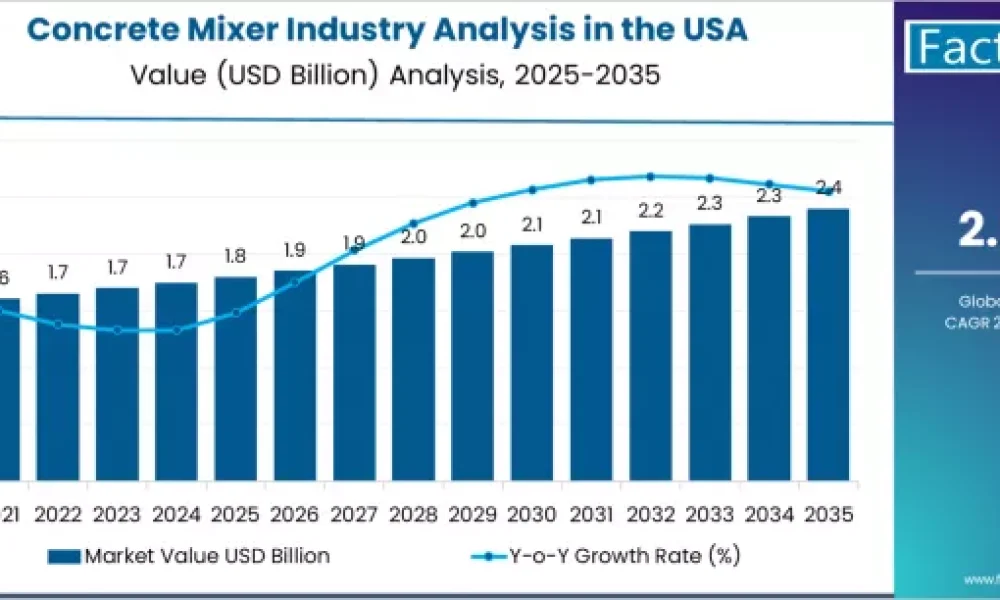
The U.S. concrete mixer industry is projected for steady growth from 2025 to 2035, fueled by rising construction activity, infrastructure development, and the adoption of advanced mobile mixing technologies. Concrete mixers—including truck-mounted, stationary, and portable systems—are essential for delivering high-quality concrete efficiently to residential, commercial, and infrastructure projects. This report highlights market size, growth drivers, regional dynamics, technology trends, and strategic insights for stakeholders.
Market Size and Growth
The U.S. concrete mixer market is expected to grow from approximately USD 1.8 billion in 2025 to USD 2.4 billion by 2035, reflecting a compound annual growth rate (CAGR) of 2.9%. Truck-mounted mixers dominate the market with a 62.5% share, while mixers with 3–9 m³ capacity lead the segment. Growth is supported by increased construction projects nationwide, integration of automated delivery systems, and demand for efficient and reliable concrete delivery solutions across urban and metropolitan areas.
To access the complete data tables and in-depth insights, request a Discount On The Report here: https://www.factmr.com/connectus/sample?flag=S&rep_id=11580
Key Growth Drivers
- Infrastructure Expansion:Federal and state-level infrastructure projects, urban development, and modernization of building facilities are driving demand for concrete mixers. Contractors increasingly rely on mobile delivery systems to meet project deadlines and compliance standards.
- Technological Advancements:Adoption of automated mixing technologies, GPS-enabled tracking, and electric-powered solutions are enhancing operational efficiency and delivery precision. These innovations support large-scale construction and specialized applications.
- Urbanization and Residential Development:Rising urban populations and residential construction projects are creating demand for portable and truck-mounted mixers to ensure timely concrete delivery and consistent quality.
- Efficiency and Quality Control:Construction companies prioritize systems that provide accurate mixing, consistent output, and flexible deployment across multiple sites, reinforcing adoption of advanced mixer technologies.
Regional Insights
The U.S. market is segmented into the West, Northeast, Midwest, and South. The West region leads in demand, driven by ongoing infrastructure projects and large-scale commercial developments. The Northeast and Midwest regions show steady growth due to urban redevelopment and modernization projects. Market opportunities also exist in the South, where residential and infrastructure expansions are increasing. Regional adoption varies based on local regulations, project types, and construction practices.
Technology Trends and Competition
Key technology trends shaping the U.S. concrete mixer industry include:
- Truck-mounted and mobile mixersfor enhanced operational flexibility.
- Automated mixing systemsto improve quality control and reduce manual intervention.
- Integration with digital construction platformsfor project tracking and delivery optimization.
- Sustainable and electric-powered solutionsto meet environmental standards and reduce operational costs.
Major market players include CIFA (Sany/CIFA), Schwing Stetter (Putzmeister Concrete Machines Inc.), Liebherr USA Co., SANY America Inc., and Volvo Construction Equipment North America. Competitive strategies focus on product innovation, service networks, and integrated delivery solutions.
Challenges
The industry faces moderate growth rates compared with other construction equipment segments. Key challenges include cost pressures, high maintenance requirements, and the need for skilled operators. Variations in local infrastructure regulations and project specifications also affect adoption rates of advanced mixer systems.
Strategic Implications
- For Manufacturers and Suppliers:Invest in advanced, automated, and mobile solutions to meet growing urban and infrastructure demands. Emphasize service networks, digital integration, and energy-efficient systems to maintain competitiveness.
- For Construction Contractors:Upgrade fleet capabilities with truck-mounted and automated mixers to improve efficiency, quality control, and project delivery timelines.
- For Investors:The market presents stable growth opportunities, particularly in regions with high infrastructure investment, residential construction, and modernization projects.
Outlook Summary
From 2025 to 2035, the U.S. concrete mixer industry is expected to grow steadily, supported by infrastructure development, urbanization, and adoption of advanced mixing technologies. While growth is moderate, opportunities exist in mobile delivery systems, automated platforms, and energy-efficient solutions. The sector offers promising prospects for manufacturers, construction contractors, and investors seeking to capitalize on evolving construction standards and project demands.
Purchase Full Report for Detailed Insights
For access to full forecasts, regional breakouts, company share analysis, and emerging trend assessments, you can purchase the complete report here: https://www.factmr.com/checkout/11580
Have a specific Requirements and Need Assistant on Report Pricing or Limited Budget please contact us – [email protected]
About Fact.MR
Fact.MR is a global market research and consulting firm, trusted by Fortune 500 companies and emerging businesses for reliable insights and strategic intelligence. With a presence across the U.S., UK, India, and Dubai, we deliver data-driven research and tailored consulting solutions across 30+ industries and 1,000+ markets. Backed by deep expertise and advanced analytics, Fact.MR helps organizations uncover opportunities, reduce risks, and make informed decisions for sustainable growth.



