
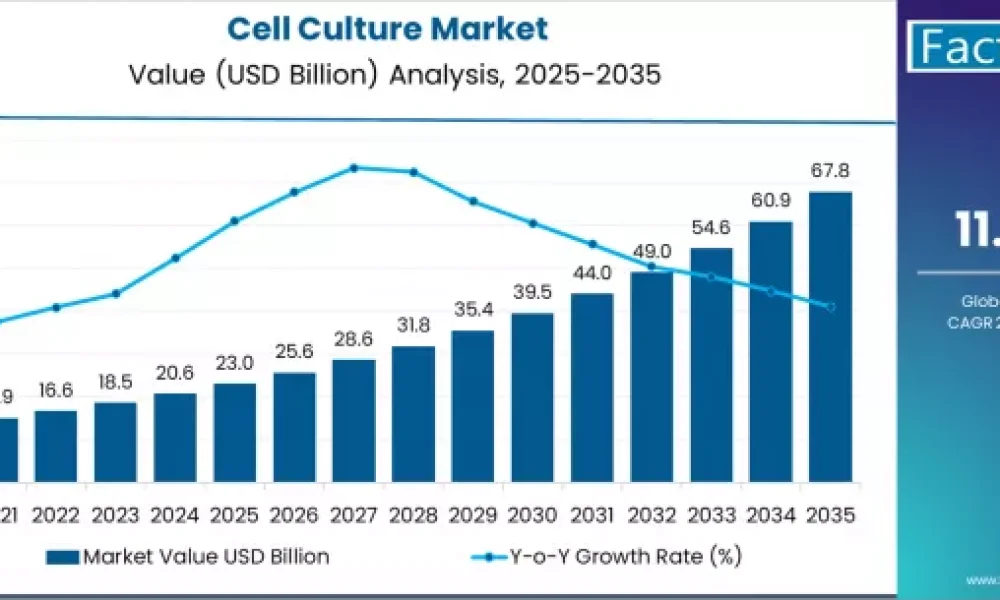
The global cell culture market is entering a decade of accelerated growth, driven by rapid advancements in biopharmaceutical manufacturing, expanding applications in regenerative medicine, and rising investments in precision therapeutics. According to the latest analysis by Fact.MR, the global cell culture market is projected to climb from USD 23.0 billion in 2025 to USD 67.8 billion by 2035, marking an absolute rise of USD 44.8 billion over the assessment period. The market is set to expand at a robust CAGR of 11.4%, reflecting the central role of cell-based research and production across diverse life-science domains, including vaccines, monoclonal antibodies, gene therapy, and tissue engineering.
Cell culture systems—encompassing media, reagents, sera, bioreactors, consumables, and cell lines—are vital for supporting controlled growth and maintenance of cells used in research, diagnostics, and manufacturing. This report outlines global market size projections, key growth drivers, technological trends, challenges, and strategic implications for ecosystem stakeholders from 2025 to 2035.
To access the complete data tables and in-depth insights, request a Discount On The Report here: https://www.factmr.com/connectus/sample?flag=S&rep_id=11805
Market Size and Growth
The global cell culture market will grow nearly 2.9X between 2025 and 2035, rising from USD 23.0 billion to USD 67.8 billion. This significant expansion is linked to the growing demand for advanced biologics, increased R&D investments in cellular therapeutics, and the adoption of innovative culture technologies that enhance scalability and quality. The strong CAGR of 11.4% positions the cell culture industry among the fastest-growing segments within the broader biotechnology and bioprocessing space.
Key Growth Drivers
Biopharmaceutical Boom
The surge in biologics—including vaccines, monoclonal antibodies, and recombinant proteins—continues to be the strongest driver. Cell culture systems form the backbone of biologics production, enabling controlled and scalable manufacturing.
Rising Adoption of Cell-Based Therapies
Advancements in stem cell research, CAR-T cell therapy, gene editing, and regenerative medicine are propelling demand for high-quality culture media, stable cell lines, and automated platforms.
Shift Toward Serum-Free and Chemically Defined Media
With increasing emphasis on reproducibility, safety, and regulatory compliance, laboratories and manufacturers are adopting serum-free, animal component–free, and chemically defined media for enhanced consistency and reduced contamination risks.
Growing Investments in Life Sciences R&D
Government funding, private-sector investment, and collaborations among biotech companies are accelerating cell culture innovation, particularly across North America, Europe, and Asia-Pacific.
Expansion of Contract Manufacturing
Growing dependency on CMOs and CROs for large-scale biologics production is further amplifying demand for high-throughput, scalable, and cost-efficient cell culture systems.
Technology Trends and Competitive Landscape
The cell culture market is characterized by rapidly evolving technologies and intensifying competition. Key trends include:
- 3D cell culture platforms enabling more physiologically relevant models for drug discovery and toxicity testing.
- Single-use bioreactors and disposable systems reducing contamination risks and improving operational flexibility.
- AI-driven automation for monitoring cell growth, optimizing conditions, and reducing manual errors in lab workflows.
- Organoid and tissue-engineering applications gaining momentum for personalized medicine and disease modeling.
- Advanced media formulations tailored for specific cell types to enhance growth efficiency and reproducibility.
These technological enhancements are transforming productivity, scalability, and precision in modern laboratories and manufacturing environments.
Challenges
Despite impressive growth prospects, the cell culture market faces several structural challenges:
- High cost of reagents, equipment, and specialized media may restrict adoption for smaller labs.
- Contamination risks and stringent regulatory requirements demand continuous process validation and quality control.
- Skill gaps in handling advanced culture systems and automation platforms hinder widespread implementation.
- Scalability limitations for certain cell types remain a bottleneck for commercial therapeutics manufacturing.
Strategic Implications
For Manufacturers and Suppliers
Focus on innovation-led differentiation by offering robust, scalable, and contamination-resistant systems. Develop flexible product portfolios combining premium technologies with cost-effective solutions for emerging markets.
For Research Institutions and Healthcare Providers
Increase investment in advanced cell culture platforms and automation to support growing research workloads and improve reproducibility for clinical-grade applications.
For Investors
The market presents exceptional opportunities driven by biotechnology expansion, therapeutic innovation, and strong long-term demand across pharmaceutical and academic sectors.
Outlook Summary
Between 2025 and 2035, the global cell culture market is poised for exceptional growth, supported by rising biologics production, increasing adoption of cell-based therapies, and rapid technological advancements. With the market expected to reach USD 67.8 billion by 2035, cell culture will remain a foundational pillar of modern biotechnology, offering compelling opportunities for manufacturers, researchers, and investors. The decade ahead promises breakthroughs in precision medicine, regenerative therapies, and high-throughput production cementing cell culture’s role at the core of future scientific and therapeutic innovation.
Have a specific Requirements and Need Assistant on Report Pricing or Limited Budget please contact us – [email protected]
About Fact.MR
Fact.MR is a global market research and consulting firm, trusted by Fortune 500 companies and emerging businesses for reliable insights and strategic intelligence. With a presence across the U.S., UK, India, and Dubai, we deliver data-driven research and tailored consulting solutions across 30+ industries and 1,000+ markets. Backed by deep expertise and advanced analytics, Fact.MR helps organizations uncover opportunities, reduce risks, and make informed decisions for sustainable growth.



