
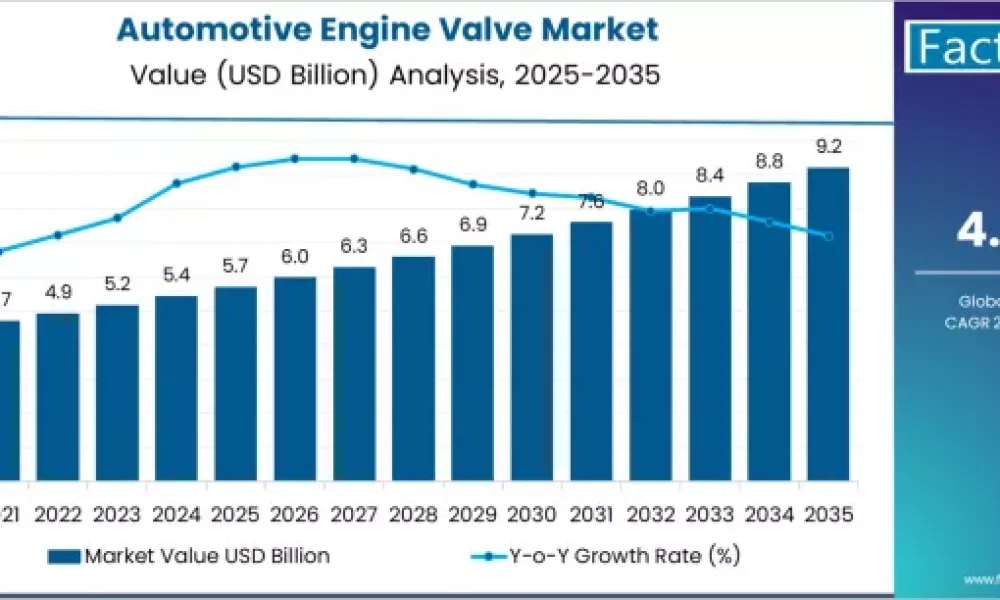
The U.S. automotive engine valve market is poised for steady growth from 2025 to 2035, driven by rising demand for fuel-efficient engines, stricter emission compliance standards, and increasing production of passenger and commercial vehicles. Automotive engine valves—including mono metallic, hollow, and bimetallic designs—play a critical role in controlling airflow, maintaining engine efficiency, and optimizing combustion performance. This report highlights market size, growth drivers, technology trends, regional dynamics, and strategic implications for stakeholders.
Market Size and Growth
The U.S. automotive engine valve market is projected to grow from approximately USD 5.7 billion in 2025 to USD 9.2 billion by 2035, reflecting a compound annual growth rate (CAGR) of 4.9%. Mono metallic valves dominate with a 39.8% share, while passenger cars represent the largest vehicle segment at 68% of demand. This steady growth reflects rising engine downsizing trends, increasing adoption of lightweight materials, and regulatory requirements for emission reduction and fuel economy improvement.
To access the complete data tables and in-depth insights, request a Discount On The Report here: https://www.factmr.com/connectus/sample?flag=S&rep_id=11866
Key Growth Drivers
- Fuel-efficient engine adoption: Increasing focus on fuel economy and engine downsizing is driving demand for advanced valve technologies, including lightweight and thermally optimized designs.
- Emission compliance: Regulatory pressures on NOx and CO₂ emissions are prompting manufacturers to integrate high-performance valves capable of precise combustion control.
- Vehicle production growth: Expanding passenger vehicle production, alongside light and heavy commercial vehicle manufacturing, supports ongoing demand for OEM-grade valves.
- Material and technology innovation: Development of mono metallic, hollow, and bimetallic valves with steel, nickel, and titanium alloys enhances durability, thermal resistance, and engine efficiency.
U.S. Market Insights
North America, led by the U.S., represents a significant market due to the mature automotive industry, high adoption of fuel-efficient technologies, and stringent emission standards. Passenger cars dominate valve consumption, supported by high-volume production. Hollow and bimetallic valves are gaining traction for weight reduction and thermal optimization, particularly in high-performance and hybrid vehicle applications.
Technology Trends and Competition
- Advanced material processing: Steel and nickel alloys are engineered for enhanced thermal resistance, wear durability, and lightweight performance.
- Hollow valve adoption: Hollow designs reduce engine mass and improve fuel efficiency without compromising structural integrity.
- OEM integration: Direct manufacturer partnerships ensure quality compliance, warranty alignment, and production scalability.
Key players in the U.S. market include Eaton, BorgWarner Inc., MAHLE GmbH, NITTAN Corporation, and Fuji Oozx Inc., competing through material innovation, technical validation, and integrated engine solutions.
Challenges
Despite strong growth, the market faces challenges such as high material costs, manufacturing complexity, and the need for technical expertise in installation and maintenance. Adoption of advanced valves in smaller workshops and aftermarket segments may be slower due to these constraints.
Strategic Implications
For manufacturers: Focus on innovative valve materials, lightweight designs, and OEM collaboration for passenger and commercial vehicles.
For automotive OEMs: Integrate advanced valves to enhance engine efficiency, meet emission standards, and optimize fuel performance.
For investors: The market offers steady growth driven by regulatory compliance, engine optimization trends, and material innovation opportunities.
Outlook Summary
From 2025 to 2035, the U.S. automotive engine valve market is expected to expand steadily, with mono metallic valves continuing to dominate and hollow and bimetallic valves gaining importance for fuel efficiency and performance. Growth will be driven by engine downsizing, emission compliance, and advancements in valve materials and design. While challenges such as cost and technical complexity remain, the market presents strong opportunities for manufacturers, OEMs, and investors focused on innovation and regulatory alignment.
Have a specific Requirements and Need Assistant on Report Pricing or Limited Budget please contact us – [email protected]
About Fact.MR
Fact.MR is a global market research and consulting firm, trusted by Fortune 500 companies and emerging businesses for reliable insights and strategic intelligence. With a presence across the U.S., UK, India, and Dubai, we deliver data-driven research and tailored consulting solutions across 30+ industries and 1,000+ markets. Backed by deep expertise and advanced analytics, Fact.MR helps organizations uncover opportunities, reduce risks, and make informed decisions for sustainable growth.



