
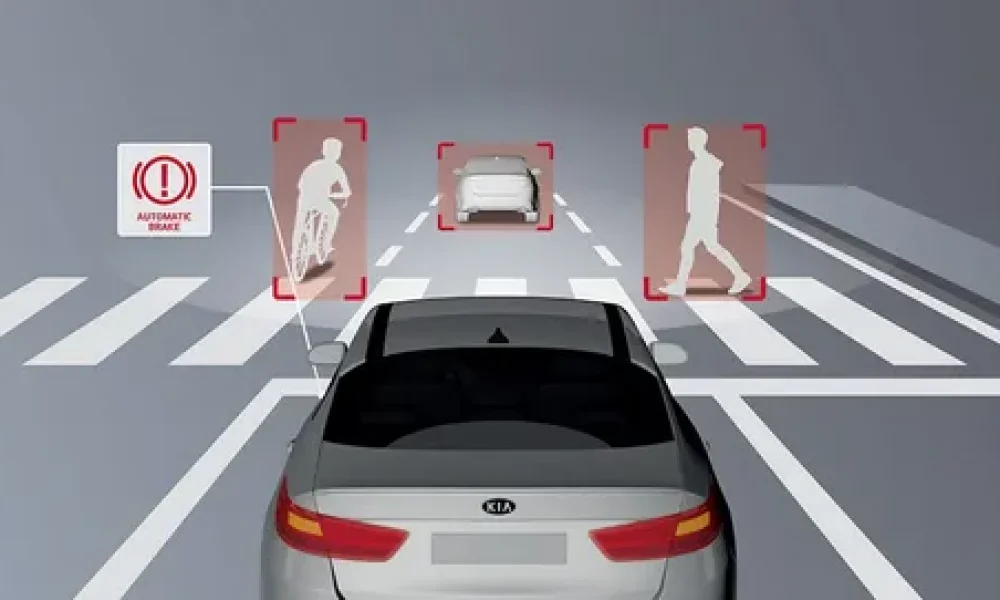
The global automotive emergency braking system (AEBS) market is entering a decade of accelerated expansion, driven by intensifying regulatory requirements, growing deployment of advanced driver assistance systems (ADAS), and the rising global commitment to reducing road fatalities. The market is projected to grow from USD 36.86 billion in 2025 to USD 75.99 billion by 2035, expanding at a CAGR of 7.5%, according to new industry forecasts.
Governments worldwide are strengthening vehicle safety frameworks, compelling automakers to integrate high-performance braking technologies that prevent collisions through automated sensing, decision-making, and vehicle intervention. As the industry transitions toward connected, electric, and increasingly autonomous vehicle platforms, AEBS has become one of the fastest-adopted active safety technologies across passenger and commercial fleets.
Global Mandates Accelerate Adoption Across All Vehicle Segments
Regulatory initiatives are reshaping the competitive landscape for vehicle safety systems. In April 2024, the U.S. National Highway Traffic Safety Administration (NHTSA) finalized Federal Motor Vehicle Safety Standard (FMVSS) No. 127, making automatic emergency braking mandatory by 2029 for all new passenger vehicles and light trucks. These systems must detect pedestrians in day and night conditions and stop vehicles traveling at speeds up to 62 mph, significantly reducing the risk of severe crashes.
Additionally, a 2025 report by the U.S. Department of Transportation and MITRE’s PARTS initiative confirmed that AEB systems lowered rear-end collisions by approximately 49%, reinforcing their role as essential components of modern vehicle safety architectures. Similar requirements are being implemented across Europe, Japan, and South Korea, accelerating OEM integration timelines.
Automakers are now embedding high-speed emergency braking capabilities into electric vehicle (EV) platforms, crossovers, and mid-segment passenger cars to comply with Euro NCAP, UN regulations, and national safety programs. Industry analysts expect AEBS to become standard across most global vehicle models by early 2030.
Subscribe for Year-Round Insights → Stay ahead with quarterly and annual data updates
https://www.futuremarketinsights.com/reports/sample/rep-gb-14558
Sensor Fusion Technology Emerges as the Top Investment Priority
The next generation of emergency braking systems is being defined by improvements in multi-sensor coordination and real-time data processing. Fusion-based AEBS platforms, which combine radar, camera, and LiDAR inputs for superior detection accuracy, accounted for 36% of the market in 2025 and are projected to grow at a CAGR of 7.9% through 2035.
In 2025, OEMs widely implemented fusion systems in Level 2 and Level 2+ ADAS-equipped vehicles, reducing false positives, eliminating blind zones, and enhancing detection of pedestrians, cyclists, and vehicles under varied driving conditions. Tier-1 suppliers collaborated with automakers to develop custom fusion algorithms optimized for high-speed highways, congested urban conditions, and low-visibility environments. As chipset costs decline and processing power expands, fusion-based braking is expected to scale rapidly into mid-range and entry-level vehicle segments.
Forward Emergency Braking Dominates Application Demand
Forward emergency braking (FEB) remained the strongest application segment, holding 58% of the global market in 2025 and growing at a CAGR of 7.6% through 2035. FEB systems are deployed to prevent frontal collisions by detecting vehicles, pedestrians, and vulnerable road users across dynamic driving environments.
Regulatory frameworks such as UNECE Regulation No. 152 and voluntary AEB adoption programs in North America have made forward emergency braking standard in compact cars, crossovers, premium SUVs, and electric vehicles. Advancements in dynamic braking pressure modulation, enhanced pedestrian recognition, and adaptive responsiveness have improved FEB reliability at both low and high speeds.
Challenges: High Costs and System Integration Complexities
Despite rapid adoption, the AEBS market faces several structural challenges:
- High cost of radar, camera, and LiDAR technologies limits penetration in emerging markets and entry-level vehicle segments.
- Integration complexity requires upgrades to vehicle electrical architectures, ECU performance, and sensor calibration systems.
- False braking events, often triggered by environmental factors or calibration errors, contribute to consumer hesitation and increase R&D burdens for OEMs and suppliers.
Addressing these challenges requires advancements in algorithmic precision, AI-supported threat detection, and system standardization across manufacturers.
Opportunities: Regulatory Momentum and Commercial Fleet Adoption
Growth opportunities for AEBS are expanding as governments strengthen safety legislation, particularly in the USA, UK, EU, Japan, and South Korea. Commercial fleets are emerging as a major demand driver, with logistics and long-haul transport operators adopting emergency braking systems to reduce accident-related downtime and insurance costs.
The combination of Vision Zero initiatives, expanding smart city infrastructures, and rising V2X communication capabilities will further enhance the performance and market penetration of automated braking technologies.
Personalize Your Experience: Ask for Customization to Meet Your Requirements
https://www.futuremarketinsights.com/customization-available/rep-gb-14558
Country-Level Outlook
United States (CAGR 7.8%)
New AEB mandates and high EV adoption are boosting development of radar-, camera-, and AI-based braking solutions. Automakers such as Ford, Tesla, and GM are deploying next-generation AEBS to meet regulatory timelines. Retrofitting demand is also strong in the U.S. aftermarket.
United Kingdom (CAGR 7.4%)
The UK’s implementation of the General Safety Regulation (GSR) by 2026 and the government’s self-driving roadmap for 2025 are accelerating AEB integration across EVs and autonomous vehicle fleets.
European Union (CAGR 7.6%)
EU mandates require AEB as standard in all new models, accelerating investments by Volkswagen, Stellantis, and BMW in radar-LiDAR fusion braking and predictive analytics.
Japan (CAGR 7.7%)
JNCAP’s expansion of mandatory AEB requirements and Japan’s leadership in hybrid and autonomous technologies make it a major market for advanced braking solutions.
South Korea (CAGR 7.5%)
Government mandates for AEB by 2025, coupled with Hyundai and Kia’s rapid ADAS innovation, are pushing high-performance braking systems into mainstream vehicle lineups.
Competitive Landscape
The AEBS market is characterized by strong innovation in AI-enabled braking, sensor fusion, V2X communication, and multi-directional emergency braking platforms. Leading companies are investing heavily in LiDAR-assisted braking, high-speed actuation mechanisms, and predictive decision-making software to support the transition toward fully autonomous vehicles.
Why Choose FMI: Empowering Decisions that Drive Real-World Outcomes:
https://www.futuremarketinsights.com/why-fmi
About Future Market Insights (FMI)
Future Market Insights, Inc. (FMI) is an ESOMAR-certified, ISO 9001:2015 market research and consulting organization, trusted by Fortune 500 clients and global enterprises. With operations in the U.S., UK, India, and Dubai, FMI provides data-backed insights and strategic intelligence across 30+ industries and 1200 markets worldwide.



