
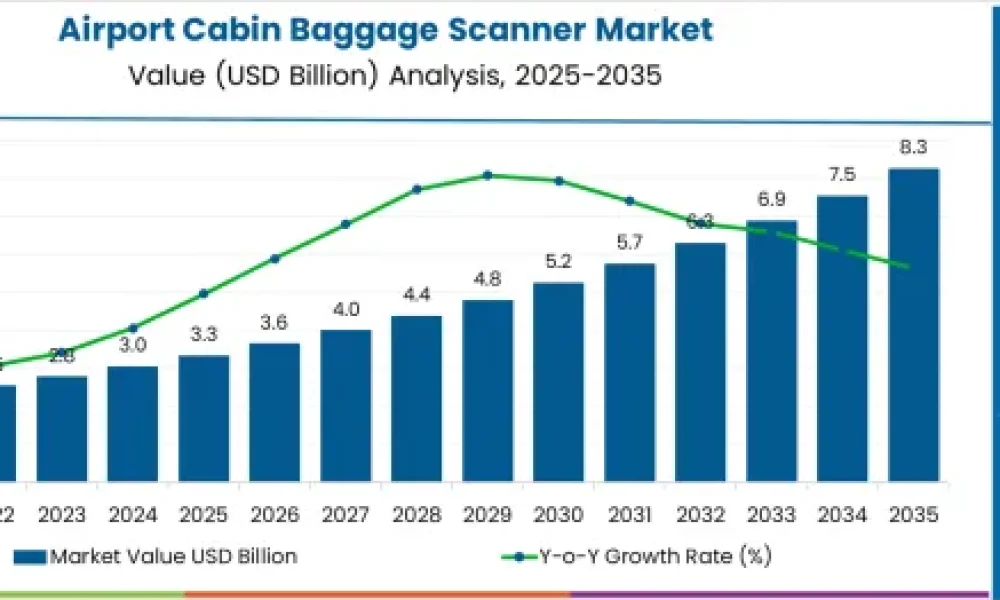
The Airport Cabin Baggage Scanner Market is entering a decade of accelerated transformation as regulatory mandates, rising passenger volumes, and rapid technology adoption converge. Valued at USD 3.3 billion in 2025, the market is projected to reach USD 8.3 billion by 2035, expanding at a CAGR of 9.5%. Market Share Erosion or Gain Analysis indicates significant growth headroom for vendors investing in advanced CT-based, automated, and AI-driven screening solutions, while suppliers of legacy X-ray systems risk rapid competitive displacement.
Early-Decade Growth Driven by CT Adoption and AI Integration
Between 2025 and 2030, the market is expected to grow from USD 3.3 billion to USD 4.8 billion, generating USD 1.5 billion in new revenue—representing nearly 30% of total forecasted expansion. This phase is characterized by widespread adoption of:
- Computed Tomography (CT) scanners
- AI-assisted threat detection algorithms
- Automated tray return systems
- Integration with biometric identity platforms
Airports pursuing compliance with TSA, ECAC, and ICAO standards are accelerating procurement cycles, prioritizing systems capable of delivering higher throughput and enhanced detection accuracy. Vendors offering high-resolution imaging, automated classification, and seamless integration with airport IT ecosystems are emerging as early market share gainers.
Subscribe for Year-Round Insights → Stay ahead with quarterly and annual data updates
https://www.futuremarketinsights.com/reports/sample/rep-gb-23047
2030–2035: High-Velocity Growth Fueled by Smart Airport Ecosystem Integration
The second half of the forecast period contributes USD 3.5 billion, accounting for 70% of total market expansion, with market size reaching USD 8.3 billion by 2035. Growth momentum during this phase is shaped by:
- Deployment of next-generation CT scanners at mega hubs and expanding regional airports
- Integration of fully automated lanes and self-screening systems
- Large-scale replacement cycles of outdated X-ray platforms
- Airport digitalization initiatives and predictive maintenance adoption
- Expansion of new terminals in Asia-Pacific and the Middle East
Suppliers unable to transition to CT-based architectures, real-time analytics, and automated detection solutions are expected to face severe market share erosion as airport operators increasingly favor advanced, data-optimized systems.
Quick Market Highlights
- 2025 Value: USD 3.3 Billion
- 2035 Forecast Value: USD 8.3 Billion
- CAGR (2025–2035): 9.5%
- Leading Component (2025): Hardware (61.3%)
- Top Regions: North America, Asia-Pacific, Europe
- Key Companies: Smiths Group Plc, Leidos, Rapiscan Systems, Nuctech, L3Harris Technologies, Safeway Inspection System, Astrophysics Inc.
Strategic Positioning Within the Security Technology Landscape
Airport cabin baggage scanners hold a critical position across associated security categories:
- 20–22% of the aviation security screening systems market
- 15–17% of the baggage handling and screening market
- 10–12% of the airport security equipment market
- 3–4% of the homeland security and public safety market
- 6–8% of overall transportation security systems
Demand continues to intensify as global airports adopt CT imaging, AI-enabled detection, automated lanes, and cloud-connected screening capabilities to support next-generation checkpoint modernization.
Market Drivers
- Aviation Security Protocols Intensify System Upgrades
Global aviation regulators are enforcing mandatory implementation of CT-based scanners and automated detection systems. As passenger volumes return to pre-pandemic highs, airports require solutions that ensure both security compliance and efficient passenger handling.
- Surge in Smart Airport Programs
Digital transformation initiatives—ranging from centralized checkpoint management to biometric-enabled processing—are creating demand for scanners with real-time data integration and remote monitoring capabilities.
- Increased Focus on Throughput and Passenger Experience
Systems that eliminate the need for removing electronics and liquids, reduce false positives, and minimize secondary checks are being prioritized.
Market Restraints
- High capital costs for CT and dual-energy imaging systems
- Long procurement cycles and infrastructure compatibility constraints
- Need for trained operators and technical security personnel
- Maintenance complexity and calibration requirements for advanced systems
- Integration challenges at smaller or resource-constrained airports
Despite these challenges, retrofit opportunities and modular scanner designs are expanding adoption across smaller terminals.
Key Trends Shaping Market Direction
- 3D CT Imaging Becomes Standard: Expected to reach 68.7% share in 2025
- AI-Enabled Screening: Reduces manual intervention and improves detection accuracy
- Portable & Compact Units: Increasing adoption at regional airports, temporary checkpoints, and VIP lanes
- Cloud & Remote Screening: Enables centralized threat detection centers
- Biometric Integration: Syncs passenger identity verification with baggage screening
- Predictive Maintenance: Improves scanner uptime and reduces operational disruptions
Segmental Insights
Hardware Leads with 61.3% Share
Hardware remains the most capital-intensive segment, driven by demand for durable CT scanners, high-capacity conveyors, and energy-efficient systems.
3D CT Dominates with 68.7% Share
Superior detection capabilities, regulatory compliance, and faster passenger flow continue to push adoption of CT scanners over legacy 2D X-ray units.
Commercial Service Airports Hold 72.1% Share
High passenger throughput and large-scale modernization initiatives sustain dominance of commercial service airports.
Country-Level Highlights
- China: 12.8% CAGR – fueled by mega airport expansion and early CT adoption
- India: 11.9% CAGR – driven by privatization, UDAN airports, and capacity upgrades
- Germany: 10.9% CAGR – ECAC Standard 3 compliance accelerates CT deployment
- France: 10.0% CAGR – demand influenced by global event security preparations
- UK: 9.0% CAGR – CT implementation mandates across major airports
Personalize Your Experience: Ask for Customization to Meet Your Requirements
https://www.futuremarketinsights.com/customization-available/rep-gb-23047
Competitive Landscape
The market is dominated by innovation-driven global OEMs, including:
- Smiths Group Plc
- Leidos
- Rapiscan Systems (OSI Systems)
- Nuctech
- L3Harris Technologies
- Safeway Inspection System
- Astrophysics Inc.
Competitive advantage is defined by imaging resolution, automated detection performance, regulatory certifications (TSA, ECAC, ICAO), and cost-effective lifecycle management.
Recent Industry Developments
- March 2025: Smiths Detection to deploy 77 HI-SCAN 6040 CTiX scanners and 156 iLane A20 systems at Fukuoka International Airport
- May 2024: OSI Systems secures USD 42 million contract for integrated airport security systems
- February 2023: Leidos installs ClearScan™ CT solution at Frankfurt Airport’s Terminal 1
Why Choose FMI: Empowering Decisions that Drive Real-World Outcomes:
https://www.futuremarketinsights.com/why-fmi
About Future Market Insights (FMI)
Future Market Insights, Inc. (FMI) is an ESOMAR-certified, ISO 9001:2015 market research and consulting organization, trusted by Fortune 500 clients and global enterprises. With operations in the U.S., UK, India, and Dubai, FMI provides data-backed insights and strategic intelligence across 30+ industries and 1200 markets worldwide.



