
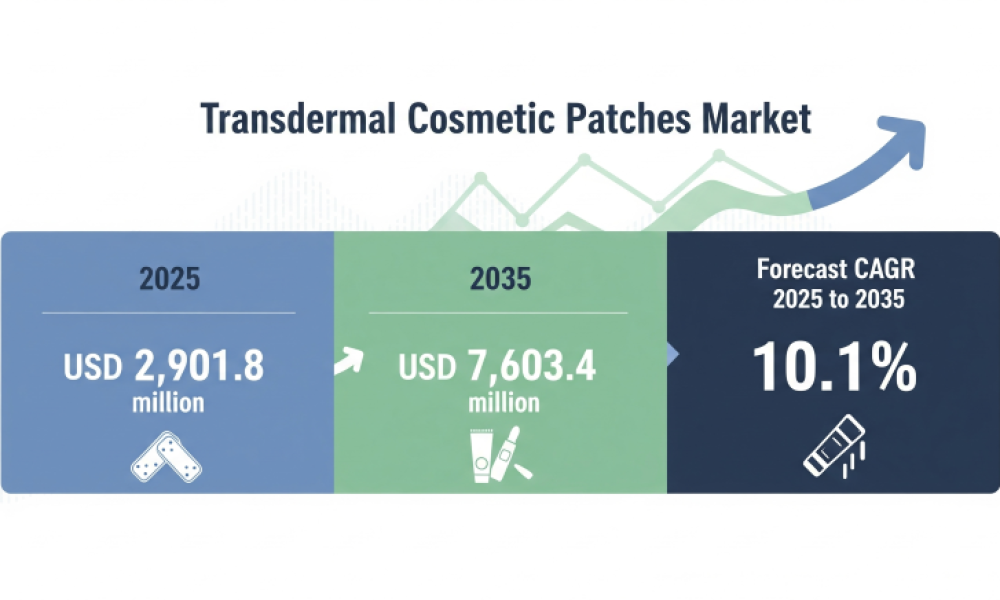
The Transdermal Cosmetic Patches Market is poised for remarkable growth, expected to expand from USD 2,901.8 million in 2025 to USD 7,603.4 million by 2035, reflecting a robust compound annual growth rate (CAGR) of 10.1%. This growth is indicative of a booming market for targeted, high-efficacy skincare solutions, driven by innovations in patch technology, personalized beauty trends, and the expansion of direct-to-consumer (D2C) brands.
Unlock detailed analytics – Request your personalized report now! https://www.futuremarketinsights.com/reports/sample/rep-gb-25292
Market Drivers: Personalization & Premiumization
The growth of the Transdermal Cosmetic Patches Market is primarily fueled by the increasing consumer demand for personalized skincare solutions. Transdermal patches, including hydrogel and microneedle formats, offer precise, direct delivery of active ingredients such as peptides, retinol, and hyaluronic acid, targeting specific skin concerns like acne, wrinkles, and pigmentation. This targeted approach is rapidly gaining popularity due to its ability to deliver faster, more visible results compared to traditional creams and serums.
Emerging trends in microdart and microneedle technologies are significantly accelerating market expansion, particularly in the premium skincare sector. These technologies enable deeper penetration of actives, providing near-clinical results without the need for invasive dermatological procedures. As a result, premium patches are becoming increasingly sought after by consumers who seek clinical-grade efficacy at home.
In parallel, the rise of D2C beauty brands leveraging AI-driven skin diagnostics and personalized subscription models is reshaping the consumer experience. Brands like ZitSticka, Peace Out Skincare, and COSRX are capturing a substantial market share by offering tailored skincare regimens and fostering direct relationships with their consumers.
Competitive Landscape: Major Players & Innovations
The Transdermal Cosmetic Patches Market is highly competitive, with several leading brands at the forefront of this transformative segment. 3M, Nitto Denko, Amorepacific, and KAO dominate the industry with their hydrogel and occlusive adhesive patches, which remain the most popular formats in the market. Meanwhile, ZitSticka, Peace Out Skincare, and Rael are emerging as key players in the microdart and microneedle space, leveraging their digital-first strategies to capture millennial and Gen Z consumers.
The competitive advantage is shifting away from patch material innovation alone to include ecosystem strength, scalability of personalized skincare solutions, and the ability to foster recurring revenue streams through subscription models. Digital-first brands are particularly successful in driving this shift, with ZitSticka and Peace Out Skincare leading the charge by combining e-commerce, AI-powered skincare assessments, and social media-driven influencer marketing.
Regional Insights: Asia-Pacific Leads Growth
Asia-Pacific is emerging as the fastest-growing region for transdermal cosmetic patches, particularly driven by the demand in China and India. China is expected to maintain a strong growth trajectory at a CAGR of 15.9%, fueled by a rapidly growing middle class, increasing consumer awareness, and government initiatives to promote cosmeceuticals. Similarly, India is projected to experience explosive growth at a CAGR of 17.9%, driven by the rise of affordable masstige skincare products and e-commerce expansion into tier II and III cities.
Europe, led by the UK and Germany, is also experiencing steady growth, with increasing consumer demand for eco-friendly, dermatologically tested skincare solutions. Meanwhile, North America, particularly the USA, shows moderate expansion due to a maturing market, but digital-first models and service-driven platforms continue to push the boundaries of market innovation.
Download Brochure for Full Insights: https://www.futuremarketinsights.com/reports/brochure/rep-gb-25292
Segmental Analysis: Hydrogel Patches and Acne Treatment Lead Demand
By patch type, hydrogel patches are expected to account for 51.5% of the market share in 2025. These patches are highly favored for their cooling and hydrating properties, making them ideal for acne treatment, wrinkle reduction, and skin brightening applications. Hydrogel formulations also ensure better adherence and enhanced transdermal delivery of active ingredients.
The acne/blemish active focus segment is set to hold a significant share, with 44.4% of the market in 2025. Acne patches are increasingly popular for their discreet, hygienic, and fast-acting properties, particularly among teenagers, young adults, and even professionals seeking on-the-go solutions for breakouts. The overnight patch segment will remain dominant, accounting for 58.6% of the market in 2025, as consumers prefer the convenience of prolonged wear during sleep to achieve optimal skincare results.
Challenges: Regulatory Hurdles and Clinical Validation
While the market shows promising growth, challenges such as the lack of standardized clinical validation and regulatory ambiguity persist. Particularly, microneedle patches, which blur the line between cosmetics and medical devices, face heightened regulatory scrutiny. In addition, concerns over the performance consistency and skin compatibility of some patch formats may limit broader adoption.
About Future Market Insights (FMI)
Future Market Insights, Inc. (ESOMAR certified, recipient of the Stevie Award, and a member of the Greater New York Chamber of Commerce) offers profound insights into the driving factors that are boosting demand in the market. FMI stands as the leading global provider of market intelligence, advisory services, consulting, and events for the Packaging, Food and Beverage, Consumer Technology, Healthcare, Industrial, and Chemicals markets. With a vast team of over 400 analysts worldwide, FMI provides global, regional, and local expertise on diverse domains and industry trends across more than 110 countries.



