
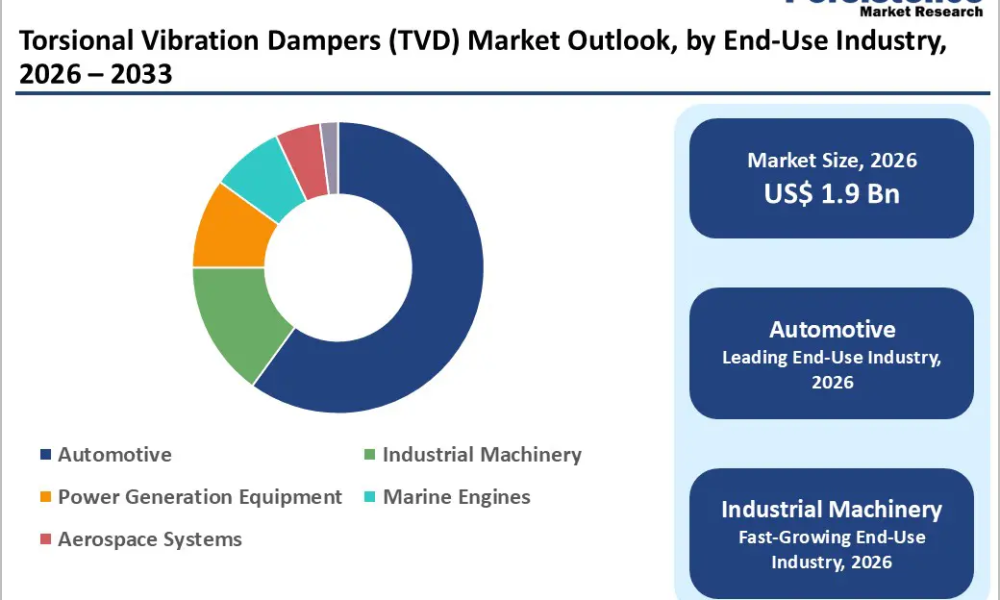
The global torsional vibration dampers (TVD) market is poised for sustained growth over the coming decade, underpinned by rising demand for enhanced engine durability, improved powertrain efficiency, and stricter emissions regulations across automotive and industrial sectors. According to consolidated insights from leading market research firms, the global TVD market is estimated to be valued at approximately US$ 1.9 billion in 2026 and is projected to reach US$ 2.8 billion by 2033, registering a compound annual growth rate (CAGR) of 5.7% during the forecast period from 2026 to 2033.
Torsional vibration dampers play a critical role in minimizing crankshaft oscillations and rotational irregularities generated by internal combustion engines and high-torque rotating machinery. By absorbing and dissipating torsional energy, TVDs enhance engine smoothness, reduce noise and vibration, prevent premature mechanical failure, and extend the service life of critical drivetrain components. These functional benefits are becoming increasingly vital as engines are downsized, turbocharged, and optimized for higher torque outputs and lower emissions.
Market growth is being driven primarily by the global automotive industry’s focus on fuel efficiency, reduced noise, vibration, and harshness (NVH), and compliance with stringent emission norms such as Euro 7, China VII, and updated Corporate Average Fuel Economy (CAFE) standards. In addition, rising production of commercial vehicles, agricultural machinery, construction equipment, marine engines, and stationary power generators is expanding the application scope of torsional vibration dampers beyond passenger vehicles.
The increasing complexity of modern powertrains, including hybridized internal combustion systems, high-output diesel engines, and advanced gasoline direct injection platforms, is further accelerating demand for high-performance and precisely engineered TVDs.
Get Your FREE Sample Report Instantly Click Now: https://www.persistencemarketresearch.com/samples/31621
Market Segmentation
By Product Type
- Elastomer Dampers
- Viscous Dampers
- Pendulum Dampers
- Dual Mass Flywheels
- Composite Material Dampers
By Mechanical Configuration
- Internal Combustion Engine (ICE)
- Turbocharged Engines
- Hybrid Powertrains
- Electric Vehicle (EV) Drivetrains
- Others
By End-Use Industry
- Automotive
- Industrial Machinery & Equipment
- Power Generation Equipment
- Marine Engines
- Aerospace Systems
- Others
Regional Insights
Regionally, Asia-Pacific leads the global torsional vibration dampers market, accounting for the largest share in terms of both production and consumption. The region’s dominance is attributed to high automotive manufacturing volumes in countries such as China, Japan, India, and South Korea, along with the strong presence of commercial vehicle and engine manufacturers. Rapid industrialization, infrastructure development, and rising vehicle ownership continue to bolster demand for torsional vibration dampers across the region.
Europe represents another key market, driven by stringent emissions regulations, advanced automotive engineering standards, and the presence of leading OEMs and tier-one suppliers. The region’s focus on NVH optimization and powertrain efficiency has resulted in the widespread adoption of high-performance viscous and pendulum dampers.
North America maintains a significant market share due to strong demand for heavy-duty trucks, agricultural machinery, and power generation equipment. The increasing focus on engine durability and compliance with evolving emission norms is supporting steady growth in the region.
Among all regions, Asia-Pacific is also expected to be the fastest-growing market during the forecast period. Growth is supported by expanding manufacturing capacities, increasing investments in commercial transportation, and the gradual implementation of stricter emission standards across developing economies, which are driving the adoption of advanced torsional vibration damping solutions.
Customize This Report for Your Exact Requirements: https://www.persistencemarketresearch.com/request-customization/31621
Unique Features and Innovations in the Market
Modern torsional vibration dampers are increasingly characterized by advanced materials, precision engineering, and integration with digital design tools. Manufacturers are leveraging high-performance elastomers, specialized silicone fluids, and composite materials to enhance damping efficiency while reducing weight and improving thermal stability.
Digital technologies such as artificial intelligence and advanced simulation software are being used extensively in the design and testing of TVDs. AI-driven modeling enables manufacturers to predict torsional behavior across a wide range of operating conditions, significantly reducing development cycles and improving product reliability. Internet of Things (IoT)-enabled monitoring systems are also being explored, allowing real-time condition monitoring of dampers in industrial and heavy-duty applications to support predictive maintenance strategies.
While 5G technology does not directly influence TVD functionality, it supports connected vehicle and industrial ecosystems where real-time data exchange enhances diagnostics, performance optimization, and lifecycle management of powertrain components, including vibration dampers.
Market Highlights
The adoption of torsional vibration dampers is being driven by a combination of regulatory, operational, and economic factors. Stricter global emissions and noise regulations are compelling OEMs to adopt advanced NVH control solutions, making TVDs an essential component in modern engine design.
From a cost perspective, effective vibration damping reduces wear and tear on critical engine components, lowering maintenance expenses and minimizing downtime for commercial fleets and industrial operators. Sustainability considerations are also playing a growing role, as improved engine efficiency and durability contribute to lower fuel consumption and reduced environmental impact over the vehicle or equipment lifecycle.
Key Players and Competitive Landscape
The global torsional vibration dampers market is moderately consolidated, with several established players competing on the basis of technology, quality, and long-term OEM relationships. Key companies operating in the market include:
✦ Continental AG, which focuses on advanced NVH solutions and leverages its strong relationships with global automotive OEMs to expand its torsional vibration damper portfolio.
✦ BorgWarner Inc., known for its powertrain expertise, continues to invest in high-performance damping solutions for both conventional and hybrid powertrains.
✦ Schaeffler Group, which emphasizes precision engineering and material innovation to deliver durable and lightweight torsional vibration dampers.
✦ ZF Friedrichshafen AG, which integrates torsional vibration damping technologies into broader drivetrain and transmission systems to offer comprehensive solutions.
✦ Dayco Products LLC, a prominent supplier of engine drive systems, focusing on cost-effective and reliable rubber and viscous dampers for global markets.
✦ Vibracoustic, which leverages its specialization in vibration control to develop tailored solutions for passenger and commercial vehicles.
Competition in the market is characterized by continuous product innovation, strategic partnerships with OEMs, and expansion into high-growth regions, particularly in Asia-Pacific and emerging economies.
Recent Developments
- Several leading manufacturers have recently announced the development of next-generation viscous torsional vibration dampers designed specifically for high-output diesel and hybrid engines, featuring improved thermal resistance and extended service life.
- Key players have expanded their manufacturing and engineering footprints in Asia-Pacific to support growing regional demand and strengthen supply chain resilience for automotive and industrial customers.
Ready to Dive Deep? Buy Full Report Today: https://www.persistencemarketresearch.com/checkout/31621
Future Opportunities and Growth Prospects
Looking ahead, the torsional vibration dampers market is expected to benefit from sustained demand for internal combustion and hybrid powertrains, particularly in commercial vehicles, off-highway equipment, and industrial machinery. While the gradual transition toward full electrification may moderate long-term demand in certain passenger vehicle segments, the continued reliance on ICE-based systems in many applications ensures a stable growth outlook through 2033.
Evolving regulations related to emissions, noise, and fuel efficiency will continue to shape product development priorities, driving innovation in materials, damping technologies, and system integration. The increasing use of digital engineering tools, AI-based simulations, and connected diagnostics is expected to further enhance product performance and open new opportunities for value-added services.
Overall, the global torsional vibration dampers market is positioned for steady and resilient growth, supported by technological advancements, regulatory compliance requirements, and the ongoing need for reliable and efficient powertrain solutions across automotive and industrial sectors.




