
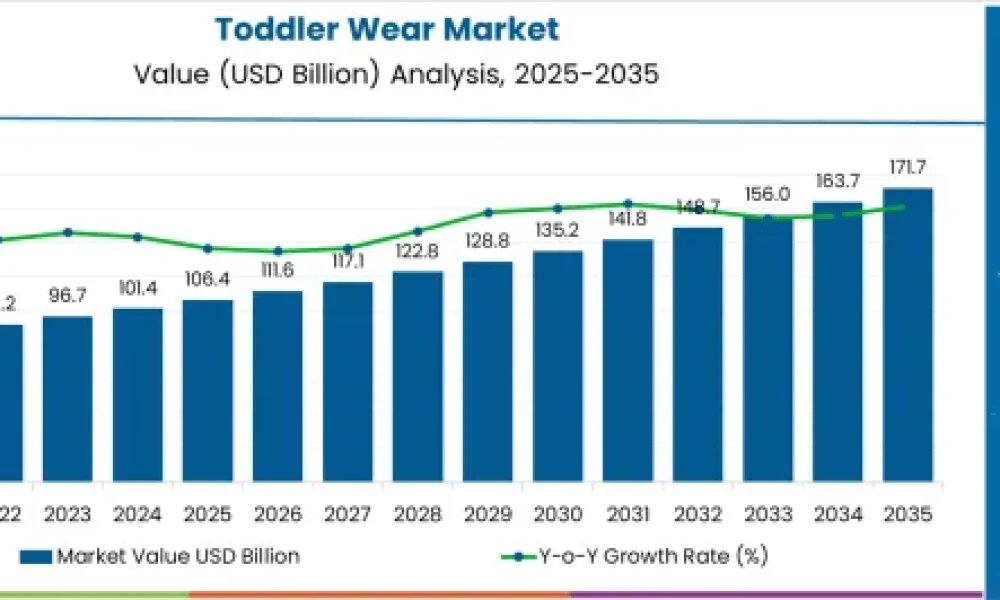
The global toddler wear market is entering a decade of steady expansion, supported by rising parental spending, heightened focus on child safety and comfort, and the growing influence of fashion trends in early-age apparel. According to the latest market assessment, the toddler wear industry is valued at USD 106.4 billion in 2025 and is projected to reach USD 171.7 billion by 2035, registering a compound annual growth rate (CAGR) of 4.9% over the forecast period.
This growth trajectory reflects structural shifts across global apparel manufacturing, retail distribution, and consumer preferences for children aged one to four years. North America, Asia-Pacific, and Europe remain the leading regions, while emerging economies in Asia continue to outpace the global average.
To access the complete data tables and in-depth insights — Request Your Sample Report Now
Market Outlook: What Is Driving Growth Through 2035
Between 2025 and 2035, the toddler wear market is expected to expand as manufacturers diversify product offerings and retailers strengthen omnichannel strategies. From 2031 to 2035 alone, market value is projected to rise from USD 111.6 billion to USD 148.7 billion, supported by demand for organic cotton apparel, durable fabrics, and customization options such as subscription-based clothing models.
Parents are prioritizing durability, softness, washability, and safety certifications, prompting brands to invest in improved fabric technology and eco-friendly production practices. The expansion of organized retail and the rapid growth of e-commerce platforms have further enhanced accessibility, particularly in urban and semi-urban markets.
Industry Structure and Regulatory Environment
The toddler wear market operates within highly regulated global apparel supply chains. Manufacturers design garments using child-safe materials, specialized sizing systems, and construction techniques that account for rapid growth patterns and active movement. Features such as wider necklines, snap closures, reinforced seams, and tagless designs are standard across product categories.
Compliance with international safety frameworks—including the Consumer Product Safety Improvement Act (CPSIA) in the United States and REACH regulations in Europe—remains a defining factor for market entry. These standards restrict chemical content, small parts, drawstrings, and flammability levels. Third-party testing, certificates of conformity, and traceability systems add to production costs but are essential to maintaining consumer trust and regulatory approval.
Retail Channels and Consumer Buying Patterns
Toddler wear is distributed through specialty children’s stores, department stores, mass-market retailers, and online platforms. Purchasing decisions are influenced by ease of dressing, comfort, growth accommodation, and price sensitivity. Seasonal demand patterns align with growth spurts, weather changes, and gifting occasions, creating predictable fluctuations throughout the year.
Brand positioning increasingly emphasizes safety compliance, organic materials, and developmental appropriateness. At the same time, retailers balance these attributes against affordability, particularly in the medium price range, which continues to dominate global sales.
Key Segment Insights: Product, Material, and Price Range
- Top Wear Leads Product Demand
Top wear is the leading product category, accounting for 34.2% of global toddler wear revenue in 2025. High usage frequency, faster replacement cycles, and versatility across casual, festive, and outdoor occasions support its dominance. Manufacturers continue to introduce functional features and skin-friendly fabrics to meet parental expectations for comfort and durability. - Cotton Remains the Preferred Material
Cotton-based toddler apparel is projected to hold 32.9% of market revenue in 2025. Breathability, hypoallergenic properties, and ease of care make cotton suitable across climates. Growing awareness of sustainable materials has also increased demand for organic cotton, reinforcing its role in both mass-market and premium segments. - Medium Price Range Captures Majority Share
The medium price range segment is expected to represent 51.7% of market revenue in 2025. This category appeals to middle-income households seeking a balance between quality and affordability, supported by promotional pricing, seasonal sales, and wide product variety.
Regional Performance: Asia-Pacific Outpaces Global Average
The toddler wear market is projected to grow at a global CAGR of 4.9% from 2025 to 2035, with Asia-Pacific emerging as the fastest-growing region.
- China leads with a CAGR of 6.6%, driven by strong manufacturing capacity, high online retail penetration, and rising demand for premium toddler apparel.
- India follows at 6.1%, supported by expanding organized retail, e-commerce adoption, and a large young population base.
- Germany (5.6%) and France (5.1%) benefit from premium fashion influence and established retail networks.
- The United Kingdom (4.7%) and United States (4.2%) show steady growth, anchored by safety-certified, comfort-driven apparel and expanding digital channels.
Competitive Landscape and Market Positioning
The global toddler wear market is highly competitive, with established apparel brands and niche players focusing on safety, sustainability, and agile design cycles. Leading companies include Carter’s Inc., The Children’s Place Inc., Gap Inc. (GapKids and OshKosh B’gosh), H&M Group, Zara (Inditex), Nike Inc., Adidas AG, Ralph Lauren Corporation, and Marks & Spencer Group plc.
Premium and sustainability-focused brands such as Burberry Group plc, Petit Bateau, Patagonia Inc., J.Crew Group (crewcuts), and Next plc continue to differentiate through material quality, craftsmanship, and eco-conscious positioning. Across all segments, digital expansion and personalization strategies are shaping long-term competitive advantage.
Outlook
With sustained demand for safety-certified, comfortable, and fashion-forward toddler apparel, the global toddler wear market is positioned for consistent growth through 2035. Continued innovation in materials, deeper e-commerce penetration, and regional expansion in Asia-Pacific are expected to define the next phase of industry development.
Have a specific Requirements and Need Assistant on Report Pricing or Limited Budget please contact us – [email protected]
About Future Market Insights (FMI)
Future Market Insights, Inc. (FMI) is an ESOMAR-certified, ISO 9001:2015 market research and consulting organization, trusted by Fortune 500 clients and global enterprises. With operations in the U.S., UK, India, and Dubai, FMI provides data-backed insights and strategic intelligence across 30+ industries and 1200 markets worldwide
Why Choose FMI: https://www.futuremarketinsights.com/why-fmi



