
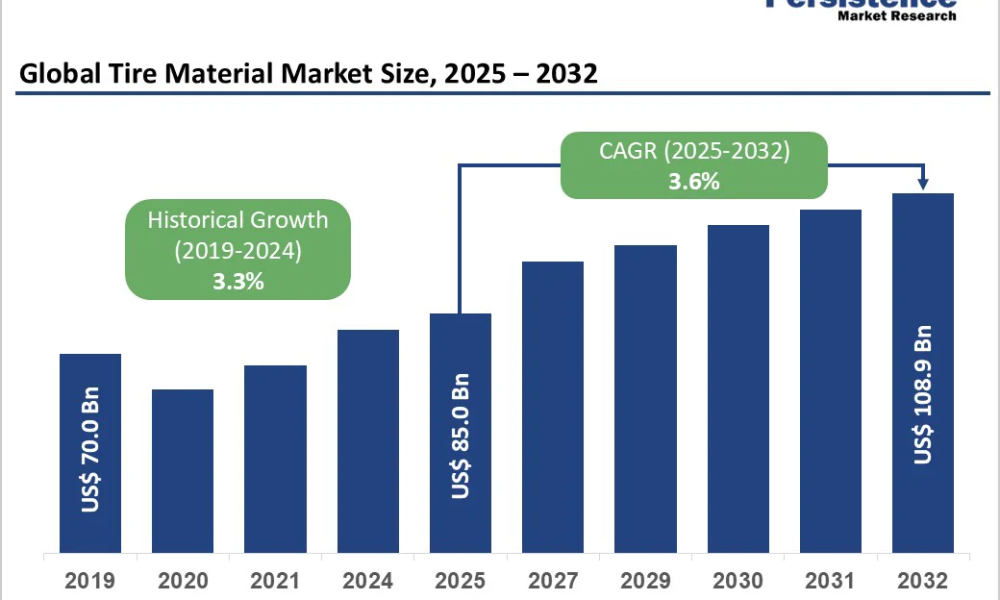
The global Tire Material Market is witnessing steady expansion driven by rising vehicle production, evolving mobility trends, and advancements in tire manufacturing technologies. According to Persistence Market Research, the global tire material market size was valued at US$ 85.0 Bn in 2025 and is projected to reach US$ 108.9 Bn by 2032, growing at a CAGR of 3.6% between 2025 and 2032. Tire materials, including natural rubber, synthetic rubber, carbon black, steel cord, and specialty chemicals, form the backbone of modern tire performance, durability, and safety standards across passenger and commercial vehicles.
Market growth is strongly supported by increasing demand for fuel-efficient and high-performance tires, particularly in emerging economies. Expansion in automotive production, replacement tire demand, and the push toward electric vehicles are further shaping material requirements. The leading segment in the tire material market is synthetic rubber due to its superior durability and adaptability across varying climatic conditions. Geographically, Asia Pacific dominates the market owing to its robust automotive manufacturing base, cost-effective production facilities, and expanding transportation infrastructure.
Get Your FREE Sample Report Instantly Click Now: https://www.persistencemarketresearch.com/samples/35798
Company Insights
Key players operating in the tire material market include:
- Bekaert
- Birla Carbon
- Cabot Corporation
- Evonik Industries AG
- ExxonMobil Corporation
- JSR Corporation
- Kuraray Co., Ltd.
- LANXESS
- PetroChina Company Limited
- Solvay SA
- Orion
- Sinopec
- Umicore
- Michelin
- Bridgestone
- Continental
Key Highlights from the Report
➤ The global tire material market size was valued at US$85.0 Bn in 2025.
➤ The market is projected to reach US$108.9 Bn by 2032.
➤ The tire material market is expected to grow at a CAGR of 3.6% between 2025 and 2032.
➤ Synthetic rubber remains the leading product segment due to high durability and performance characteristics.
➤ Asia Pacific continues to dominate the tire material market driven by strong automotive production.
➤ Growing demand for fuel-efficient and high-performance tires is accelerating material innovation.
Market Segmentation
By Material Type
- Elastomers
- Reinforcing Fillers
- Plasticizers
- Chemicals
- Metal Reinforcements
- Textile Reinforcements
By Vehicle Type
- Passenger Cars
- Buses
- Trucks
- LCV
By Region
- North America
- Europe
- East Asia
- South Asia and Oceania
- Latin America
- Middle East and Africa
Customize This Report for Your Exact Requirements: https://www.persistencemarketresearch.com/request-customization/35798
Regional Insights
Asia Pacific leads the tire material market, supported by strong automotive production in countries with large manufacturing hubs. Rapid urbanization, increasing vehicle ownership, and infrastructure development contribute to rising demand for tire materials. The region benefits from the presence of raw material suppliers and established tire manufacturers, ensuring efficient supply chains and cost competitiveness. Export-oriented production further strengthens the region’s position in the global market.
North America and Europe also hold significant shares in the tire material market due to technological advancements and stringent performance standards. These regions emphasize sustainable and high-performance tire materials to meet environmental regulations and fuel efficiency targets. Innovation in silica-based compounds and eco-friendly materials is gaining traction. Meanwhile, emerging markets in other regions are gradually increasing consumption due to expanding transportation networks and industrial growth.
Market Drivers
The primary driver of the tire material market is the consistent growth in global automotive production. Increasing vehicle ownership across developing economies has led to higher demand for both original equipment manufacturer (OEM) and replacement tires. As vehicles become more technologically advanced, the need for high-quality tire materials that enhance safety, performance, and longevity continues to rise. This dynamic supports stable demand across material categories.
Another significant driver is the growing focus on fuel efficiency and emission reduction. Tire manufacturers are increasingly incorporating advanced materials that reduce rolling resistance and improve energy efficiency. This trend directly impacts the demand for innovative synthetic rubber compounds and specialty chemicals. The transition toward electric vehicles also contributes to market growth, as EVs require specialized tire materials capable of handling higher torque and delivering quieter performance.
Market Restraints
Volatility in raw material prices poses a major restraint for the tire material market. Natural rubber and petrochemical-based synthetic rubber are subject to fluctuations influenced by supply chain disruptions and global economic conditions. Price instability affects production costs and profit margins, creating challenges for manufacturers in maintaining competitive pricing.
Environmental concerns related to rubber processing and carbon emissions also limit market expansion. Regulatory pressures in developed economies demand sustainable sourcing and reduced environmental impact, increasing compliance costs. Additionally, dependence on petroleum-derived raw materials for synthetic rubber exposes the industry to uncertainties in crude oil markets, further restraining growth potential.
Market Opportunities
The growing emphasis on sustainable and eco-friendly materials presents significant opportunities for the tire material market. Manufacturers are investing in bio-based rubber, recycled carbon black, and silica-enhanced compounds to meet environmental standards. These innovations not only align with regulatory requirements but also cater to consumer demand for greener mobility solutions.
Technological advancements in material science offer additional growth avenues. Development of lightweight and high-durability materials improves tire lifespan and vehicle efficiency. Expansion of electric mobility and smart tire technologies is expected to create new demand patterns for advanced compounds. Emerging economies also present untapped potential due to expanding automotive fleets and infrastructure projects.
Recent Developments:
- March 2024: A leading tire material manufacturer expanded its synthetic rubber production capacity to strengthen supply capabilities.
- September 2023: A major player introduced advanced silica-based compounds to enhance fuel efficiency and tire durability.
Ready to Dive Deep? Buy Full Report Today: https://www.persistencemarketresearch.com/checkout/35798
Frequently Asked Questions
➤ What are the main factors influencing the Tire Material Market 2025-2032?
➤ Which companies are the major sources in the Tire Material Market?
➤ What are the market’s opportunities, risks, and general structure in the Tire Material Market?
➤ Which of the top Tire Material Market 2025-2032 companies compare in terms of sales, revenue, and prices?
➤ How are market types and applications and deals, revenue, and value explored in the Tire Material Market?
Future Opportunities and Growth Prospects
The tire material market is expected to witness sustained expansion through 2032, supported by steady automotive production and technological innovation. As the market progresses from US$85.0 Bn in 2025 to US$108.9 Bn by 2032 at a CAGR of 3.6%, manufacturers will increasingly focus on sustainable sourcing and advanced material engineering. Long-term growth prospects remain favorable, particularly in regions with expanding mobility infrastructure and rising vehicle ownership, positioning the tire material market for resilient and consistent development.




