

Tidal Energy Market Overview
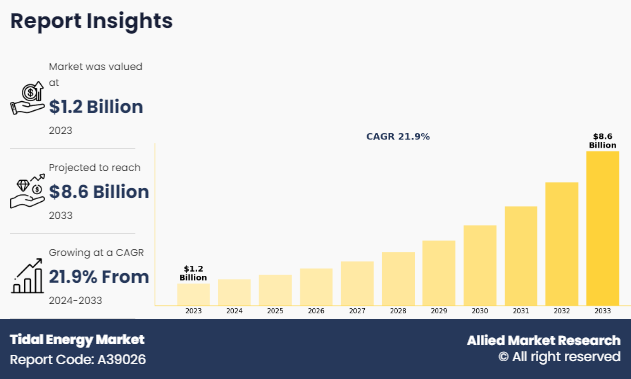
According to a new report published by Allied Market Research, the tidal energy market size was valued at $1.2 billion in 2023 and is projected to reach $8.6 billion by 2033, growing at a CAGR of 21.9% from 2024 to 2033. The rising global demand for renewable power, technological advancements in marine energy systems, and the availability of abundant ocean resources are driving significant growth in the tidal energy market.
Tidal energy is gaining recognition as a reliable and environmentally friendly renewable energy source. It is generated from the natural rise and fall of ocean tides, which occur due to the gravitational interaction between the Earth, Moon, and Sun. Because tidal movements are predictable and consistent, tidal energy provides a stable source of renewable power compared to other energy sources.
The growing emphasis on sustainable energy solutions, along with increasing investments in marine power technologies, is expected to strengthen the growth of the tidal energy market in the coming years.
Download PDF Brochure: https://www.alliedmarketresearch.com/request-sample/A39026
Rising Demand for Renewable Energy Driving Market Growth
The tidal energy market is expanding rapidly as countries focus on reducing carbon emissions and transitioning toward clean energy sources. Governments across the world are promoting renewable energy technologies to achieve sustainability goals and reduce dependence on fossil fuels.
Tidal energy plays an important role in this transition because it produces zero greenhouse gas emissions during operation. Once tidal energy plants are installed, they can generate electricity without burning fuel, making them environmentally sustainable.
Another key advantage of tidal energy is its predictability. Unlike solar and wind energy, which depend on weather conditions, tidal movements follow predictable patterns. This reliability makes tidal energy an attractive option for long-term power generation planning.
Technological advancements in tidal turbines, energy converters, and marine engineering are also contributing to the growth of the tidal energy market. These innovations improve efficiency and reliability while reducing operational costs, encouraging greater investment in tidal energy projects.
Environmental Challenges Affecting Market Development
Despite strong growth potential, the tidal energy market faces several challenges that may slow its expansion. One of the primary concerns is the environmental impact associated with tidal energy infrastructure.
The construction of tidal power plants, barrages, and underwater turbines can potentially disrupt marine ecosystems. Changes in water flow patterns, habitat disturbances, and risks to marine life are some of the environmental concerns raised by researchers and environmental groups.
To address these issues, developers are focusing on careful site selection and environmentally responsible project planning. Advances in turbine design and installation techniques are also helping reduce the environmental footprint of tidal energy systems.
Comprehensive environmental assessments and improved regulatory frameworks are essential to ensure the sustainable development of the tidal energy market.
Coastal Regions Offer Significant Growth Opportunities
Coastal regions around the world present significant opportunities for the expansion of the tidal energy market. Many coastal communities rely heavily on imported fossil fuels for electricity generation, which can be expensive and environmentally harmful.
Tidal energy offers these regions a locally available and renewable energy solution. By harnessing ocean tides, coastal areas can reduce energy costs and improve energy security.
In addition to providing clean electricity, tidal energy infrastructure can stimulate local economic development. The construction and operation of tidal power plants create employment opportunities in engineering, manufacturing, and maintenance sectors.
Furthermore, tidal energy projects often promote technological innovation and research, enabling coastal regions to become centers of renewable energy expertise.
Technological Innovations and Patent Developments
Innovation continues to play a major role in advancing the tidal energy market. Several patents and technological breakthroughs have improved the efficiency and safety of tidal energy systems.
For example, innovative tidal flow energy generation systems with predictive control mechanisms are helping optimize energy production. Other patented technologies focus on improving turbine efficiency, energy conversion methods, and safety features in tidal energy devices.
Some inventions also explore the integration of tidal energy systems with seawater desalination technologies. These solutions use tidal power to convert seawater into freshwater, addressing water scarcity issues in regions with limited freshwater resources.
Such technological advancements are expected to enhance the commercial viability of tidal energy and accelerate market growth.
Market Segmentation
The tidal energy market is segmented based on method, application, and region.
By Method
Based on method, the market is categorized into:
- Tidal stream
- Tidal barrage
- Tidal turbine
- Tidal fences
Among these, the tidal turbine segment is expected to grow at a CAGR of 21.6% during the forecast period. Tidal turbines are designed to capture the kinetic energy of tidal currents and convert it into electricity. Their high energy density and efficiency make them ideal for operation in challenging marine environments.
Increasing government investments and large-scale marine energy projects are expected to boost the deployment of tidal turbines worldwide.
By Application
By application, the tidal energy market is divided into:
- Power generation
- Desalination
The power generation segment currently dominates the market, accounting for the largest share of tidal energy installations.
However, the desalination segment is projected to grow at a CAGR of 22.4% during the forecast period. The rising global demand for freshwater resources is driving the development of desalination plants powered by renewable energy sources such as tidal power.
Countries in the Middle East, including Saudi Arabia and the UAE, are exploring tidal energy-powered desalination technologies to meet growing water demand.
Regional Analysis
Regionally, the tidal energy market is analyzed across North America, Europe, Asia-Pacific, and LAMEA.
Europe is expected to dominate the market during the forecast period, accounting for a significant share of global revenue. The region has a strong focus on renewable energy development and faces limited availability of traditional energy resources.
Several European countries, including the United Kingdom and France, are investing heavily in marine energy technologies and tidal power projects.
Meanwhile, Asia-Pacific is projected to witness the fastest growth, with a CAGR of 21.9% during the forecast period. South Korea currently leads the region with one of the world’s largest tidal power installations.
China is also actively investing in pilot marine energy projects to explore tidal power potential and enhance marine energy security. Additionally, countries such as India, Japan, and the Philippines are exploring tidal energy as part of their renewable energy strategies.
Get a Customized Research Report: https://www.alliedmarketresearch.com/request-for-customization/A39026
Competitive Landscape
The tidal energy market features several prominent companies focused on developing innovative marine energy technologies. Key players operating in the market include European Marine Energy Centre, Andritz AG, Orbital Marine Power Ltd., Sustainable Marine Energy Ltd., Nova Innovation Ltd., SIMEC Atlantis Energy Ltd., HydroQuest SAS, Verdant Power Inc., Hammerfest Strom AS, and Minesto AB.
These companies are investing in advanced turbine technologies, research collaborations, and pilot projects to strengthen their market presence and expand commercial tidal energy installations.
Future Outlook
The tidal energy market is expected to witness substantial growth over the next decade as governments and energy companies invest in renewable energy infrastructure. Rising concerns about climate change, increasing electricity demand, and advancements in marine technology are driving the adoption of tidal power systems worldwide.
With continuous innovation and supportive policy frameworks, tidal energy has the potential to become a significant contributor to the global renewable energy mix, helping countries achieve long-term sustainability and energy security goals.
Other Trending Reports:-
About Us
Allied Market Research (AMR) is a full-service market research and business-consulting wing of Allied Analytics LLP based in Portland, Oregon. Allied Market Research provides global enterprises as well as medium and small businesses with unmatched quality of “Market Research Reports” and “Business Intelligence Solutions.” AMR has a targeted view to provide business insights and consulting to assist its clients to make strategic business decisions and achieve sustainable growth in their respective market domain.
Pawan Kumar, the CEO of Allied Market Research, is leading the organization toward providing high-quality data and insights. We are in professional corporate relations with various companies and this helps us in digging out market data that helps us generate accurate research data tables and confirms utmost accuracy in our market forecasting. Each and every data presented in the reports published by us is extracted through primary interviews with top officials from leading companies of domain concerned. Our secondary data procurement methodology includes deep online and offline research and discussion with knowledgeable professionals and analysts in the industry.




