
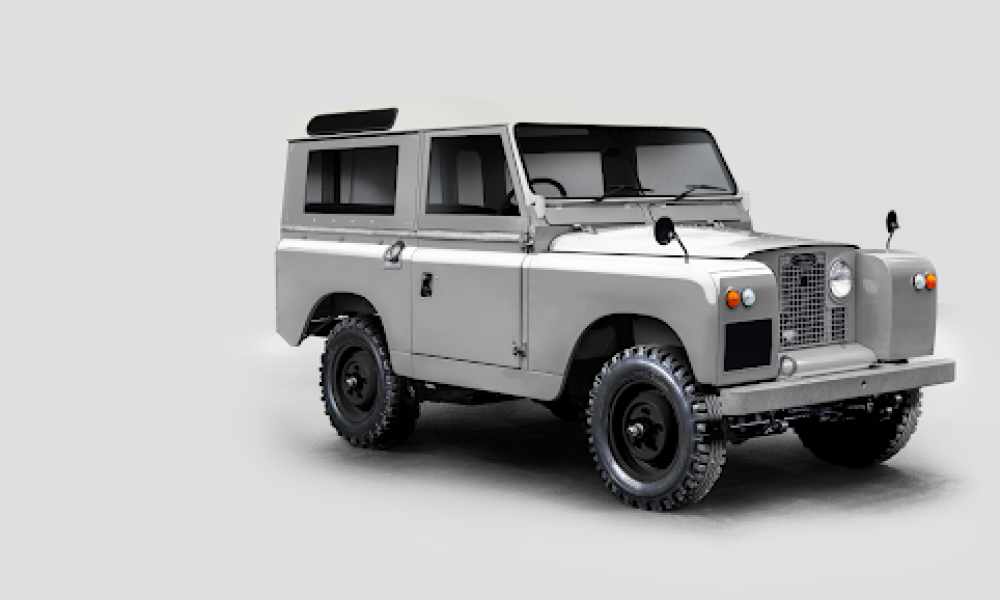
In 1961, the iconic Land Rover Series IIA dominated streets worldwide, largely known for its 2.25L inline four engine, pleated black seats, sleek curvature, and wide axles for improved turning cycle. Rich and historic in all its glory, one electric car company is taking this machinery to an entire new level.
While one of the most recognizable vehicles ever made, the Land Rover Series IIA is now making its way to the electric industry. An effort made by Everrati, a UK-based luxury car company turning classic cars into electric vehicles, this reimagining includes a fully restored chassis and a zero-emission powertrain delivering 150bhp, 300Nm of torque, and up to 125 miles of usable range, respectively.
Uniquely, what makes this car desirable is its homage to its historical framework. Meaning, the vehicle’s original design and character stays the same, but beneath its exterior lies a new electrified powertrain, promising a seamless driving experience for car lovers everywhere.
“As we continue delivering on our mission, this redefined Series IIA embodies what we stand for—crafting capable, sustainable vehicles that respect the soul of an icon while preparing it for the demands of today,” says Justin Lunny, CEO of Everrati.
To put it simply, the Land Rover Series IIA remains what it once was over six decades ago, but with a modern twist on the inside. Now with its electric engine, the latest vehicle features two- and four-wheel-drive modes, hi/low range gearing, regenerative braking, and reversible electrification. Notably, interior upgrades also include heated Bridge of Weir leather seats, power steering, and modern HVAC, all wrapped in a classic utilitarian silhouette.
Electrification has become the new normal as technology surrounds the market. In fact, in the first three months of 2025 alone, electric car sales were up 25% in comparison to last year, says the International Energy Agency. As a result of this, it is projected that more than 1 in 4 cars sold worldwide this year will be electric as car sales continue to grow. Looking ahead, the EV industry can expect to exceed 40% in 2030.
As more electric vehicles become preferable forms of transportation, that also means greater advantages in many other aspects. Unlike conventional cars, EVs are incredibly safe for the environment. Because they rely on a rechargeable battery, driving does not create tailpipe emissions, which would otherwise be a significant source of pollution. Furthermore, with electric cars comes advanced technology, allowing them to run smoothly with less maintenance requirements over time. In regard to air quality, EVs help eliminate CO2 into the atmosphere, preventing the potential contribution of respiratory diseases. Also, without internal combustion engines, electrified vehicles operate more quietly than traditional cars, offering a more peaceful space all around.
Plus, owning an electric car is far more convenient than your average automobile. Given most cars spend around 95% of their lifetime parked, according to Pod Point, using that time wisely can make the greatest difference, especially for folks who are always busy and on the go. With an EV, car owners can simply charge it when they are at home or their destination, saving them significant time and an out-of-the-way route to the gas station.
In essence, the latest Land Rover Series IIA is a model we all know and love. When you picture it, you see it as a legend in the realm of old cars, classified by its unmatched comfort at the time, distinct side windows, and all-metal construction. It is regarded as a motor staple, and one car fans have cherished since the very beginning.
The electric Land Rover Series IIA is a must-have for those who need a renowned keepsake. With its original shape in-tact transformed to an electric model, it is a driving mechanism that surely keeps history alive forever. And as more automotives make the shift to electrification, this work is a true testament to moving the car industry toward a more efficient and sustainable future.