
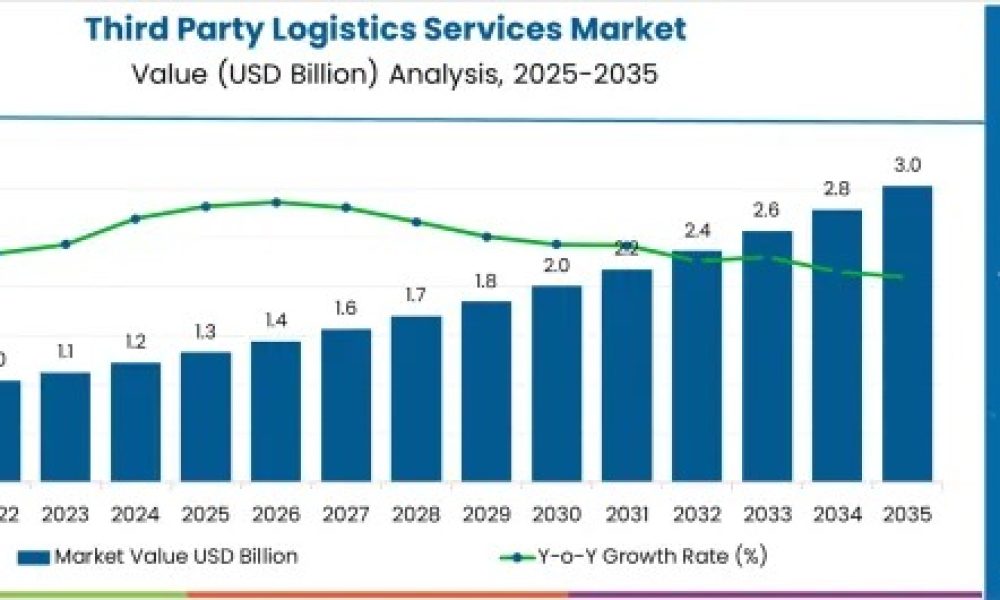
The Third Party Logistics (3PL) Services Market is emerging as a critical backbone of global trade and supply chain efficiency. As businesses increasingly focus on core competencies, outsourcing logistics functions such as warehousing, transportation, and inventory management has become a strategic priority. Valued at USD 1.3 billion in 2025, the market is projected to reach USD 3.0 billion by 2035, expanding at a CAGR of 8.6% over the forecast period.
This growth reflects the accelerating pace of globalization, the rapid rise of e-commerce, and the growing complexity of multi-country supply chains that demand professional, technology-enabled logistics solutions.
Meaning: What Are Third Party Logistics Services?
Third party logistics services refer to the outsourcing of logistics and supply chain operations to specialized service providers. These providers manage one or more logistics functions on behalf of manufacturers, retailers, or distributors.
Core 3PL service offerings include:
- Warehousing and storage
- Transportation and freight forwarding
- Distribution and order fulfillment
- Inventory and procurement management
- Packaging and value-added services
By leveraging scale, infrastructure, and technology, 3PL providers help organizations reduce operational costs, improve delivery performance, and enhance supply chain visibility.
Request For Sample Report | Customize Report |purchase Full Report – Sample link
Market Outlook
The outlook for the third party logistics services market remains robust through 2035. Growth is underpinned by:
- Rising global trade volumes
- Expansion of cross-border e-commerce
- Increasing need for flexible, asset-light supply chains
- Adoption of automation, AI, and real-time tracking technologies
As supply chains become more data-driven and customer-centric, 3PL providers offering integrated, technology-enabled solutions are expected to gain a competitive edge.
Market Overview
The market is segmented by service type, asset ownership, asset contract type, end-use industry, and region.
By Service Type
- Warehousing
- Transportation
- Packaging
- Procurement
- Distribution
- Inventory management
- Others
By Asset Ownership
- Asset-based 3PL
- Non-asset-based 3PL
By Asset Contract Type
- Public
- Private
By End-Use Industry
- Food & beverages
- Pharmaceuticals
- Chemicals
- Automotive & aerospace
- Electronics goods
- Others
Market Growth Drivers
Several factors are accelerating market expansion:
- Rapid e-commerce growth and omnichannel retailing
- Increasing outsourcing of non-core operations
- Demand for scalable logistics solutions during peak seasons
- Advancements in warehouse automation and route optimization
- Regulatory complexity encouraging reliance on specialized providers
The so-called “Amazon effect” has reshaped customer expectations, driving demand for faster deliveries, real-time visibility, and efficient fulfillment, all of which favor professional 3PL providers.
Demand Analysis
Demand for 3PL services is strongest among industries with high-volume, time-sensitive, or regulated supply chains. Food & beverages, pharmaceuticals, and electronics manufacturers increasingly rely on third-party providers to ensure temperature control, compliance, and fast distribution.
Small and medium enterprises (SMEs) are also driving demand, as public asset models allow them to access high-quality logistics infrastructure without heavy capital investment.
Key Segment Insights
Warehousing Service Type – Leading Segment (25.6%)
The warehousing segment accounts for 25.6% of market revenue in 2025, making it the largest service category. Growth is driven by:
- Expansion of e-commerce fulfillment centers
- Demand for multi-client and shared storage facilities
- Adoption of smart warehouses with IoT and automation
Warehousing services help businesses reduce lead times, manage inventory efficiently, and respond quickly to demand fluctuations.
Asset-Based 3PL – Dominant Ownership Model (55.2%)
The asset-based 3PL segment leads with 55.2% market share, as companies value providers that own and operate their own fleets, warehouses, and distribution centers. Benefits include:
- Greater reliability and service consistency
- Improved capacity assurance
- Enhanced visibility and control across logistics operations
Asset-based providers are particularly attractive for high-volume and mission-critical supply chains.
Public Asset Contract Type – Preferred Model (60.7%)
Public asset contracts account for 60.7% of market revenue, reflecting the growing preference for shared logistics infrastructure. This model:
- Reduces capital expenditure for clients
- Enables scalability during seasonal peaks
- Supports SMEs and fast-growing e-commerce players
The flexibility and cost efficiency of public contracts are key to their continued dominance.
Market Trends
Key trends shaping the third party logistics services market include:
- Integration of AI, machine learning, and predictive analytics
- Growth of real-time shipment tracking and visibility platforms
- Expansion of temperature-controlled and pharma-grade logistics
- Increased mergers and acquisitions to enhance regional coverage
- Focus on sustainability and carbon-efficient transportation
3PL providers are increasingly positioning themselves as end-to-end supply chain partners rather than transactional service vendors.
Regional Insights
- China leads with an 11.6% CAGR, driven by manufacturing scale and cross-border trade.
- India follows at 10.8% CAGR, supported by e-commerce and infrastructure development.
- Germany (9.9%) benefits from strong industrial exports and logistics efficiency.
- USA (8.2%) shows stable growth with advanced warehousing and transport networks.
- Japan (6.5%) grows steadily, emphasizing precision and reliability.
Competitive Landscape
The market is highly competitive, with global logistics giants and regional specialists competing on technology, network reach, and service integration.
Key players include:
- C.H. Robinson Worldwide, Inc.
- FedEx
- Kuehne + Nagel
- DB Schenker Logistics
- DSV
- XPO Logistics, Inc
- CEVA Logistics
- United Parcel Service of America, Inc.
- J.B. Hunt Transport, Inc.
- Nippon Express
These companies are investing heavily in digital platforms, automation, and strategic acquisitions to strengthen global coverage and service differentiation.
Key Market Highlights (Bullets)
- Market size: USD 1.3B (2025) → USD 3.0B (2035)
- Forecast CAGR: 8.6%
- Leading service: Warehousing (25.6%)
- Dominant ownership model: Asset-based 3PL (55.2%)
- Preferred contract type: Public assets (60.7%)
- Core demand drivers: E-commerce, globalization, automation
Conclusion
The third party logistics services market is transitioning from traditional outsourcing to technology-driven, integrated supply chain partnerships. With rising global trade complexity, demand for scalability, and growing reliance on digital logistics platforms, 3PL providers are becoming indispensable to modern commerce. Companies that invest in automation, transparency, sustainability, and end-to-end solutions are best positioned to capitalize on the strong growth outlook through 2035.
Why FMI: https://www.futuremarketinsights.com/why-fmi
About Future Market Insights (FMI)
Future Market Insights, Inc. (FMI) is an ESOMAR-certified, ISO 9001:2015 market research and consulting organization, trusted by Fortune 500 clients and global enterprises. With operations in the U.S., UK, India, and Dubai, FMI provides data-backed insights and strategic intelligence across 30+ industries and 1,200 markets worldwide.
Contact Us:
Future Market Insights Inc.
Christiana Corporate, 200 Continental Drive,
Suite 401, Newark, Delaware – 19713, USA
T: +1-347-918-3531
For Sales Enquiries: [email protected]



